Print this page
 Click to view page images in PDF format.
Jeremy J. Zimmerman1
Search and Discovery Article #40023 (2001)
1Nuevo Energy Company, Houston, TX ([email protected]).
*Adapted for online presentation from article entitled “It’s All a Matter of Space and Time” by the same author in Geophysical Corner, AAPG Explorer, December, 1996. Appreciation is expressed to the author and to M. Ray Thomasson, former Chairman of the AAPG Geophysical Integration Committee, and Larry Nation, AAPG Communications Director, for their support of this online version.
Most geoscientists in the petroleum industry are dealing with the problem that seismic information is usually displayed in some form of a time section, be it a time stack section or a time-migrated section. Drillers, engineers, geologists, geophysicists, and earth scientists in general describe the earth in depth, as in “x” number of feet to target, “x” number of feet of oil column, etc. How do you get easily from time to depth? The answer depends on the desired level of complexity, which is usually dictated by how soon something is needed or how much it will cost.
The overall process is
called depth conversion, although some prefer to be more rigorous and call it
depth  migration
 . The simplest definition of depth conversion is the conversion
of some measurable time quantity into some understandable value in depth. The
old joke of when someone asks how deep is the well and the junior geoscientist
responds that “it’s about three seconds ...” pops into many people’s
minds when dealing with representations of well progress with respect to a
chosen seismic section. So just how do we convert from time to depth?
. The simplest definition of depth conversion is the conversion
of some measurable time quantity into some understandable value in depth. The
old joke of when someone asks how deep is the well and the junior geoscientist
responds that “it’s about three seconds ...” pops into many people’s
minds when dealing with representations of well progress with respect to a
chosen seismic section. So just how do we convert from time to depth?
The purpose of this
article is to introduce geoscientists to some basic ideas about depth conversion
as well as give examples of when it is appropriate to use a given method. It is
not meant to be a rigorous dissertation of depth migration.
|
|
Click here for sequence of Figures 3 and 7.
Click here for sequence of Figures 4 and 5.
Click here for sequence of Figures 4 and 5.
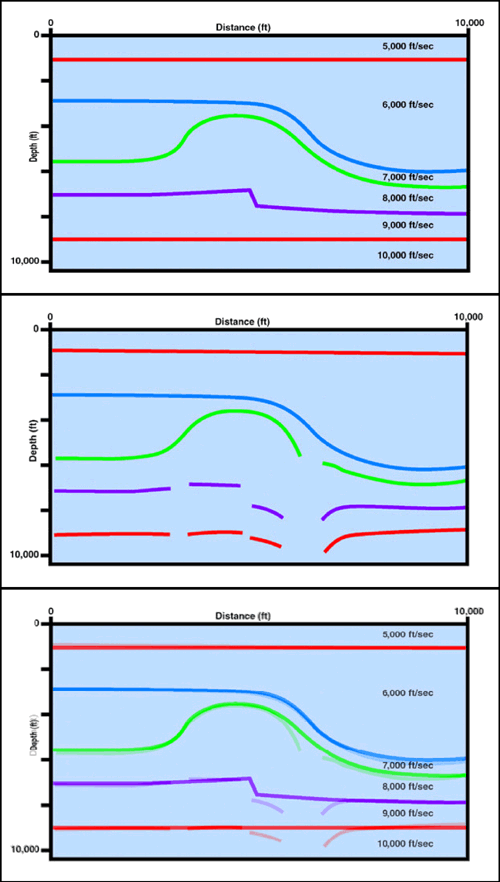
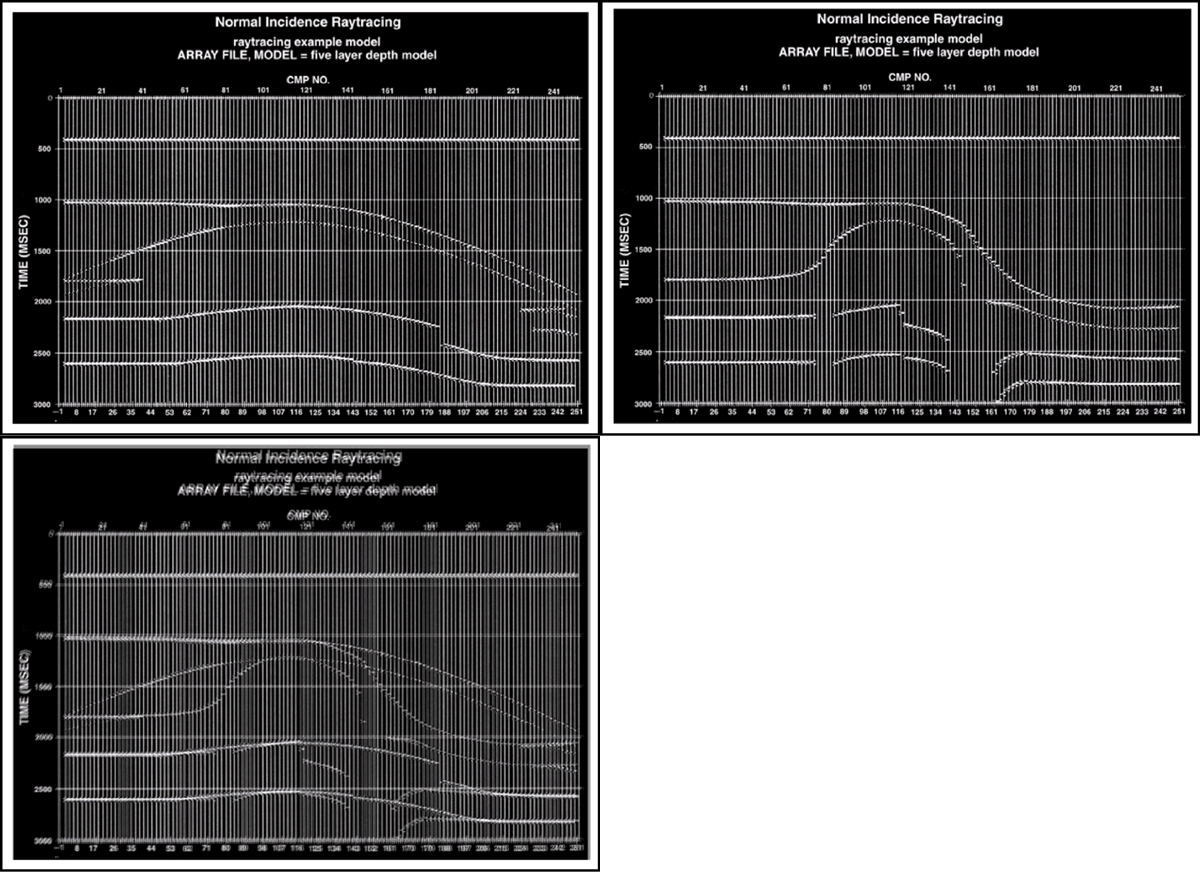
Click here for sequence of Figures 3 and 7. The raypath concept is the keystone to seismic exploration. The assumption that an expanding wavefront (analogous to the expanding circle that is produced when a rock is dropped in water) can be simulated by a collection of raypaths that are traveling perpendicular to the wavefront, is the basis of seismic modeling and travel-time simulation. Most seismic-modeling packages, whether they are two-dimensional (2-D) or three-dimensional (3-D), simulate the expansion of the wavefront in the subsurface by describing a raypath along which a portion of the wavefront travels (Figure 1). A seismic source imparts energy into the ground, sending waves of energy down into the subsurface, where some of the energy is reflected, some of it is transmitted and some portion is lost as attenuation. That part which is reflected is measured or detected by geophones (land) or hydrophones (marine). A seismic section is a measure of the amount of energy that is reflected back to the location of the geophone/hydrophone with respect to the time it takes a wavefront, and therefore the assumed model of the wavefront – the ray, to travel along selected paths. Typically, rays are easily influenced by the medium in which they travel. The characteristic that is of greatest concern to the geoscientist is the velocity of the different layers through which the rays travel. When seismic energy encounters a medium of different velocity from the one in which it is traveling, it is deflected in accordance with the velocity change, as shown in Figure 2. If the new medium is higher velocity, the energy – and therefore, the raypath – is bent more away from vertical. If the new medium is a lower velocity, the seismic energy is deflected to more nearly vertical. The first type of section (and most often ignored by much of the petroleum industry) is the time stack section. It is seen as confusing because it contains segments of events, events that exaggerate the size of structures and even events that cross each other (the ubiquitous “bow-tie” structure). The time stack image of the depth model (Figure 3) is shown in Figure 4. Note that the flat portion of the model remains flat, but the dipping events are much more complex. The second type of section (and the one most often used by the petroleum industry) is the time migrated section. It is seen as less confusing and more of a realistic depiction of the subsurface. To many geoscientists, this represents a realistic cross-section and therefore can be used to infer structural and tectonic features and stress regime. Many of the models regarding interaction between salt and sediment in the Gulf of Mexico are based on these time migrated sections. As shown in Figure 5, this image is still distorted in comparison to the actual model that produced it. Upon
seeing a time-migrated section, one is apt to describe geologic processes
that have produced such a structure. However, the problem remains that the
section is shown with respect to time. When dealing with flat or slightly
dipping events (less than 10o), a simple depth conversion using
the straight vertical ray assumption can be used. This is done by taking
the vertical time difference between events on a time-migrated seismic
section and multiplying it by the interval velocity. This result must be
divided in two to account for the two-way travel path (down to the
reflector and back up to the shallower reflector). The interval velocity
value is often calibrated to available well information in the area. (A
entirely different problem exists with respect to deriving interval
If dips on events exceed 10o and the velocity field is “well-behaved,” then depth conversion becomes a little more complicated. The idea that vertical travel times taken from even a time-migrated section can be used to calculate a depth section using an interval-velocity value (be it local, regional, constant, or varying) can lead a geoscientist down the primrose path to a dry hole. What often happens is an interval velocity map is created for selected horizons at sample points taken from wells. This interval-velocity map is then multiplied by the isochron map made on the time differences between the two selected horizons, and a depth map that matches at the well is created by this “depth-stretch” method. Of course, this depth map agrees with the information at the wells; it was derived using that information. The fallacy of this method is the assumption that the raypath generated by the seismic source travels along a purely vertical path. If
the subsurface reflectors exhibit no dip, then this is a valid assumption.
Otherwise, the endpoint at depth for the vertical raypath and the actual
raypath for the time-migrated sections differ (Figure
6). The greater the
dip, the greater the offset between these two endpoints. What this means
is that the lateral placement of the events is wrong, commonly leading to
misplaced highs or unplanned lows. An example of errors inherent in using
the “depth-stretch” method is shown in Figure
7. The time-migrated
section generated previously (Figure 5) was depth-converted using the
vertical-ray assumption and the interval Snell’s
law tells us that small changes in dip and velocity can cause the raypath
to refract. To best compensate for this change in raypath direction, depth
The
example shown here is only in two dimensions. A method for creating depth
models based on ray displacements in three dimensions is called map
Many
map Depth
|
 Figure
1: Wavefront and raypath orthogonal to wavefront.
Figure
1: Wavefront and raypath orthogonal to wavefront. Figure
2: Elements of Snell’s Law.
Figure
2: Elements of Snell’s Law. Figure
3: Idealized model.
Figure
3: Idealized model. Figure
4: Normal–incidence (time–stack) seismic section.
Figure
4: Normal–incidence (time–stack) seismic section.  Figure
5: Time–migrated section.
Figure
5: Time–migrated section. Figure
6. Raypath endpoints for tme-stack, time-migrated, and depth.
Figure
6. Raypath endpoints for tme-stack, time-migrated, and depth. Figure
7. “Depth-streched” section.
Figure
7. “Depth-streched” section.