Print this page
 Click to view this article in PDF format.
Understanding the Seismic Wavelet*
By
Steven G. Henry1
Search and Discovery Article #40028 (2001)
1Geolearn, Houston, TX ([email protected])
*Adapted for online presentation from two articles by same author, entitled “Catch the (Seismic) Wavelet” in Geophysical Corner, AAPG Explorer, March, 1997, and “Zero Phase Can Aid Interpretation” in Geophysical Corner, AAPG Explorer, April, 1997. Appreciation is expressed to the author and to M. Ray Thomasson, former Chairman of the AAPG Geophysical Integration Committee, and Larry Nation, AAPG Communications Director, for their support of this online version.
|
uComparison of different methods of deconvolution
uComparison of different methods of deconvolution
uComparison of different methods of deconvolution
uComparison of different methods of deconvolution
uComparison of different methods of deconvolution
uComparison of different methods of deconvolution
uComparison of different methods of deconvolution
|
The
seismic wavelet is the link between seismic data (traces) on which
interpretations are based and the geology (reflection coefficients) that
is being interpreted, and it must be known to interpret the geology
correctly. However, it is typically unknown, and assumed to be both broad
band and zero phase. Providing this broad band, zero phase wavelet is the
processing goal of deconvolution. Unfortunately, this goal is rarely met
and the typical wavelet that remains in fully processed seismic data is
mixed-phase. Differences in mixed-phase The
purpose of this article is to show interpreters that significant
improvements in seismic data quality and, correspondingly, their
interpretations of those data are easily obtainable by converting from
mixed-phase to zero phase
Click here for sequence of Figures 7 and 8. Click here for sequence of Figures 7 and 8.
Seismic data can provide a remarkably good image of the subsurface. However, without knowing the seismic wavelet, there are many equally valid surface geologic interpretations of the actual subsurface geology. The seismic wavelet is the filter through which geology is viewed when interpreting the image provided by seismic data. The
common assumption that seismic data contain a broad band - zero phase
wavelet is nearly always wrong. The majority of mis-tie problems between
seismic and synthetics, seismic to seismic of different vintages, and many
of the misinterpretations based on modeling (lithology prediction, trace
attributes, AVO, etc.) are the result of mixed-phase The
convolutional model is useful for understanding how changes in rock
Where
lithologic boundaries are widely separated, the field wavelet can be seen
“hanging” below the reflector at 2.2 seconds (Figure
1). When
boundaries are more closely spaced (2.3-2.5 seconds), the wavelet is not
as easily seen due to the The convolutional model states that all seismic traces are the result of convolving (summing) the wavelet with the reflection coefficient series. In Figure 1, the raw field trace images the desired geology (lithologic boundaries = reflection coefficients), but it is through the complex filter (convolution) of the field wavelet. Exploring for the sand in Figure 1 and assuming the wavelet is broad band - zero phase, the sand should be the largest peak. The largest peak, however, is at 2.5 seconds, due to the field wavelet not being zero phase. When the wavelet in the seismic trace is unknown, the geology is unknown. Interpretations are not made on raw field traces, but even on processed seismic traces, the wavelet must be known to more correctly interpret the geology. The seismic processing procedure designed to convert the field wavelet to the desired broad band - zero phase wavelet is deconvolution. The two common methods of deconvolution are deterministic deconvolution and statistical deconvolution. Deterministic deconvolution can be applied when the field wavelet is known (measured and/or modeled). As shown in Figure 2, when the wavelet is known, an inverse can be determined and the field trace deconvolved to contain the desired zero phase wavelet. When processed traces contain a zero phase wavelet, increases in rock velocity (shale to sand) will result in peaks (positive reflection coefficients). More
typically, the field wavelet is unknown and statistical deconvolutions
must be used. Statistical deconvolutions must make assumptions about both
the wavelet and the reflection coefficient series. The most common
assumption is that the wavelet is Over
90 percent of all seismic data are processed assuming A
wavelet extracted deterministically from seismic data (using the known
reflection coefficient series from the well) that had been deconvolved
assuming In
describing mixed-phase The description of this mixed-phase wavelet is interpretive, and could be described differently by using other frequency bands. Using the bands shown in Figure 3, with most of the power (amplitude spectrum squared) in the 20-65 Hertz band, this wavelet has the phase characteristic of -90 degrees (trough-peak). An
important ramification of mixed-phase Mixed-phase
Combining these corrections will approximate the curved shape of the mixed-phase (Figure 3) with a single sloping line (time shift) that intersects the phase axis at the desired constant phase. A different time shift and constant phase is required to match the curve deeper in the section due to the earth’s absorption of higher frequencies. Due to the mixed-phase wavelet, peak-trough relationship change as a function of earth absorption (Figure 4), and interpretations based on amplitudes, AVO, attributes, etc., are likely to be incorrect. The solutions to these problems are to convert the mixed-phase wavelet to zero phase in seismic processing or to extract the mixed-phase wavelet, know its effects, and use it when modeling. When
interpreting seismic data, it is important to realize that the actual
subsurface geology is always being viewed through the filter of the
seismic wavelet. Although deconvolution is designed to provide a broad
band - zero phase wavelet, this goal is typically not met, and most
seismic data contain mixed-phase Comparison of Seismic Data After Different Methods of Deconvolution The
The
reason for the improved accuracy is illustrated in Figure
6. The extracted
The
zero phase wavelet’s sharp “nose” provides a clear image of the top
sand, and its “flat belly” does not interfere with neighboring
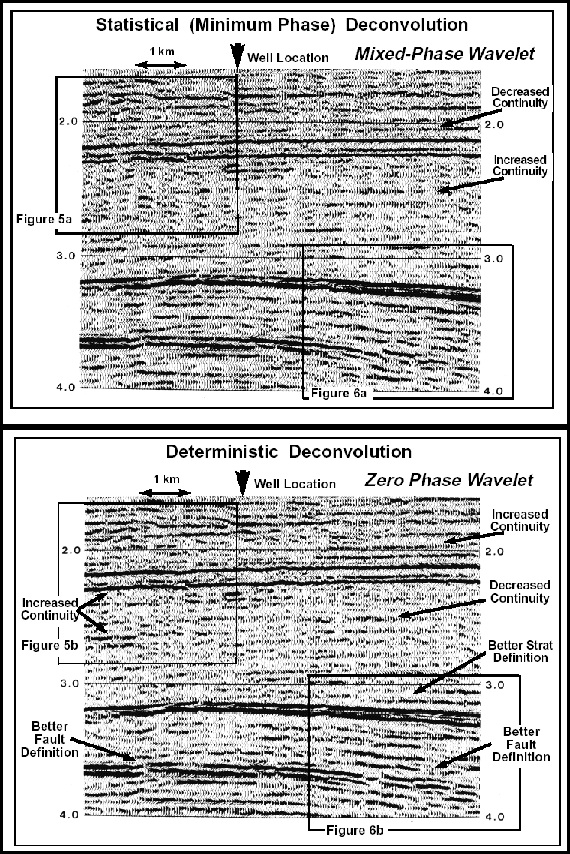
reflectors. The comparison of the seismic data in Figures 7 and
8 illustrate typical improvements that are easily obtainable by converting
from mixed-phase to zero phase. Both seismic sections “look” good, and
visual advantages can be found in each. In general, however, the seismic
data containing the zero phase wavelet (Figure
8) have a better overall
reflector continuity, better fault definition and more easily identified
stratigraphic relationships. Mixed-phase The seismic data comparison for the shallower section is shown in Figure 9. Due to minor earth absorption, the majority of the wavelet’s phase characteristics, as noted above, are derived from the higher frequencies (20-65 Hertz). The lower frequencies, although contributing less, still influence the character of the reflectors. The non-zero phase components (5-20 Hertz) of the mixed-phase wavelet (Figure 9a) can be seen distorting the image of the geology. These
two images (Figure 9a and b) of the same geology would likely result in
different interpretations. For example, laterally discontinuous reflectors
within the high amplitude package (2.2-2.3 seconds) appear with different
seismic character and even in different locations. Interpretation of them
(channel sands? carbonate mounds?) and their position relative to the
deeper high amplitude reflector (within/below--Figure
9a, or above--Figure 9b) are in question. Knowing that mixed-phase In general, the zero phase wavelet provides a much sharper (broad band - zero phase) image of the subsurface geology. Stratigraphic relationships above 2.0 seconds (Figure 9) are more clearly defined, and reflector continuity in general (especially 2.6 seconds) is improved. Deeper in the section (Figure 10), as the earth’s filtering of the higher frequencies increases, the lower frequencies contribute more strongly to the wavelet’s phase characteristic (as described above). In the mixed-phase seismic data, the non-zero (135 degrees) low-frequency (5-20 Hertz) components begin contributing more. This adds to the distortion seen shallow in the section (Figure 9), further reducing the ability to image the geology accurately. Absorption also affects the zero phase wavelet, reducing high frequencies (narrowing the bandwidth) and thereby stretching out the wavelet. However, since all frequencies (5-65 Hertz) are zero phase, the seismic image provides an accurate representation of the geology. The most striking improvement seen in the zero phase seismic data (Figure 10b) is the ability to define faults more accurately. The mixed-phase wavelet’s “beer-gut,” which has grown with depth due to absorption (loss of high frequencies), is hanging in the fault zones. “Noses” on the other side of the faults are smeared out by the “beer-guts” from above. Other significant improvements seen in the zero phase seismic data are the improved continuity of reflectors and the imaging of geologic details needed for stratigraphic interpretations. The zero phase wavelet, as shown in these examples, provides a more accurate image of the subsurface geology than the mixed-phase wavelet. Significant
improvements in the quality of seismic data are shown here to be easily
obtainable when |

 Figure
1: Lithologic boundaries define a Reflection Coefficient series, which
when convolved (*) with the field wavelet results in a simulated raw field
trace. Interpreting the highest amplitude event (2.5 seconds) as the
reservoir sand would be wrong. This mixed-phase wavelet provides a
distorted image of the actual geology.
Figure
1: Lithologic boundaries define a Reflection Coefficient series, which
when convolved (*) with the field wavelet results in a simulated raw field
trace. Interpreting the highest amplitude event (2.5 seconds) as the
reservoir sand would be wrong. This mixed-phase wavelet provides a
distorted image of the actual geology. Figure
2: When the field wavelet is known, deterministic deconvolution is able to
produce a processed trace that contains the desired broad band zero
phase wavelet. Note, the highest amplitude in the processed trace is now
associated with the largest Reflection Coefficient at the top sand.
Figure
2: When the field wavelet is known, deterministic deconvolution is able to
produce a processed trace that contains the desired broad band zero
phase wavelet. Note, the highest amplitude in the processed trace is now
associated with the largest Reflection Coefficient at the top sand. Figure
3: Extracted wavelet and the associated amplitude and phase spectrum.
Figure
3: Extracted wavelet and the associated amplitude and phase spectrum. Figure 4: Seismic data containing this mixed-phase wavelet will display a
changing peak trough relationship (-90 degrees to +60 degrees) and time
shift (linear phase) due to the earth’s attenuation of higher
frequencies with depth. For simplicity, the waveforms shown here are only
for the top sand reflector.
Figure 4: Seismic data containing this mixed-phase wavelet will display a
changing peak trough relationship (-90 degrees to +60 degrees) and time
shift (linear phase) due to the earth’s attenuation of higher
frequencies with depth. For simplicity, the waveforms shown here are only
for the top sand reflector. Figure
5. These
Figure
5. These  Figure
6. The mixed-phase wavelet (Figure 5a) has the character of “Pinocchio
with a beer-gut.”
Figure
6. The mixed-phase wavelet (Figure 5a) has the character of “Pinocchio
with a beer-gut.” Figure
7. Seismic data identical to Figure 8 other than the method of
deconvolution, Statistical. This seismic data contains the mixed-phase
wavelet of Figure 5a. The “Pinocchio with a “beer-gut” character can
be seen as the trailing low frequencies beneath the high amplitude
reflectors. Mixed-phase
Figure
7. Seismic data identical to Figure 8 other than the method of
deconvolution, Statistical. This seismic data contains the mixed-phase
wavelet of Figure 5a. The “Pinocchio with a “beer-gut” character can
be seen as the trailing low frequencies beneath the high amplitude
reflectors. Mixed-phase  Figure
8. Seismic data identical to Figure 7 other than method of deconvolution,
Deterministic. This seismic data contains the desired zero phase wavelet (Figure 5b). Note that reflectors are sharper and lack the low-frequency
“beer-gut” of the mixed- phase wavelet. In general reflector
continuity, fault breaks, and stratigraphic relationships are
significantly improved.
Figure
8. Seismic data identical to Figure 7 other than method of deconvolution,
Deterministic. This seismic data contains the desired zero phase wavelet (Figure 5b). Note that reflectors are sharper and lack the low-frequency
“beer-gut” of the mixed- phase wavelet. In general reflector
continuity, fault breaks, and stratigraphic relationships are
significantly improved. Figure
9. Enlargement of corresponding parts in upper left of Figures 7 and 8,
showing significantly different seismic images from the same subsurface
geology. The zero phase (b) seismic data not only “looks” better, but
also provides a more accurate image. Mixed-phase
Figure
9. Enlargement of corresponding parts in upper left of Figures 7 and 8,
showing significantly different seismic images from the same subsurface
geology. The zero phase (b) seismic data not only “looks” better, but
also provides a more accurate image. Mixed-phase  Figure
10. Enlargement from corresponding parts in lower right of Figures 7 and 8
showing significant improvements in the definition of faults are seen on
the zero phase seismic data (b). “Pinocchio’s beer-gut” in the
mixed-phase seismic data (a) hangs over the faults, distorting the image.
Reflector continuity and stratigraphic relationships are also improved in
the seismic data containing the zero phase wavelet.
Figure
10. Enlargement from corresponding parts in lower right of Figures 7 and 8
showing significant improvements in the definition of faults are seen on
the zero phase seismic data (b). “Pinocchio’s beer-gut” in the
mixed-phase seismic data (a) hangs over the faults, distorting the image.
Reflector continuity and stratigraphic relationships are also improved in
the seismic data containing the zero phase wavelet.