
 Print this page
 Click to view this article in PDF format.
CROSSWELL
SEISMIC PROFILING:  PRINCIPle
 TO APPLICATIONS*
By
Jerry M. Harris1 and Robert T. Langan2
Search and Discovery Article #40030 (2001)
1Stanford University, Palo Alto, CA.
2Chevron Petroleum Technology.
*Adapted for online presentation from the article by the same authors, entitled “Crosswell Seismic Fills the Gap” in Geophysical Corner, AAPG Explorer, January, 1997. Appreciation is expressed to the authors, along with Spyros Lazaratos of TomoSeis Inc. and Mark Van Schaack of Stanford University, and to M. Ray Thomasson, former Chairman of the AAPG Geophysical Integration Committee, and Larry Nation, AAPG Communications Director, for their support of this online version.
|
|
Much is being written about using seismic methods as reservoir management and monitoring tools. However, when we try to apply these methods, there are always issues of vertical resolution. Figure 1 illustrates the relationship between the level of resolution and the seismic measurement technique. Core and log data provide high vertical resolution, but sample only a small volume of rock. On the other hand, surface seismic methods sample large rock or reservoir volumes, but have limited resolution. Surface-based seismic methods often fail to resolve the important small-scale features which allow one to characterize the reservoir for such applications as flow simulations or the accurate placement of directional wells. Crosswell seismic profiling fills the gap between data types that provide high resolution (but small sample volume) and data types with lower resolution (but high sample volume).
Crosswell seismic profiling is conducted between wells with the source and receivers placed inside the wellbore, as illustrated in Figure 2. The receiver arrays are held fixed in one well while the source is slowly drawn upwards in the other well and is “fired” at preset intervals. After one source “run,” the receivers are relocated and the source run is repeated. The typical spacing between adjacent source points ranges from 2.5 feet (0.8 meter) to 20 feet (six meters). Receiver separation is usually similar. It is possible for these systems to acquire 20,000 or more traces in a single, 24-hour day. A
complete survey can be as small as a few thousand traces or as large as
several hundred thousand traces. Such factors as the well separation, the
thickness and structure of the imaging target, and the frequency content
of the received signal dictate the necessary size of a survey. The
distance between the source and receivers, which is on the order of the
well spacing, is considerably less than the propagation distances
associated with surface seismic methods. The short propagation distances,
combined with avoidance of weathered zones, allow the use of frequencies
at Crosswell
surveys currently employ a frequency band between 20 Hz and 2000 Hz,
depending on the type of source used, the distance between wells and the
attenuation characteristics of the zone under investigation. Resolution on
the order of 10 feet (3 meters) is possible. Crosswell processing is
similar to surface seismic processing in that it includes velocity
estimation (“travel In Figure 3 comparison is made of a crosswell velocity image and reflection image with modern surface seismic data, a sonic log, and core data. All of these data were collected in a carbonate reservoir in the Permian Basin of West Texas. Crosswell methods are not a replacement for 3-D surface seismic technology in areas where the frequency content is similar and where surface accessibility is not a problem. It is 2-D by nature and the insufficiencies of 2-D versus 3-D seismic data are well documented in the literature. However, by requiring multiple profiles, a 3-D perspective can be achieved. One should view crosswell profiling as being complementary to both surface seismic methods and logging methods (as illustrated in Figure 1), and it is best targeted at locations where the enhanced resolution between wells can serve a critical need. Crosswell
profiling is a technology for reservoir delineation, development,
characterization, and monitoring, but not exploration. Monitoring changes
in reservoir conditions (e.g. saturation or pressure) is easier than
absolute imaging of reservoir properties (e.g., porosity), but monitoring
requires multiple visits to the same site in order to obtain In
the San Joaquin Valley, the primary interest has been managing the heat
budget of thermal recovery processes. The well separations are usually
small, the reservoirs shallow and the thermal recovery processes create
large velocity changes that make it easy to monitor the progress of
thermal fronts. The images used for monitoring are predominantly
The
main difficulty with using crosswell profiling in this environment is that
the sedimentary rocks are commonly quite attenuating, which can restrict
the useful upper frequency range, and a powerful source may be required to
propagate energy between wells. A second problem is that some wells will
not hold water for a sufficient period of In West Texas, the reservoirs are dominantly carbonates with favorable attenuation characteristics. As a result, frequencies as great as 2,000 Hz can propagate over hundreds or thousands of feet between wells. The high degree of vertical variability in the acoustic impedance in these carbonates generates many reflections helpful for reservoir characterization. The combination of smaller well separations associated with these mature fields and the good propagation characteristics permits the successful use of relatively low powered, high frequency sources that are cost-effective to deploy. Although
there are a variety of applications for which crosswell profiling is
technically feasible, for some of them the technique is currently too
expensive to implement on a routine, operational basis. For example,
successful imaging of CO2-saturation and -pressure effects on a
vertical scale of three meters has been attained in a pilot flood in a
carbonate reservoir in West Texas, but the cost of data acquisition under
high pressure conditions, combined with the need to collect several
“snapshots” over One of the first applications where it is thought that crosswell profiling is likely to find wide operational acceptance is in providing an accurate “roadmap” for directional wells. It is becoming an increasingly common practice to optimize recovery in a reservoir by targeting specific units for a directional well. Directional wells are relatively expensive, and in areas where the structure or stratigraphy between wells is not easily predicted using traditional data types, crosswell methods may be the only way to obtain the high resolution information one needs to plan where to drill – or to make the decision as to whether to drill. The acquisition systems currently available commercially are based on two different source technologies: · A small airgun that is impulsive and relatively widebanded. · Piezoelectric elements that are swept in frequency in a manner similar to surface vibrators. Both
sources are frequently used with hydrophone receiver arrays. The airgun
system has been used successfully in clastic rocks in Kansas at a well
separation exceeding 2,000 feet (600 meters), while the piezoelectric
system has been used in carbonates at a well separation of 1,800 feet (550
meters). Greater well separations are possible and are slated for future
projects. An axial hydraulic vibrator is currently under development by a
cooperative Research and Development Agreement (CRADA) between the U.S.
National Laboratories and numerous industry partners and was scheduled to
be commercially available by the Crosswell images fill a resolution gap between the more traditional reservoir data types. Crosswell velocity tomograms and reflection images exhibit resolution better than modern surface seismic images do, but less resolution than log measurements. For many reservoirs, information about heterogeneities at the scale imaged by crosswell methods is critically important. For some applications, crosswell technology is currently moving from being a purely research activity to being an operational technique. Among the current barriers it faces in gaining a wider acceptance are the cost of data acquisition, the potential disruption to normal field operations and insufficient experience using technology in a variety of environments. The cost of data acquisition is dropping quickly, however, due to hardware improvements and the expanding experience base. It is expected that future improvements in data processing will reduce the disruption in field operations by carefully scheduling the survey during normal maintenance activities or before tubing is placed in a new well. Recent advances in multi-level receiver systems that can operate through production tubing and can be used simultaneously in multiple wells will permit more rapid data acquisition, reduce field disruption, and reduce costs. More and more case studies will expand the routine acceptability of crosswell profiling. |

 Figure
2. Crosswell data are collected by placing a seismic source in one well
and a receiver string in a nearby well. Energy which propagates directly
between wells without being scattered serves as the basis for constructing
velocity images (tomograms). Energy which is reflected is used to
construct reflection images.
Figure
2. Crosswell data are collected by placing a seismic source in one well
and a receiver string in a nearby well. Energy which propagates directly
between wells without being scattered serves as the basis for constructing
velocity images (tomograms). Energy which is reflected is used to
construct reflection images.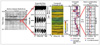 Figure
3. The crosswell reflection and velocity images (center) fill the
resolution gap between modern surface seismic data (left), and the sonic
log data (right center) and core measurements (far right). These data are
from a West Texas carbonate reservoir.
Figure
3. The crosswell reflection and velocity images (center) fill the
resolution gap between modern surface seismic data (left), and the sonic
log data (right center) and core measurements (far right). These data are
from a West Texas carbonate reservoir.