
 Print this page
 Click to view article in PDF format.
A Practical Approach to  Seismic
 Imaging of Complex Geology*
By
Matthew Brzostowski1 and Todd Jones2
Search and Discovery Article #40057 (2002)
*Adapted for online presentation from the article by the authors in AAPG Explorer (April, 2000), entitled “Complexities Can Be Mind-Bending.” Appreciation is expressed to the authors and to M. Ray Thomasson, former Chairman of the AAPG Geophysical Integration Committee, and Larry Nation, AAPG Communications Director, for their support of this online version.
1Houston, Texas (713-469-1311)
2Houston, Texas
|
|
General StatementThe biggest distinction between geology and geophysics can probably be broken down into the different domains from which they both start their work. The geologist works in terms of spatial coordinates and depth, with perhaps the roadcut epitomizing the best example of his world view. Depth is also how he makes use of his interpretation results, i.e. a well is drilled to a certain depth.
The geophysicist, however, deals with information recorded in time. His
job in
Figure 1b. Complications of translating time
into distance where the well is not
Analogies and ExamplesThe problem is not unlike the scenario depicted in Figure 1a: Here we have a person determining the depth of his water well by dropping a rock into it and recording the time for the splashing sound to come back. After some mathematical manipulation - and knowing the speed of sound in air - the person can translate time into depth. This sounds simple enough, but we made assumptions about the rock traveling straight down and the sound traveling straight back up to our ears. If the well is not vertically straight but deviated (Figure 1b), then we have a more complicated problem to solve.
This is the nature of
Figure 2a shows more clearly the issue.
Reflected energy from a subsurface point will travel to our surface
receivers in a straight line if the velocity field is constant. It would
be a simple and straightforward process to compute the location of the
subsurface point if we knew this velocity field. However, the issue
becomes more complicated when we acknowledge that
This ray bending is not unlike light bending as it travels through water
and air as depicted in Figure 3. The
resultant bent rays can lead to a gross misinterpretation of what is in
the glass if we do not account for it. That is the goal of
Figure 4 shows this distortion due to
velocity contrasts quite clearly. In both cases we are looking for the
oil trap depicted by the black shape. In one case, on the left in
Figure 4, we need only deal with the
relatively minor velocity contrast between the water column and the
subsurface when imaging the Specification of Velocity field
One of the means we have for controlling the
processing of
There are two broad classes of imaging
algorithms available to the geophysicist. One class has historically
been referred to as time migration, while the other class has been
referred to as depth migration. The names are confusing because of the
implication as to the domain the final images are in. However, it is
possible to convert
Time migration velocity fields will not honor
lateral velocity changes, although they can pick up The price for the accuracy, however, is more expense - and there is a greater need to determine the velocity field accurately. Imaging algorithms are available, as are mechanisms to build the velocity model |
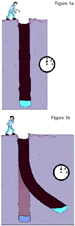 Figure
1a. Determination of the depth of a water well by translating time into
distance.
Figure
1a. Determination of the depth of a water well by translating time into
distance.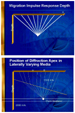
 Figure
3: A simple example of light rays bending across the air-water surface.
Figure
3: A simple example of light rays bending across the air-water surface. Figure
4: The oil trap on the left is imaged without
Figure
4: The oil trap on the left is imaged without  Figure
5: The depth migration velocity field (left) looks more like the geology
the
Figure
5: The depth migration velocity field (left) looks more like the geology
the 