Print this page
 Click to view article in PDF format.
GCWhy
We Need Color for  Seismic
 Display*
By
Alistair Brown1
Search and Discovery Article #40069 (2003)
*Adapted for online presentation
from the Geophysical Corner column in AAPG Explorer, January, 2001,
entitled “Color Reveals Seismic Message,” and prepared by the author.
Appreciation is expressed to the author, to R. Randy Ray, Chairman of the AAPG
Geophysical Integration Committee, and to Larry Nation, AAPG Communications
Director, for their support of this online version.
1Consulting reservoir geophysicist, Dallas, TX
|
uBackground and need for color
uBackground and need for color
uBackground and need for color
uBackground and need for color
|
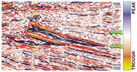
Everybody must have noticed that Variable-intensity color is needed rather than variable-area wiggle (Figure 1) for four reasons:
All logic and intuition in color usage comes
from the color cube, and good color schemes are based closely on it.
Contrasting color schemes are used for maps; gradational color schemes
for A double-gradational color scheme, such as seen in Figure 1, enhances high amplitude events and is particularly applicable to recognizing hydrocarbon effects and studying reservoir reflections. A single-gradational color scheme, on the other hand, enhances low amplitude events and is particularly applicable to fault recognition and general structural interpretation. The best example here is variable intensity gray. The most common double-gradational color scheme and the most universal color scheme overall is the well-known blue-white-red (Figure 1). The normal and conventional use of this has blue for positive amplitude, red for negative and white on zero. That makes it symmetrical with respect to the color cube and symmetrical with respect to amplitude numbers. We can thus easily compare one amplitude that is positive with another one that is negative. We do not add any contrasting color boundaries, because they make those amplitude levels look special -- so that they distract the eye from the study of amplitude trends, patterns, and relationships.
This is the best Look again at Figure 1, and note how the upper high amplitude blue and red reflections very closely mimic each other. This helps us identify them as the reflections from the top and the base of one reservoir. The lower high amplitude blue and red reflections also very closely mimic each other. These are the top and base of a separate lower reservoir. Special enhanced dynamic range color schemes permit even better definition of stratigraphic detail. A good example of this is the color scheme cyan-blue-white-red-yellow illustrated in Figure 2, which provides even more visual dynamic range than blue-white-red. Here, cyan and yellow highlight the maximum amplitudes. Figure 2 shows a reservoir offshore Nigeria in which gas is over oil, which, in turn, is over water. You can easily see that the gas-oil contact is higher amplitude than the oil-water contact, and that the gas bright spot is higher amplitude than the oil bright spot.
An interpreter with a detailed objective will
be looking for amplitude trends and patterns, low amplitude indications,
and high amplitude indications. He will be looking for character and
lateral changes. He will never see these important subtleties in wiggle
trace displays. He needs color for reflection identification using
natural pairing. He needs color to help identify problems with
Color is also valuable for other types of
Remember:
Please use color and select your color scheme with care. |