

 Print this page
 Click to view article in PDF format.
The Look Ahead VSP Survey: Its Utility and Future*
By
Robert J. Brewer1
Search and Discovery Article #40060 (2002)
*Sequel to article, VSP Data in Comparison to the Check Shot Velocity Survey, Search and Discovery Article #40059 (2002), by the author.
1Halliburton Energy Services, Houston ([email protected]).
|
|
General StatementVertical seismic profiling (VSP) technology although not new, is still viewed by some as something of a novelty. Our industry has been using it somewhat reluctantly since the early 1970’s--reluctantly, perhaps because there may be a tendency to view surface seismic data as a sort of panacea and ultimate resource to get subsurface information between wells. General industry knowledge of surface seismic techniques are widely known; not so with VSP technology. Fortunately, more and more VSP surveys are being run today because advantages of producing high-resolution seismic images to help tie the well bore to surface seismic data to lower overall drilling risk are starting to be more appreciated and documented. Of course, other types of subsurface data are used. Included are the obvious well-log curves and the occasional use of gravity and magnetic coverage to augment deficiencies and gaps which may be encountered in surface seismic data sets--especially where regional and frontier work is involved. We are always asking structural and stratigraphic questions about the subsurface and wanting to know what lies ahead of the drill. The writer re-visits “Look Ahead” VSP or PAB (“Prediction Ahead of Bit”) VSP (whichever acronyms are preferable) technology and presents this type of VSP survey as an accurate and versatile seismic method available for imaging an appreciable distance around and ahead of the drill bit.
The Zero Offset VSP Survey as a Start The look ahead VSP survey is not much more than special data processing treatment of the standard zero offset VSP survey. The zero or near offset VSP survey (these terms tend to be distance from wellhead related and generally used interchangeably), is defined as a VSP survey where the energy source whether a vibroseis truck, airgun array, dynamite shothole, etc., is positioned as close as logistically possible to the wellhead in an effort to focus downgoing energy in and around the bore hole from near-surface to T.D and beyond. This geometry favors the recording of reflected arrivals to the downhole geophone tool for about an approximate 100 ft. radius (depending on dip), around the well bore as well as reflected arrivals several thousands of feet below the T.D. of the well. Typical objectives of this type of survey are (1) to obtain velocity control to allow surface-seismic-time to depth conversion and (2) to produce a processed seismic image known as a corridor stack of the area around and including the well bore. Zero offset surveys are either run alone or in conjunction with some type of offset vertical seismic profiling (Figure 1). Included may be an offset VSP, static or walk-away or a salt-proximity, survey. Offsets are designed to image some distance laterally away from the well bore in the direction of the energy source, image a salt dome flank or perhaps a granite intrusive interface. Zero offset is the most common type of VSP survey. The surveys are usually recommended by geophysicists seeking accurate on-depth seismic correlation to tie a well to a 2D and/or 3D surface seismic survey. Those who run VSP’s routinely have appreciation from past experience of the limitations and pitfalls involving surface-seismic-time to depth conversion and seismic-reflection-character-tie challenges. They understand the problems that may result from trying to get too much information from just a checkshot velocity survey alone and/or a simple and limited synthetic seismogram made from a sonic log. The checkshot velocity survey is basically a seismic travel time study that measures almost exclusively the downgoing energy traveling from a surface energy source to a downhole geophone tool. The checkshot survey is valuable for velocity control, however, it contains virtually no reflected arrivals and cannot be used to produce an optical reflection seismic image of the subsurface unless it is used to calibrate a sonic log that has been transformed into a hybrid known as a synthetic seismogram. Synthetic seismograms are popular because they are inexpensive, easy to produce and use from available sonic log data, and they may give satisfactory results in cases where rock velocities are already well known and more predictable. Difficulties may arise in softer rock regimes, such as the U.S. Gulf Coast and areas of more complex structure and stratigraphy.
Because
genuine reflected arrivals from strata a significant distance below the
T.D. of a well are recorded by the downhole geophone tool in a VSP
survey, there usually is always an opportunity to handle this
information selectively during the data processing
VSP Data Inversion Produces Acoustic Impedance Log Below T.D. of Well
Inversion is a process that is closely related to look ahead or
prediction ahead of the bit and entails one of the most useful tools for
this application. The process that generated the reflection response of
the recorded VSP data is inverted to derive the original reflection
sequence. Corridor stacking of a zero or near offset VSP survey can be
used to generate an acoustic impedance log (sometimes known as a pseudo
sonic log), below the total depth of a well. Acoustic impedance
variations indicative of changes in rock properties can be identified.
The information is useful in identifying a particular target below the
well, such as a salt layer, overpressured zone, or a sequence of sands
in an otherwise homogeneous shale section. Specific details of the
inversion process are beyond the intended scope of this article;
however, they basically involve describing the acoustic profile
associated with a reflectivity sequence of discrete reflection
coefficients. Additional applications of inversion include modeling to
fill gaps in logs, lateral impedance prediction in a deviated well,
aiding surface seismic inversion after
The FutureVSP surveys will be performed more often as our industry strives to get the most useful and cost-effective seismic data available in a prospect area to help make critical drilling decisions. The shortcomings of surface seismic profiling relating to recorded frequency bandwidth limitations, shadow zones in areas of complex subsurface structure, higher cost and significantly slower data-processing turnaround than the VSP will continue to encourage explorationists to consider borehole seismic surveys. The look ahead capability of the zero or near offset VSP is currently an under-utilized option in our industry. Its usage will undoubtedly increase with time because it is easy to include in a well’s logging program and is probably the most cost-effective and accurate way to obtain information about the nature of the rocks ahead of the drill.
Recommended ReferencesBrewer, Robert J. 2002, VSP Data in Comparison to the Check Shot Velocity Survey: Search and Discovery Article #40059 (2002). Clough, R.P., Understanding VSP’s, Techniques, Interpretation, Applications, CGGBSD, Compagnie Generale de Geophysique (CGG) 1993. Sheriff, Robert, E., Encyclopedic Dictionary of Exploration Geophysics, Society of Exploration Geophysicists, Third Edition, Second Printing, 1994. |
 Figure 1. Near or zero offset source surface position with offset
position for comparison. An offset VSP survey design should always
include a zero offset source location to calibrate the offset to the
well bore and to provide velocity control.
Figure 1. Near or zero offset source surface position with offset
position for comparison. An offset VSP survey design should always
include a zero offset source location to calibrate the offset to the
well bore and to provide velocity control. Figure 2. Comparison of predicted data
(center panel) with well results - log data (left panel) and additional
VSP data recorded after well was deepened (right panel).
Figure 2. Comparison of predicted data
(center panel) with well results - log data (left panel) and additional
VSP data recorded after well was deepened (right panel).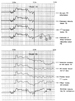 Figure
3. Effects of different velocity trends applied below TD of a well. Top
panel represents available choices for handling velocity below TD.
Bottom panel shows resultant impedance log below TD with actual sonic
log for comparison.
Figure
3. Effects of different velocity trends applied below TD of a well. Top
panel represents available choices for handling velocity below TD.
Bottom panel shows resultant impedance log below TD with actual sonic
log for comparison.
