Print this page
 Click to view article in PDF format.
GCShaded
Relief in Display of  Seismic
 Data*
Data*
By
Arthur Barnes1
Search and Discovery Article #40097 (2003)
*Adapted for online presentation from the Geophysical Corner column in AAPG Explorer August, 2002, entitled “What a Relief Shade Can Be,” prepared by the author. Appreciation is expressed to the author, to R. Randy Ray, Chairman of the AAPG Geophysical Integration Committee, and to Larry Nation, AAPG Communications Director, for their support of this online version.
1Landmark Graphics, Englewood, Colorado ([email protected].)
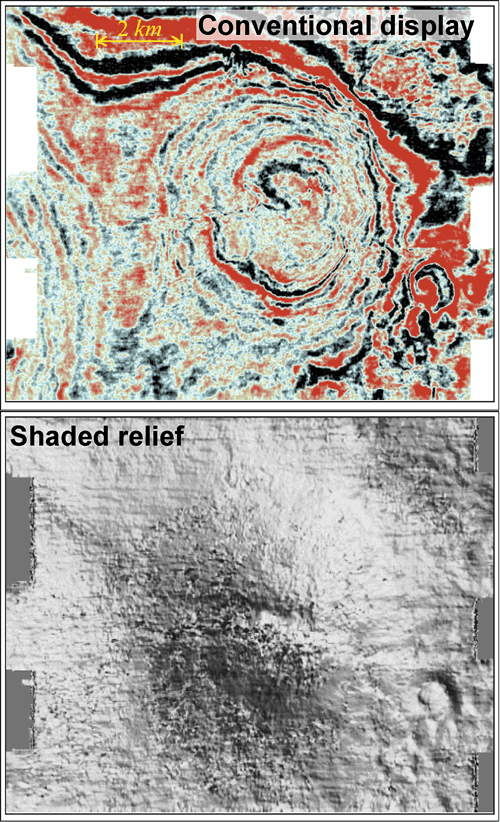
In the shaded relief image of Figure 1 you see a
rugged mountain with craters on its flanks. Lunar topography? A stretch of
remote desert on Earth? Hardly – it is a time slice through a seismic volume.
Compare this image with Figure 2, a conventional display of the same data, and
you will agree that shaded relief wonderfully complements standard
displays by revealing details and presenting them in a form that geologists
readily appreciate. Yet, already knew that, for shaded relief has been employed
for over a century in displays of topography, and today it is ubiquitous in the
display of any geological or geophysical data that is presented as a map,
including digital elevations, gravity and magnetic data, interpreted seismic
horizons and geologic models. Whatever the application, the motivation for
shaded relief displays is always the same – to transform data into
realistic-looking apparent topography and thereby aid interpretation by
revealing or suggesting true geology.
|
uShaded
relief and
uShaded
relief and
uShaded
relief and
|
Click to view
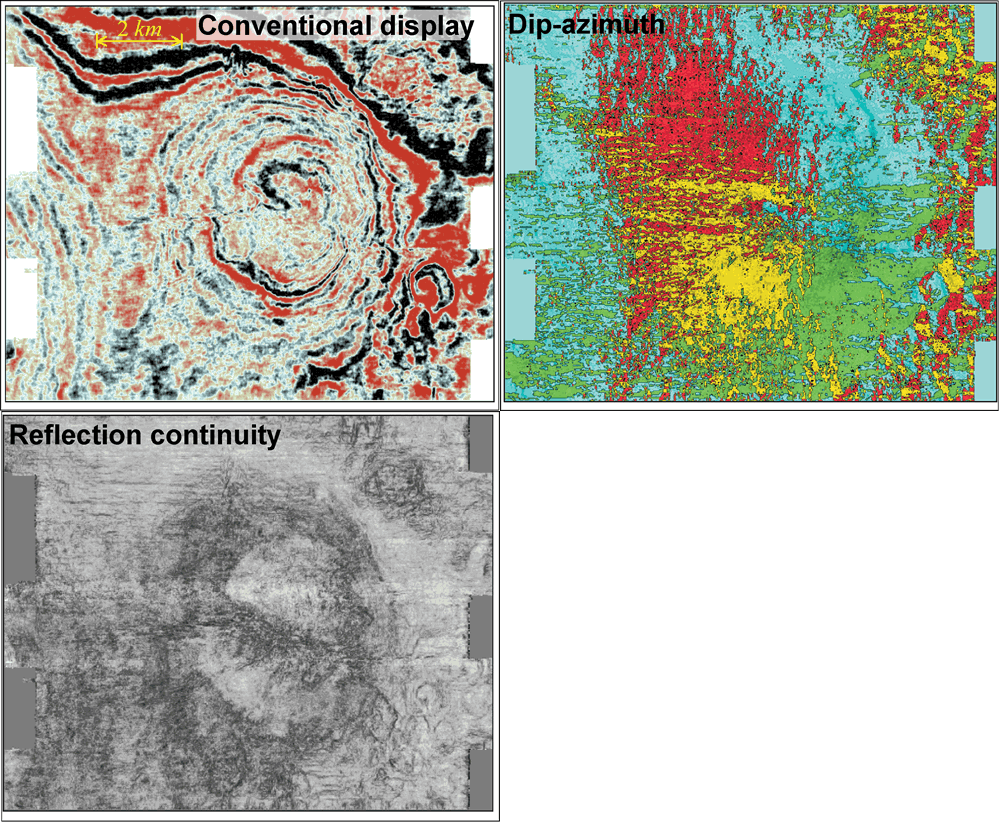
sequence of Figures 2 (conventional display of time slice), 4
(dip-azimuth), and 5 (
Shaded Relief and
Why was shaded relief not applied to the
display of
Two reasons stand out:
To apply shaded relief to a 3-D
Shaded relief actually contains the same
information as the common dip-azimuth attribute (Figure 4). This common
information is the While shaded relief replaces dip-azimuth, it complements other attributes, such as continuity (Figure 5). Both shaded relief and continuity reveal details hidden in the data, but continuity highlights faults and other discontinuities, whereas shaded relief shows changes in reflector orientation. There is also a difference of directionality, for most attributes reveal structures in all directions, whereas shaded relief is directional, enhancing features perpendicular to the illumination direction while suppressing those that are parallel. As a result, shaded relief displays should be created in pairs with orthogonal illumination directions so as to capture all features. This directionality is useful, as it makes a powerful directional filter of shaded relief, enabling a user to selectively highlight certain trends while hiding others.
|
 Figure 1. A picture of the moon? No, a time
slice through a
Figure 1. A picture of the moon? No, a time
slice through a  Figure 2. The conventional display of the same
time slice shown in
Figure 2. The conventional display of the same
time slice shown in Figure 3. The relative illumination at a point
on a surface is a function of the angle between the incident light and
the surface normal.
Figure 3. The relative illumination at a point
on a surface is a function of the angle between the incident light and
the surface normal. Figure 4. Dip-azimuth corresponding to
 Figure 5.