Print this page
 Click to view article in PDF format.
GC Fracture
 Models and Fractured Reservoirs*
By
Steve Ahlgren1, Jim Holmlund2, Paul Griffiths1, and Rob Smallshire1
Search and Discovery Article #40100 (2003)
*Adapted for online presentation from the
Geophysical Corner column in AAPG Explorer September, 2002, entitled “Fracture
Model Analysis Is Simple,” prepared by the authors. Appreciation is
expressed to the authors, to R. Randy Ray, Chairman of the AAPG Geophysical
Integration Committee, and to Larry Nation, AAPG Communications Director, for
their support of this online version.
EDITORIAL NOTE: The reader is referred to a
companion article, entitled “Using
3-D Outcrop Laserscans for Fracture Analysis,”
prepared by authors Ahlgren and Holmlund.
1Midland Valley Exploration, Glasgow, UK ([email protected])
2Geo-Map Inc., Tucson, Arizona
Introduction
Ahlgren and Holmlund (2003)
describe a new fracture detection method incorporating a portable laserscan unit
to completely image analog outcrops in three dimensions. In this article, we
explore how simple analysis of calibrated analog fracture models can enhance
exploration and production in fractured reservoirs.
After collecting laserscan data from analog outcrops, semi-automatic processing
extracts important fracture data such as geometries, intersections, trace
lengths and orientation statistics. These statistical and spatial properties are
extrapolated in three dimensions and used to generate synthetic fracture models
at a scale consistent with existing or planned wells. The synthetic,
three-dimensional fracture networks have similar statistical and topological
characteristics of observed data, but offer distinct advantages over their
natural counterparts. One important benefit is the ability to construct multiple
realizations of the observed fractures quickly to test different hypotheses and
perform sensitivity testing of the input parameters. Results also can be
compared to well production volumes and modified to get good matches.
|
|
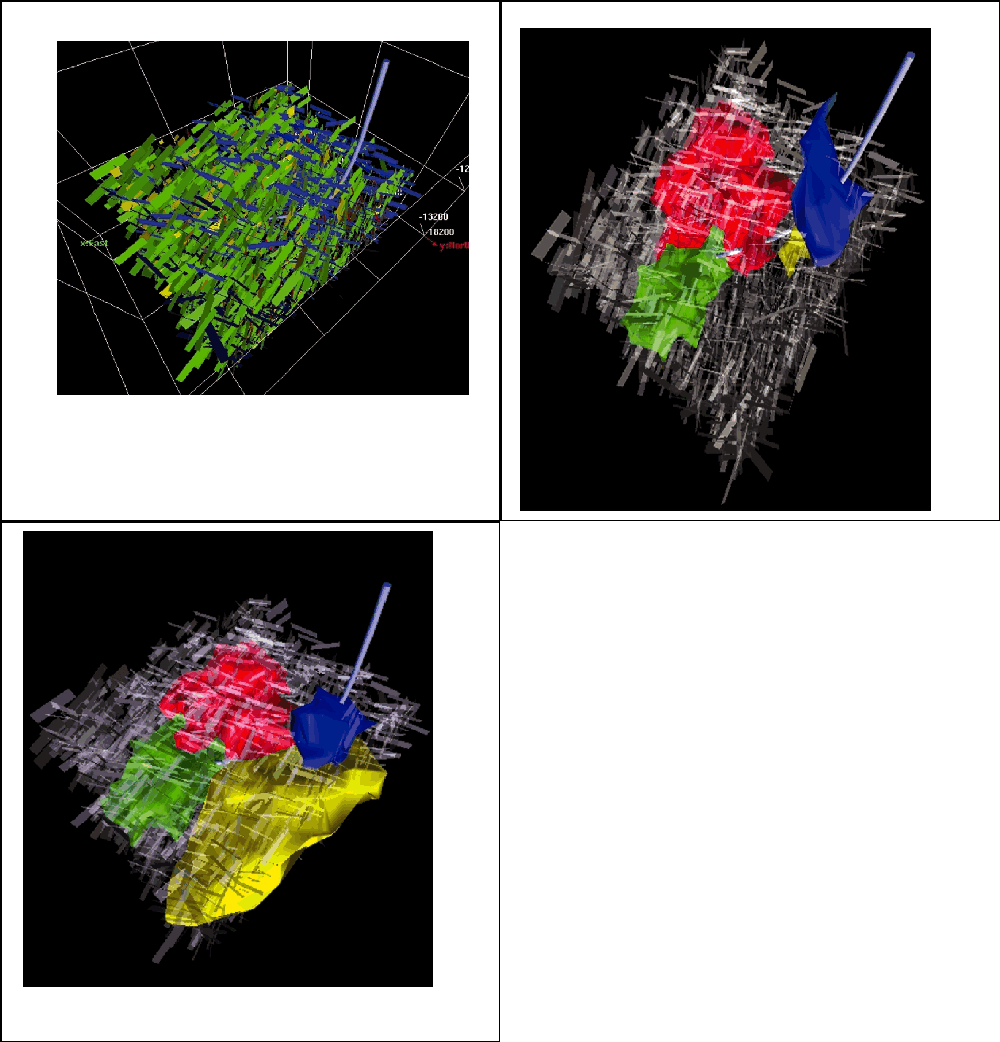
Click to view in sequence the differences in the model, as illustrated by Figures 2, 3, and 4.
Technique
The new laserscan technique provides robust
statistical data on
One technique is three-dimensional
connectivity
The resulting scale model of the
Since the
Although both
Conclusion
Laserscanning can be used to generate
calibrated
Sensitivity testing may help to provide
additional confidence in well planning and the
ReferenceAhlgren,
Steve, and Jim Holmlund, 2003, Using 3-D outcrop laserscans for
AcknowledgmentThis research was funded in part by BP. |
 Figure 1. Meshed laserscan image of a
fractured outcrop on Mt. Lemmon, Ariz. The face measures 28m x 18m.
Figure 1. Meshed laserscan image of a
fractured outcrop on Mt. Lemmon, Ariz. The face measures 28m x 18m. Figure 2. Synthetic
  Figure 3. The synthetic well drains four
distinct fractured volumes.
Figure 3. The synthetic well drains four
distinct fractured volumes. Figure 4. Changing the mean length and aspect
ratio of one
Figure 4. Changing the mean length and aspect
ratio of one