
 Print this page
Energy and Environment into the Twenty-First Century: The Challenge to Technology and Ingenuity*
WILLIAM L. FISHER
Search and Discovery Article #70003 (2000)
Department of Geological Sciences and Bureau of Economic Geology, The University of Texas at Austin, Austin, TX 78713
* Slight adaptation for online presentation from article of same title published in Environmental Geosciences. Volume 6, Number .4. 1999, p. 191-199.
ABSTRACT
Traditional
energy resources, chiefly fossil fuels, are adequate to meet likely global
energy demands as the transition to a hydrogen and renewable energy economy is made
over the next three to five decades. Long-term trends in efficiency in energy
 development
 , use, and conversion will continue and be enlarged. Reliance on
fossil fuels for the transition should not cause unacceptable environmental
impact, especially with the likely increased emphasis on low-carbon natural
gas. The historical economic growth of 3% per annum can be maintained for a
global population that will probably stabilize at ~10 billion by the middle
part of the twenty-first century.
, use, and conversion will continue and be enlarged. Reliance on
fossil fuels for the transition should not cause unacceptable environmental
impact, especially with the likely increased emphasis on low-carbon natural
gas. The historical economic growth of 3% per annum can be maintained for a
global population that will probably stabilize at ~10 billion by the middle
part of the twenty-first century.
INTRODUCTION AND BASIC TRENDS
The
challenge of meeting the resource and environmental needs of the global
society over the next century is a daunting one. The requirements must not
only be met but met in a way that balances what to many seem to be conflicting
goals. Inherent in resource development and consumption is exploitation;
inherent in maintaining the global environment is preservation or at least
conservation, seemingly opposites.
As we stand at the end of the twentieth century, a number of long-term trends have been established that are of positive benefit in meeting future resource demands and do so in an environmentally acceptable manner. Most of these trends will surely extend into the next century and will most likely be enlarged. The first salutary trend, well established in the latter part of this century, has been the remarkable reduction in birth rates in almost all parts of the globe. Many demographers now project global population, currently at ~5.6 billion, reaching 10 billion, stabilizing, then declining slightly sometime in the first half of the next century. In fact, in many parts of the industrial world, population is now declining and poses a major challenge in the maintenance of economic growth in those nations. Although population may only increase by 40-80% over the next century, it is the aspirations of the global population for economic growth and the energy and material resources such growth requires that pose the greatest challenge.
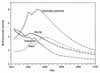
Energy and material resource demand is being substantially moderated through efficiency in use as measured in unit of energy or materials used per unit of economic product. This trend is long-running in the industrial world and recently in the formerly centrally planned economies and in the rest of the world. From the first steam engine in 1700 to today's best gas turbines, efficiency in energy use has increased 50-fold, and conversion efficiencies of 85% are in sight; in lighting, efficiency has improved by two orders of magnitude in the past 150 years (Figure 1). Energy use per unit of economic activity has been reduced by well over half in the industrial nations this century and by the end of the next should be only one-quarter of today's level and may be much less (Figure 2). The rest of the world should follow in similar progression.
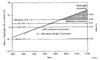
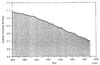
Efficiency has come not only in use ,and conversion but also from the energy mix with the long-term movement to higher hydrogen content fuels (Figure 3). The global energy mix is now entering the methane economy and should be, with extrapolation of the long-term trend, in a hydrogen economy by the middle of the next century, with the source of hydrogen from natural gas, a nonfossil energy source, or both. The long-term relentless drive for energy efficiency, driven by economic forces, carries with it a substantial decarbonization of fuel consumption. Carbon intensity of the world's energy mix has been declining at an average annual rate of 0.3% over the long term; by 2050 it should be 50% lower than now and with the advent of the hydrogen economy probably much lower (Figure 4). Another well-established trend, one also driven by technology and market forces, is what is termed dematerialization, in which needs are met through technologies and systems requiring less energy input. Heavier materials are being substantially replaced by lighter weight materials; recycling of materials is expanding rapidly, especially recycling of metals, and generally involves less energy use and less environmental impact.
Finally,
a notable trend essential to meeting requirements and enhancing economic
growth is in the cost of energy and material resources to the world's
consumer. Efficiencies, even in the face of depletable resources, have led to
real decline in commodity
prices of energy and mineral materials over the long term. The price of
gasoline, as an example of a pervasively used commodity, has declined 80%
since 1920, discounting a couple of aberrations. Gasoline benefits from efficiency
in oil finding and production, now the highest in history, and efficiencies in
refining, which now, even with strong environmental regulations in place,
are at all-time highs.
Most
of these basic, long-term trends-use efficiency, resource finding and
development efficiency, environmental cleanness, declining commodity prices,
and dematerialization, along with anticipated population stabilization-are
positive, lessening both environmental and resource impacts. All are driven by
technology and human ingenuity, in turn driven in most cases by market forces.
They are sure to be maintained and likely to be enlarged. Even so, with
conservative population growth and maintenance of historical levels of economic
growth, future demand levels for energy and material resources will be very
large.
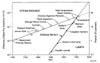 Figure
1: Historical trends in energy conversion efficiencies (from Ausubel, 1996).
Figure
1: Historical trends in energy conversion efficiencies (from Ausubel, 1996).
GLOBAL ENERGY REQUIREMENTS
Global economic growth over the past 100 years has averaged ~3% yearly, with several ups and downs. Energy has clearly been the driver for this economic growth. So far, nearly 1.8 trillion barrels of oil equivalent in total energy has been consumed in the world, and beyond the traditional biomass, 90% has been the fossil fuels and 90% has been consumed this century.
What
will the twenty‑first century require? Specifically in the case of
energy requirements, Dupont-Roc and Khor (1994) of Royal Dutch Shell's
Corporate Centre laid out two contrasting scenarios that give a measure of the
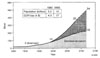
twenty-first century global energy requirements (Figure
5). Both scenarios
assume adequate energy resources to support a continuing world economic growth
of 3% per year, the same growth rate as that achieved over the last 100 years.
Population growth is assumed to follow the World Bank base case, reaching 8.5
billion by 2030 and stabilizing at some 10-12 billion in the second half of
the next century, as economic development progresses. By 2060, the world
average Gross Domestic Product (GDP) per capita would reach $17,000, similar
to today's level in the United Kingdom, and approximately four times the
current global GDP per capita level.
One of the Shell scenarios is what they call "sustained growth." Abundant energy is produced at competitive prices, growth paths of this century continue, and energy demand per capita, ~4 barrels of oil equivalent (boe) at the beginning of the century and 13 today, goes to 25 boe by 2060, roughly Japan's level of demand today, and to 54 boe by the end of the twenty-first century. A second scenario is what they call "dematerialization," in which needs are met through technologies and systems requiring much less energy input. Per capita demand moves only to 15 boe by 2060 and to 19 boe by the end of the next century. The key difference is pace of energy use efficiency. Under sustained growth, energy demand growth of 2%o supports an economic growth rate of 3%. This sustained growth calls for an increase in energy efficiency of ~1% yearly, or what the United States has managed in the twentieth century. Under dematerialization, efficiency gradually increases to 2%, a rate achieved in the past but only for relatively short periods. The difference in the two scenarios is profound as regards to the long-term demand for energy. Under sustained growth, annual energy demand reaches 250 billion boe by 2060, four times the current level, and ~540 billion boe per year (assuming a world population of 10 billion) by the end of the twenty-first century as per capita consumption increases. By contrast, the dematerialization scenario, showing the massive impact of increased efficiency in energy use, increases to 150 billion boe by 2060 and only 190 billion boe by the end of the next century, approximately one-third of the sustained growth century-end requirement. Either way, the twenty-first century energy requirements are huge, some 15 trillion boe under dematerialization and >25 trillion boe under the sustained growth scenario. As reference, these volumes are 10 to more than 15 times the total energy consumption of mankind to date.
Where will energy in such volumes come from? The vast bulk of historical supply has been and is today from fossil fuels, so-called nonrenewable resources-oil, gas, and coal-with smaller amounts from nonfossil fuel resources such as nuclear power, hydropower, and wood, among others. Most analysts see fossil fuels continuing to supply much of world energy needs for at least the next two, and more likely, the next five decades, providing a transition, sooner or later, to a new way of energy transformation.
TRADITIONAL ENERGY RESOURCES
Can the traditional energy resources meet the huge demands of the next century? And if they can, what role should they play?
Oil
Foremost
in consideration is oil, the world's transportation fuel and its most relied
upon energy resource, making up 40% of the total energy demand. The argument
about how much oil exists or remains to be found and developed has been
around, with varying intensity, since the first barrel was discovered. It
continues today. Recent estimates of ultimate recoverable conventional oil
vary by a factor of two, from as little as 1.8 trillion barrels, with 900
billion barrels remaining, to 3.8 billion barrels (Figure
6). Those with the
lower estimates tend to discount the generally reported proved reserves of 1.1
trillion barrels, contending they are politically overstated. They discount or
disregard reserve growth, the addition of new reserves in older, existing
fields by drilling based on new technologies and concepts of unrecovered
mobile oil and one of the most remarkable trends of the past 20 years,
contending such potential reserves are already accounted for in calculations
of proved reserves. Furthermore, they observe crude oil discovery levels of
the past 20 years, expectedly low in a period of very low oil prices and
during a period of emphasis on reserve growth strategies, and conclude that
future discovery volumes must be quite low. Accordingly, these analysts
generally predict a near-term peaking of conventional oil production. A recent
example is Campbell and Laherrère (1998), who projected peaking of
conventional oil production over the next decade, possibly within as little as
5 years, after which global oil production would decline at an average annual
rate of ~3.8% (Figure 7). Campbell earlier this decade (1991) predicted
peaking over this current
decade at a level lower than that currently predicted by Campbell and Laherrère
(1998).
Analysts predicting near-term peaking
generally use the symmetrical life cycle method of Hubbert (1982). This method
assumes that the amount of oil to be recovered is known and that the peak in
production will come at the midpoint of the total recoverable resource volume.
The volume of oil ultimately to be discovered and developed is impacted but
little by technology and economics. As a matter of record, the estimate of the
amount of recoverable oil is dynamic, and over time it has tended to increase
primarily with new technologies and new exploration and development concepts.
Furthermore, there is no technical justification from examining production
histories that midpoint in exhaustion of the resource represents peak
production, or vice versa. Those analysts calculating larger ultimate
recoverable volumes of hydrocarbons tend to emphasize the role of technology
and new concepts in enlarging the recoverable resource base. Field reserve
growth, for example, is a critical element of reserve additions, especially in
complex reservoirs where new sensing technology such as 3-D seismic
permits better understanding of reservoirs and permits fuller exploitation of
the field. In many reservoirs, less than half of the movable oil originally
contained is drained with existing levels of development. Entirely new trends
and provinces are accessed by technology, most notably in recent years the
ultradeep-water provinces of the Atlantic and the Gulf of Mexico.
The
U.S. Geological Survey has noted (1997) that over the 12-year period from 1981-1993
when they have made assessments, identified global oil reserves increased by
379 billion barrels; over that same period, 254 billion barrelswas
removed from reserves in the form of production, so that a total of 633
billion barrels was added to reserves (Figure 8). Reserves were thus added at
a rate 2.5 times that of production during the period. Approximately 80% of
the total additions were from reserve growth in existing fields.
Emphasizing the role of technology on the oil and gas resources base worldwide yields estimates of ultimately recoverable oil in excess of 3.8 trillion barrels with >3.0 trillion barrels of conventional oil remaining. Proved reserves make up 1.1 trillion barrels, future discovery potential is estimated to be 1.0 trillion barrels, and future reserve growth is estimated to be 950 billion barrels (Table 1). Nonconventional resources of oil, including tar sands, very heavy oils, and shale oil, add substantially to the global resource base.
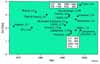 Figure
6: Recent estimates of ultimate global oil recovery from conventional
resources. C.P., cumulative production; P.R., proved reserves; DISC., to be
discovered; R.G., reserve growth; BBL, billion barrels of oil.
Figure
6: Recent estimates of ultimate global oil recovery from conventional
resources. C.P., cumulative production; P.R., proved reserves; DISC., to be
discovered; R.G., reserve growth; BBL, billion barrels of oil.
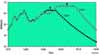 Figure 7: Forecasts of world oil
production. Campbell (1991) and Campbell and Laherrère (1998) are from Lynch
(unpublished data).
Figure 7: Forecasts of world oil
production. Campbell (1991) and Campbell and Laherrère (1998) are from Lynch
(unpublished data).
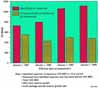
 Table
1. Estimated global oil and natural gas accounts.
Table
1. Estimated global oil and natural gas accounts.
Natural Gas
Certainly
one of the most dramatic examples of the role of technology has been the
changed perception of the natural gas resource base in the United States. As
recently as the early 1980s, the natural gas resource base of the United
States was widely judged to be near exhaustion. Production was in sharp
decline, and by statute, certain uses of natural gas were prohibited. Prices
were projected to increase several-fold while production was projected to
continue in decline. Over the past 15 years, during a period of low gas
prices, vigorously developed and applied technology along with some changed
concepts on the residency and recovery of natural gas has vastly changed the
perception. Natural gas is now widely viewed as a plentiful and abundant
resource, with estimates of the amount remaining to be found and developed an
order of magnitude greater (Figure 9). Forward projections of wellhead prices
in real terms are now essentially flat through the next decade. Production,
once projected to fall drastically, is now projected by many industry and
governmental analysts to reach levels over the next 15 years 50% greater than
the previous peak in production. Ultimately recoverable natural gas resources
are estimated to be nearly 28,000 trillion cubic feet (Tcf), with nearly
26,000 Tcf remaining. Of this, current proved reserves account for nearly 6000
Tcf; nonconventional resources., 5000 Tcf; tobe-discovered conventional
resources, 12,000 Tcf; and estimated future reserve growth, 3000 Tcf. The near-at-hand
technology to convert natural gas to middle distillate liquids for easy
transport makes much of the global oil and natural gas resource base
interchangeable. The total oil and gas resource base is estimated to be 7.3
trillion boe, a volume some six times greater than total global consumption to
date.
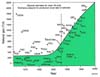 Figure
9: Estimates of remaining natural gas in the United States.
Figure
9: Estimates of remaining natural gas in the United States.
Coal
The other traditional fossil fuel, of course, is coal; it represents ~30% of both current and historical fossil fuel consumption. Proved reserves of coal exceed 5 trillion boe, and
the
total technically recoverable resource base is on the order of 23 trillion boe.
A number of constraints exist to recovery of the full resource base or even a
major portion of it, but by any measure the coal resource is huge. Global coal
production, although significant, has grown only ~2% over the past 15 years.
However, it is projected by Energy Information Administration (1998) to
increase 67% by 2020, with 95% of the projected growth in China (80%), India
(8%), and the United States (7%).
Nuclear and Hydropower
Nuclear
power and hydropower, both used almost exclusively for electrical power
generation, make up nearly 10% of primary energy consumption. Both have a
continuing role in the world's energy supply. Even with the eventual large-scale
introduction of the largely intermittent renewable energy sources, baseload
backup will be required, and nuclear and hydropower could meet such
requirement. Nuclear power carries with it what has become an almost
intractable problem of waste disposal. Uranium resources are adequate to keep
the present fleet of world reactors in operation through the middle of the
next century. There are new breeder reactor technologies that could overcome
many of the problems associated with uranium supply and radioactive waste
disposal, but the high projected investment costs and huge additional
development and demonstration costs make the future of breeder reaction
technology uncertain (Linden, 1998). Hydropower has all the desirable
attributes of a baseload renewable power source but faces growing resistance
by the environmental community both in the industrial world, where potential
is limited, and in the developing world (Linden, 1998).
TRADITIONAL FUELS IN TRANSITION
Proved or developable resources of traditional fuels, especially the fossil fuels and including conventional oil resources, are adequate to supply energy needs throughout the transition to new methods of developing energy sources. There is sufficient conventional oil and gas to maintain the historical role of the fuels throughout the next century under Shell's dematerialization scenario. Even under the sustained growth scenario, oil and gas could maintain its role through most of the first half of the next century, although the total oil and gas resource base is barely 30% of the total energy requirement for sustained growth throughout the entire century. Among the fossil fuels, there is ample coal to make up the balance of needs even for the sustained growth scenario. But exhausting the fossil fuel base, especially coal, is not likely. In many cases for coal, the methane trapped in certain deposits may well prove more important than the coal itself.
FOSSIL FUELS AND THE ISSUE OF GLOBAL WARMING
In
weighing the role of traditional fuels, especially the fossil fuels, as
transition energy sources, al major current controversy lies in the issue of
global warming and the significance of burning hydrocarbons as causative. The
issue of global warming as the result of anthropogenic emission of carbon
dioxide is much debated and largely unresolved. Furthermore, whether a warmer
Earth, whatever the cause, is good or bad is likewise not resolved. But in
regard to the issue, Linden (1998) has made some interesting calculations and
observations. The proved reserve base of fossil fuels contains ~1130 gigatons
of carbon (GtC), and the total resource base contains slightly >5000 GtC,
~85% of which is tied up in coal (Table 2). The Intergovernmental Panel on
Climate Change (IPCC) business-as-usual scenario projects carbon dioxide
concentrations in the atmosphere reaching 800 ppmv by 2085 and triple the
pre‑industrial level of 280 by 2100. For the century, total carbon
emissions would amount to 2190 GtC, less than halt the fossil fuel base
content. Stabilizing the atmospheric concentration of carbon dioxide at twice
the pre-industry level, say ~550 ppmv, is considered by many to be reasonable
and, according to the IPCC estimates of climate sensitivity on doubling of
atmospheric carbon dioxide, gives an equilibrium temperature increase of only
~1.6°C. This concentration calculates to a next century emission of ~1000 GtC.
That level of emission would allow depletion of the entire estimated natural
gas and oil resource base over the next century and further permit the current
level of global coal production for the next 100 years. By these calculations
of Linden (1998), utilization of the fossil fuels, with the certain reliance
on natural gas, as transition fuels does not pose a problem. But the real
driver in historical energy use and assuredly the driver of the next century
is efficiency-efficiency driven by market forces. The historical direction is
toward a hydrogen economy-less carbon-with the initial source of hydrogen
methane and subsequently from noncarbon sources.

RENEWABLE ENERGY SOURCES
The so-called renewable energy sources-biomass, wind, solar, among others-will play a critical and increasingly important role into the next century, despite the intermittent character of many of them. The eventual transition from the
traditional sources will require a new
way of energy transformation, possibly nuclear fusion. The new energy source,
as commonly envisioned, would allow the cheap production of electricity, which
in turn would be used to produce liquid hydrogen from water instead of natural
gas. Timing of this new energy source is probably not before the middle of the
twenty-first century, but it could be earlier.
CONCLUSIONS
The challenge of supplying the energy and material resources for a growing, more affluent world population and reconciling associated economic growth with environmental and other societal needs is huge. There is plenty in human history, especially the demonstrated human ingenuity to develop the technology and concepts and to apply them rigorously and as needed, to indicate the challenge can be met.
REFERENCES
Ausubel, J. H. (1996). Can technology spare the earth'? Am Sci, 84, 166-178.
Bookout, J. F. (1989). Two centuries of fossil fuel energy. Episodes, 12, 257-262.
Campbell, C. J. (1991). The golden century of oil: 1950-2050: The depletion of a resource. Boston: Kluwer Academic Publishers.
Campbell, C. J., and Laherrère, H. (1998). The end of cheap oil. Sci Am, March, 1998, 78-83.
Dupont-Roe, G., and Khor, A. (1994). The evolution of the world's energy ,systems. The Hague: Royal Dutch Shell, Corporate Centre.
Energy Information Administration (1998). International energy outlook. U.S. Department of Energy Publication No. DOE/EIA-0484(98). Washington, DC: U.S. Department of Energy, Energy Information Administration.
Hubbert,
M. K. (1982). Techniques of prediction as applied to the production of oil and
gas. In S. I. Gass, (Ed.), Oil and gas
supply modeling: proceedings of
a symposium (pp. 16-141).
Washington, DC: National Bureau of Standards Special Publication 631.
Linden,
H. R. (1998). Achieving sustainability-Sprint or marathon. In Proceedings
of
the Aspen Institute Energy
Forum . Aspen, CO.
U.S. Geological Survey. (1997). Changing perceptions of world oil and gas resources as shown by recent USGS assessments. U.S. Geological Survey Fact Sheet 145-97. Denver Federal Center: U.S. Geological Survey.
ABOUT THE AUTHOR
William L. Fisher
William L. Fisher is the Leonidas T. Barrow Centennial Chair in Mineral Resources and Director of the Geology Foundation at The University of Texas at Austin. He is the former Director of the Bureau of Economic Geology and former Chairman of the Department of Geological Sciences. Dr. Fisher is a long-time adviser to state and federal officials and testifies frequently to the U.S. Congress. He lectures extensively and has published more than 200 articles, reports, and books.
Dr. Fisher is a member of the National Academy of Engineering and currently serves on the National Petroleum Council, the Advisory Council of the Gas Research Institute, and the board of Pogo Producing Company. He is a former member of the White House Science Council, The President's Council of Advisors on Science and Technology, Energy Research Panel, and the Secretary of Energy Advisory Board. Dr. Fisher is a member of the Board on Energy and Environmental Systems and past Chairman of the Board on Earth Sciences and Resources of the National Academy of Sciences. He is past president of the American Association of Petroleum Geologists, the American Geological Institute, the American Institute of Professional Geologists, the Association of American State Geologists, the Gulf Coast Association of Geological Societies, and the Austin Geological Society. Dr. Fisher is a Fellow and former Councilor of the Geological Society of America. He is the recipient of the Powers Medal (AAPG), the Parker Medal (AIPG), the Campbell Medal (AGI), and the Hedberg medal (ISEM).
Dr. Fisher served as Assistant Secretary of the Interior for Energy and Minerals and as a member of the White House Energy Resources Council during the Ford Administration. He holds a B.S. and D.Sc. (Hon.) from the Southern Illinois University and an M.S. and Ph.D. in Geology, University of Kansas.