Print this page
 Click to view presentation in PDF format.
Applying Fluid Inclusions to Petroleum Exploration and Production*
By
D.L. Hall1, S.M. Sterner1, W. Shentwu1, and M.A. Bigge1
Search and Discovery Article #40042, (2002)
*Adapted from D.L. Hall’s presentation to the Tulsa Geological Society, March, 2002.
1Fluid Inclusion Technologies, Inc. (www.fittulsa.com) ([email protected]), 2217 N. Yellowood Ave., Broken Arrow, OK 74012 USA
Abstract
Mechanical crushing of core or cuttings samples, followed by bulk analysis of evolved organic and inorganic fluid inclusion volatiles by quadrupole mass spectrometry using a rapid, automated sampling system, allows for nearly continuous stratigraphic mapping of paleofluids in the subsurface. This technique is called Fluid Inclusion Stratigraphy (FIS). Application to over 6000 wells worldwide has established the utility of this technique in addressing elements of risk associated with petroleum exploration and production.
Key indicator
compounds and compound ratios are used to document petroleum  migration
 through
specific stratigraphic intervals, evaluate product type and quality, and
establish a time-integrated effectiveness for potential seals. Additionally, FIS
has proven proficient in identifying zones that are near reservoired petroleum,
even if that petroleum did not migrate directly through the analyzed section.
In these cases, water-soluble hydrocarbons, particularly benzene, toluene and/or
organic acids, occur in anomalous concentration and can often be shown to have
migrated by diffusion through an aqueous phase away from known petroleum
accumulations.
through
specific stratigraphic intervals, evaluate product type and quality, and
establish a time-integrated effectiveness for potential seals. Additionally, FIS
has proven proficient in identifying zones that are near reservoired petroleum,
even if that petroleum did not migrate directly through the analyzed section.
In these cases, water-soluble hydrocarbons, particularly benzene, toluene and/or
organic acids, occur in anomalous concentration and can often be shown to have
migrated by diffusion through an aqueous phase away from known petroleum
accumulations.
More recently, production applications have been developed, particularly in the general area of reservoir and resource characterization. Known applications include delimitation of pay zones, petroleum-water transition zones and fluid contacts for reserve estimation and EOR applications, as well as assessment of reservoir compartmentalization and connectivity. Application of this technology in real time on drilling wells has been used to influence drilling and testing decisions.
Integration of FIS
with classical fluid inclusion methodologies provides additional and more
specific data on petroleum fluid properties, salinity of associated aqueous pore
fluids and timing constraints for petroleum migration and reservoir charging.
These data can be used as input into basin models and to assess timing of
petroleum charge as it relates to trap configuration and reservoir quality.
Analysis by solvent-extraction or thermal-extraction GCMS of samples
pre-screened and targeted by FIS as being petroleum-inclusion-rich effectively
establishes links among petroleum-fluid-inclusion-bearing intervals and source
rocks, thereby providing better control on migration pathways. Specific examples
below illustrate how to use the above techniques to:
• Evaluate whether or not petroleum has moved through a dry hole with no shows that is adjacent to a prospect.
• Determine whether oil or gas should be anticipated in a given area.
• Assess the probability of encountering a deep, hydrocarbon-charged reservoir below a shallow boring.
• Pick perforation points in a problematic pay zone.
• Delineate a pay interval and fluid contact.
• Identify a failed seal.
• Infer a nearby oil field from a wet well with no shows.
• Explicitly evaluate bound-water salinity in the absence of a water analysis.
|
uFliud inclusions, their significance uFluid inclusion stratigraphy (FIS)
uFliud inclusions, their significance uFluid inclusion stratigraphy (FIS)
uFliud inclusions, their significance uFluid inclusion stratigraphy (FIS)
uFliud inclusions, their significance uFluid inclusion stratigraphy (FIS)
uFliud inclusions, their significance uFluid inclusion stratigraphy (FIS)
uFliud inclusions, their significance uFluid inclusion stratigraphy (FIS)
uFliud inclusions, their significance uFluid inclusion stratigraphy (FIS)
uFliud inclusions, their significance uFluid inclusion stratigraphy (FIS)
uFliud inclusions, their significance uFluid inclusion stratigraphy (FIS)
|
Main Points
Fluid Inclusions and Their SignificanceFluid inclusions are micron-scale, fluid-filled, isolated cavities in or between crystals in rock material (Figures 1, 2, and 3). They form during subsurface diagenetic processes in which mineral cement is added to intergranular pore space or microfractures. Fluid inclusions are representative of past or near-present-day pore fluids, and they track movement of aqueous and petroleum fluids.
Fluid inclusions may be the freshest samples
of reservoir fluids we have. They remain even after pore fluids change
(correspondingly with applications for fossil Classical Approach
Fluid Inclusion Stratigraphy (FIS) (Figures 4, 5, and 6)
E&P Applications of FIS
Inferring Updip Prospectivity from a Wet Well (Figure 7)
Local Prospectivity / Deeper Potential from Shallow Drilling (Figures 8, 9, 10, and 11)
Predicted
Drilling Success
Regional Evaluation (Figure 12)
Identifying Seals (Figure 13)
Seal Effectiveness (Figure 14)
Proximity to Pay and Inferring Nearby Undrilled Pay (Figures 15, 16, 17, 18, and 19)
Pay Delineation and Bypassed Pay Application (Figures 20, 21, 22, and 23) Shown in Figure 20 is an excellent top seal to gas reservoir. The gas column is delineated; chemistries track porosity. The present-day gas-water contact is defined; TSR products are identified; and moderately sour gas is indicated. The interpretations were verified with production tests. Figure 21 shows the log suite, along with FIS results, for a well that was an oil discovery, where there was a shallow hole that was not logged. The shallow FIS anomaly is in regionally productive interval with porosity and staining, and the chemistry is analogous to deeper known pay zone. FIS Pay Delineation Statistics
EOR Application in a Mature Field (Figure 24)
Follow-Up Analyses: Tools and Information Tools
Information
Summary
Bernard, B. B., 1978, Light hydrocarbons in marine sediments: PhD thesis, Texas A&M University, College Station, Texas, 144 p. Burtell and Jones, 1996, Benzene content of subsurface brines can indicate proximity of oil, gas: Oil & Gas Journal, June 3, 1996, p. 59-63. Faber, E., and W.Stahl, 1984 Geochemical Surface Exploration for Hydrocarbons in North Sea: AAPG Bulletin , v. 68, p. 363 – 386. Larter, S.R., and A.C. Aplin, 1996, Geochemical Application to Reservoir Assessment: AAPG Short Course Notes.
Liu, K., and P.J. Eadington, 2000, A new
method for identifying oil |
 Figure 1. Fluid inclusions in sandstone in
both grains and overgrowth.
Figure 1. Fluid inclusions in sandstone in
both grains and overgrowth.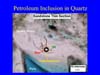 Figure 2. Petroleum inclusion in quartz grain.
 Figure 3. Petroleum inclusion in quartz,
ultraviolet light.
Figure 3. Petroleum inclusion in quartz,
ultraviolet light.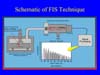 Figure 4. Schematic of FIS technique—sample
crushed in vacuum chamber with analysis by mass spectrometer to yield
mass spectrum.
Figure 4. Schematic of FIS technique—sample
crushed in vacuum chamber with analysis by mass spectrometer to yield
mass spectrum.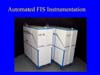 Figure
5. Automated FIS instrumentation.
Figure
5. Automated FIS instrumentation.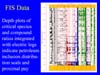 Figure 6. FIS data. Depth plots of critical
species and compound ratios integrated with electric logs indicate
petroleum inclusion distribution seals and proximal pay.
Figure 6. FIS data. Depth plots of critical
species and compound ratios integrated with electric logs indicate
petroleum inclusion distribution seals and proximal pay.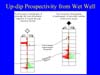 Figure 7. Updip prospectivity from wet well.
Fluid Inclusion Stratigraphy (FIS) of downdip dry hole documents
Figure 7. Updip prospectivity from wet well.
Fluid Inclusion Stratigraphy (FIS) of downdip dry hole documents
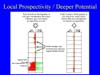 Figure 8. Local prospectivity / deeper
potential. Fluid Inclusion Stratigraphy (FIS) of rich gas condensate
discovery indicates gas and liquids prospectivity of area. FIS of dry
hole from same basin shows little encouragement for liquids
prospectivity.
Figure 8. Local prospectivity / deeper
potential. Fluid Inclusion Stratigraphy (FIS) of rich gas condensate
discovery indicates gas and liquids prospectivity of area. FIS of dry
hole from same basin shows little encouragement for liquids
prospectivity.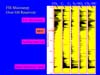 Figure 9. FIS microseep over oil reservoir.
FIS microseep in section where temperature is lower than 60oC
and above sealing interval, which overlies main reservoir sand.
Figure 9. FIS microseep over oil reservoir.
FIS microseep in section where temperature is lower than 60oC
and above sealing interval, which overlies main reservoir sand.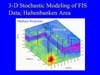 Figure 10. 3-D stochastic modeling of FIS
data; Haltenbanken area, offshore Norway. From FIS, anomalous
concentrations of methane, other light hydrocarbons, and sulfur
compounds in the shallow subsurface probably reflect anaerobic
alteration of vertically seeping gas-range compounds from depth by
sulfate-reducing bacteria.
Figure 10. 3-D stochastic modeling of FIS
data; Haltenbanken area, offshore Norway. From FIS, anomalous
concentrations of methane, other light hydrocarbons, and sulfur
compounds in the shallow subsurface probably reflect anaerobic
alteration of vertically seeping gas-range compounds from depth by
sulfate-reducing bacteria.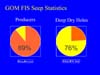 Figure 11. GOM FIS seep statistics show that
89% of producers show seepage and 76% of the deep dry holes have no
seepage.
Figure 11. GOM FIS seep statistics show that
89% of producers show seepage and 76% of the deep dry holes have no
seepage. Figure 12. Gas vs. liquids prospectivity, at
constant depth, in the Texas Gulf Coast and offshore.
Figure 12. Gas vs. liquids prospectivity, at
constant depth, in the Texas Gulf Coast and offshore.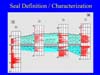
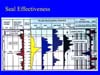
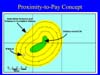 Figure 15. Proximity-to-pay concept,
illustrated by detectable benzene and toluene in formation waters.
Figure 15. Proximity-to-pay concept,
illustrated by detectable benzene and toluene in formation waters.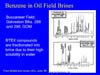 Figure 16. Benzene in oil field brines at
Buccaneer field, offshore southeast Texas, as proximity-to-pay indicator
(from Burtell and Jones; 1996)
Figure 16. Benzene in oil field brines at
Buccaneer field, offshore southeast Texas, as proximity-to-pay indicator
(from Burtell and Jones; 1996) 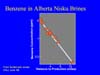 Figure 17. Benzene in Alberta Nisku brines
shows good correlation with proximity to production (from Burtell and
Jones; 1996).
Figure 17. Benzene in Alberta Nisku brines
shows good correlation with proximity to production (from Burtell and
Jones; 1996).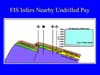 Figure 18. FIS infers nearby undrilled pay
from dry well drilled on crest (on top of Kimmeridge Clay), by detection
of anomalous levels of benzene in the lateral seal.
Figure 18. FIS infers nearby undrilled pay
from dry well drilled on crest (on top of Kimmeridge Clay), by detection
of anomalous levels of benzene in the lateral seal.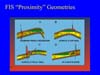 Figure 19. FIS “proximity” geometries. A.
Downdip from a reservoir. B. Across a top seal. C. Across a fault seal.
D. In a waste zone.
Figure 19. FIS “proximity” geometries. A.
Downdip from a reservoir. B. Across a top seal. C. Across a fault seal.
D. In a waste zone. Figure 20. Pay and product definition,
Devonian Leduc reef. FIS, along with log and core analyses, delineates
gas reservoir and top seal.
Figure 20. Pay and product definition,
Devonian Leduc reef. FIS, along with log and core analyses, delineates
gas reservoir and top seal.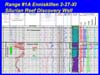 Figure 21. Pay and product definition,
Silurian Guelph reef. FIS, along with log and core analyses, delineates
oil and gas legs.
Figure 21. Pay and product definition,
Silurian Guelph reef. FIS, along with log and core analyses, delineates
oil and gas legs.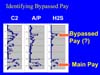 Figure 22. Identifying bypassed pay by similar
anomalies in C2, A/P
Figure 22. Identifying bypassed pay by similar
anomalies in C2, A/P 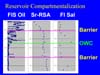 Figure
23. Reservoir compartmentalization by delineation of barriers, based on
FIS oil inclusion indicator, Sr-RSA (87Sr/86Sr
from residual salt analyses), and fluid inclusion salinities.
Figure
23. Reservoir compartmentalization by delineation of barriers, based on
FIS oil inclusion indicator, Sr-RSA (87Sr/86Sr
from residual salt analyses), and fluid inclusion salinities.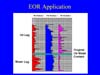 Figure 24. EOR application, as shown by the
delineation of the original oil-water contact by FIS attributes.
Figure 24. EOR application, as shown by the
delineation of the original oil-water contact by FIS attributes.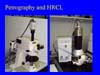 Figure
25. Petrography and HRCL
Figure
25. Petrography and HRCL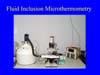 Figure 26. Apparatus for fluid inclusion
microthermometry.
Figure 26. Apparatus for fluid inclusion
microthermometry. Figure 27. Timing of biodegradation. (Left)
Relatively early carbonate vein contains interpreted original and
biodegraded oil. Degradation may have occurred during vein formation.
(Right) Later vein is barren, hence may postdate both petroleum
Figure 27. Timing of biodegradation. (Left)
Relatively early carbonate vein contains interpreted original and
biodegraded oil. Degradation may have occurred during vein formation.
(Right) Later vein is barren, hence may postdate both petroleum
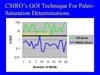 Figure 28. Example of CSIRO’s GOI
  Figure 29. Homogenization behavior of
petroleum inclusions shown diagrammatically to illustrate, respectively,
bubble and dew points, along with critical phenomena.
Figure 29. Homogenization behavior of
petroleum inclusions shown diagrammatically to illustrate, respectively,
bubble and dew points, along with critical phenomena.
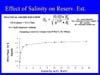 Figure 31. Effect of salinity on reserves
estimate
Figure 31. Effect of salinity on reserves
estimate 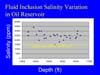 Figure 32. Fluid inclusion salinity variation
in oil reservoir.
Figure 32. Fluid inclusion salinity variation
in oil reservoir.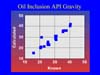 Figure 33. Oil inclusion, API gravity.
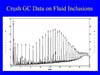 Figure 34. Crush GC
(gas chromatography) data on fluid inclusions.
Figure 34. Crush GC
(gas chromatography) data on fluid inclusions.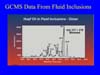 Figure 35. GCMS
(gas chromatography - mass spectrometry) data from fluid inclusions.
Figure 35. GCMS
(gas chromatography - mass spectrometry) data from fluid inclusions. Figure 36. GCMS data from biodegraded fluid
inclusions.
Figure 36. GCMS data from biodegraded fluid
inclusions.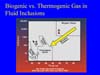 Figure 37. Biogenic vs. thermogenic gas in
fluid inclusions.
Figure 37. Biogenic vs. thermogenic gas in
fluid inclusions. Figure 38. Prevailing