
 Print this page
 Predicting
 Sandstone Reservoir System Quality and Example of Petrophysical Evaluation*
Dan J. Hartmann, Edward A. Beaumont, and Edward Coalson
Search and Discovery Article #40005 (2000)
*Adaptation
and revision for online presentation of part of Chapter 9, Predicting Reservoir
System Quality and Performance, by Dan J. Hartmann and Edward A. Beaumont, in
Exploring for Oil and Gas Traps, Edward A. Beaumont and Norman H. Foster, eds.,
Treatise of Petroleum Geology, Handbook of Petroleum Geology, 1999.
Predicting
Sandstone Porosity and Permeability
Sandstone Diagenetic Processes
Effect of Composition and Texture on Sandstone Diagenesis
Hydrology and Sandstone Diagenesis
Influence of Depositional Environment on Sandstone Diagenesis
Predicting Sandstone Reservoir Porosity
Predicting Sandstone Permeability from Texture
Estimating Sandstone Permeability from Cuttings
Example of Petrophysical Evaluation: Evaluation of Saturation Profiles
Setting and Structure of the Sorrento Field
Morrow Lithofacies and Pore Types
Sorrento Water Saturation Calculations
Petrophysical Analysis of Sorrento Field Wells
Water Saturation Profile for Sorrento Field
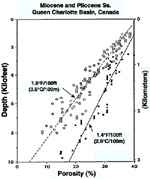 Figure 1.
Porosity-depth plot for sandstones from two wells with different
geothermal gradients. From Wilson, 1994a; courtesy SEPM.
Figure 1.
Porosity-depth plot for sandstones from two wells with different
geothermal gradients. From Wilson, 1994a; courtesy SEPM.
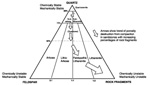 Figure 2. Effects
of sediment composition on mechanical stability and chemical stability. From
Loucks et al., 1984; courtesy AAPG.
Figure 2. Effects
of sediment composition on mechanical stability and chemical stability. From
Loucks et al., 1984; courtesy AAPG.
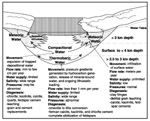 Figure 3. Water
movement processes—meteroic, compactional, and thermobaric. After Galloway,
1984, and Harrison and Tempel, 1993; courtesy AAPG.
Figure 3. Water
movement processes—meteroic, compactional, and thermobaric. After Galloway,
1984, and Harrison and Tempel, 1993; courtesy AAPG.
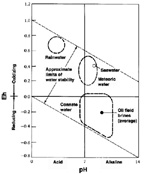 Figure 4. Eh-pH
diagram, showing the approximate distribution of various types of subsurface
fluids. From Shelley, 1985; courtesy W.H. Freeman and Co.
Figure 4. Eh-pH
diagram, showing the approximate distribution of various types of subsurface
fluids. From Shelley, 1985; courtesy W.H. Freeman and Co.
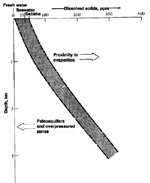 Figure 5.
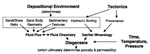 Figure 6.
Factors controlling sandstone diagenesis. From Stonecipher et al., 1984;
courtesy AAPG.
Figure 6.
Factors controlling sandstone diagenesis. From Stonecipher et al., 1984;
courtesy AAPG.
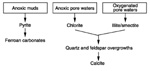 Figure 7. Typical
diagenetic pathways for marine sediments. After Stonecipher et al., 1984;
courtesy AAPG.
Figure 7. Typical
diagenetic pathways for marine sediments. After Stonecipher et al., 1984;
courtesy AAPG.
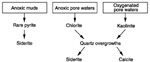 Figure 8.
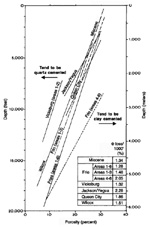 Figure 9.
Porosity-depth plot of various formations in U.S. Gulf Coast region. From
Loucks et al., 1984; courtesy AAPG.
Figure 9.
Porosity-depth plot of various formations in U.S. Gulf Coast region. From
Loucks et al., 1984; courtesy AAPG.
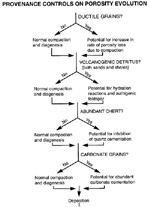 Figure 10.
Provenance controls on porosity evolution. From Surdam et al., 1989;
courtesy RMAG.
Figure 10.
Provenance controls on porosity evolution. From Surdam et al., 1989;
courtesy RMAG.
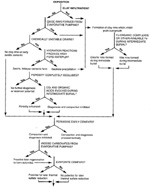 Figure 11.
Effects of near-surface diagenesis on sandstone porosity. From Surdam et al.,
1989; courtesy RMAG.
Figure 11.
Effects of near-surface diagenesis on sandstone porosity. From Surdam et al.,
1989; courtesy RMAG.
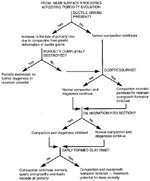 Figure 12.
Effects of mechanical diagenesis on sandstone porosity. From Surdam et
al., 1989; courtesy RMAG.
Figure 12.
Effects of mechanical diagenesis on sandstone porosity. From Surdam et
al., 1989; courtesy RMAG.
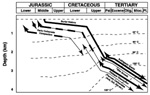 Figure 13.
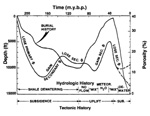 Figure 14.
Use of burial history in predicting sandstone porosity. From Hayes, 1983;
courtesy AAPG.
Figure 14.
Use of burial history in predicting sandstone porosity. From Hayes, 1983;
courtesy AAPG.
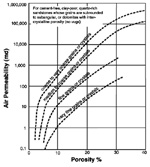 Figure 15.
Effect of grain size on permeability and porosity. From Coalson et al.,
1990.
Figure 15.
Effect of grain size on permeability and porosity. From Coalson et al.,
1990.
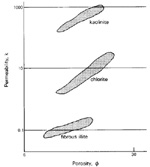 Figure 16.
Porosity-permeability relationships for kaolinite-, chlorite-, and
illite-emented sandstones. From North, 1985; courtesy Allen & Unwin.
Figure 16.
Porosity-permeability relationships for kaolinite-, chlorite-, and
illite-emented sandstones. From North, 1985; courtesy Allen & Unwin.
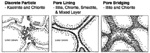 Figure 17.
Types of clay-mineral occurrences and pore geometry.After Neasham, 1977;
courtesy SPE.
Figure 17.
Types of clay-mineral occurrences and pore geometry.After Neasham, 1977;
courtesy SPE.
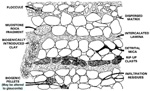 Figure 18.
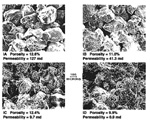 Figure
19. SEM photographs of pore types IA, IB, IC, ID in sandstones. From Sneider and
King, 1984; courtesy AAPG.
Figure
19. SEM photographs of pore types IA, IB, IC, ID in sandstones. From Sneider and
King, 1984; courtesy AAPG.
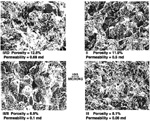 Figure
20.
Figure
20.
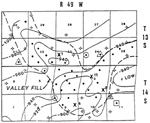 Figure
22. Structure map with outline of valley fill. Modified from Sonnenberg, 1985;
courtesy RMAG.
Figure
22. Structure map with outline of valley fill. Modified from Sonnenberg, 1985;
courtesy RMAG.
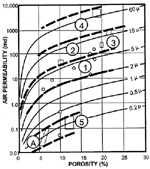 Figure
23. Ka/F cross plot for well
11 (Figure 22). From Hartmann and Coalson, 1990; courtesy RMAG.
Figure
23. Ka/F cross plot for well
11 (Figure 22). From Hartmann and Coalson, 1990; courtesy RMAG.
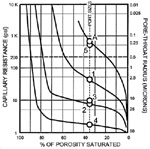 Figure
24. Family of capillary-pressure
curves. From Hartmann and Coalson, 1990; courtesy RMAG.
Figure
24. Family of capillary-pressure
curves. From Hartmann and Coalson, 1990; courtesy RMAG.
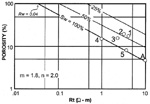 Figure
25.
Figure
25.
 Figure
26.
Figure
26.
 Figure
27.
Figure
27.
 Figure
28.
Figure
28.
 Figure
29. Petrophysical characteristics of well 8 (Figure 22). From Hartmann and
Coalson, 1990; courtesy RMAG.
Figure
29. Petrophysical characteristics of well 8 (Figure 22). From Hartmann and
Coalson, 1990; courtesy RMAG.
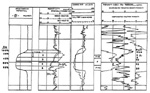 Figure
30. Petrophysical characteristics of well 1 (Figure 22). From Hartmann and
Coalson, 1990; courtesy RMAG.
Figure
30. Petrophysical characteristics of well 1 (Figure 22). From Hartmann and
Coalson, 1990; courtesy RMAG.
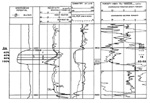 Figure
31. Sw-elevation plot for wells 4, 8, 11 (Figure 22). From Hartmann
and Coalson, 1990; courtesy RMAG.
Figure
31. Sw-elevation plot for wells 4, 8, 11 (Figure 22). From Hartmann
and Coalson, 1990; courtesy RMAG.
Table 2.
Major diagenetic processes and their impact on porosity. From Surdam et
al. (1989).
Table 3. Cements in sandtones, associated water chemistry, and derivation.
Table 4. Cements vs. facies/environments.
Table 5. Range in values of parameters Scherer (1987) used in his analysis of sandstone reservoirs.
Table 6. Characteristics of pore types I, II, and III.
The economic success of any prospect ultimately depends on reservoir system performance. The reservoir system controls two critical economic elements of a prospect: (1) the rate and (2) the amount of hydrocarbons recovered. In geologic terms, pore type and pore-fluid interaction are the most important elements determining reservoir system performance. Understanding how reservoir systems behave on a petrophysical basis helps us predict reservoir system behavior in wildcat situations.
The
interrelationship of reservoir porosity, permeability, thickness, and lateral
distribution determines reservoir system quality. Although quality prediction is
most effective with large amounts of superior data, useful predictions can still
be made from very limited data. This article discusses methods for predicting
the quality of sandstone reservoir systems.
Sandstones and carbonates are the dominant reservoir rocks. Although quite similar, they are different. Table 1 (after Choquette and Pray, 1970) compares variables affecting reservoir system quality for sandstones vs. carbonates.
Predicting
Sandstone Porosity and Permeability
General Statement
An effective
method of predicting sandstone reservoir system porosity and permeability is (1)
to predict sandstone porosity and permeability at deposition and then (2) to
predict the probable changes to porosity and permeability as the sandstone was
buried. Since other texts (Barwis et al., 1989; Galloway and Hobday, 1983) cover
the impact of depositional environment on porosity and permeability, this
subsection concentrates on predicting porosity and permeability by considering
the effects of diagenesis.
This section contains the following topics:
-
Sandstone Diagenetic Processes
-
Effect of Composition and Texture on Sandstone Diagenesis
-
Hydrology and Sandstone Diagenesis
-
Influence of Depositional Environment on Sandstone Diagenesis
Sandstone Diagenetic Processes
Diagenesis alters
the original pore type and geometry of a sandstone and therefore controls its
ultimate porosity and permeability. Early diagenetic patterns correlate with
environment of deposition and sediment composition. Later diagenetic patterns
cross facies boundaries and depend on regional fluid migration patterns (Stonecipher
and May, 1992). Effectively predicting sandstone quality depends on predicting
diagenetic history as a product of depositional environments, sediment
composition, and fluid migration patterns.
Diagenetic Processes
Sandstone diagenesis occurs by three processes:
-
Cementation
-
Dissolution (leaching)
-
Compaction
Cementation
destroys pore space; grain leaching creates it. Compaction decreases porosity
through grain rearrangement, plastic deformation, pressure solution, and
fracturing.
Diagenetic Zones
Surdam et al. (1989) define diagenetic zones by subsurface temperatures. Depending on geothermal gradient, depths to these zones can vary. Table 2 summarizes major diagenetic processes and their impact on pore geometry.
Effect of Temperature
Depending on
geothermal gradient, the effect of temperature on diagenesis can be significant.
Many diagenetic reaction rates double with each 10oC increase (1000
times greater with each 100oC) (Wilson, 1994a). Increasing
temperatures increase the solubility of many different minerals, so pore waters
become saturated with more ionic species. Either (1) porosity-depth plots of
sandstones of the target sandstone that are near the prospect area or (2)
computer models that incorporate geothermal gradient are probably best for
porosity predictions.
Figure 1 is a
porosity-depth plot for sandstones from two wells with different geothermal
gradients. The well with the greater geothermal gradient has correspondingly
lower porosities than the well with lower geothermal gradient. At a depth of
7000 ft, there is a 10% porosity difference in the trend lines.
Effect of Pressure
The main effect
of pressure is compaction. The process of porosity loss with depth of burial is
slowed by overpressures. Basing his findings mainly on North Sea sandstones,
Scherer (1987) notes sandstones retain approximately 2% porosity for every 1000
psi of overpressure during compaction. He cautions this figure must be used
carefully because the influence of pressure on porosity depends on the stage of
compaction at which the overpressure developed.
Effect of Age
In general,
sandstones lose porosity with age. In other words, porosity loss in sandstone is
a function of time. According to Scherer (1987), a Tertiary sandstone with a
Trask sorting coefficient of 1.5, a quartz content of 75%, and a burial depth of
3000 m probably has an average porosity of approximately 26%. A Paleozoic
sandstone with the same sorting, quartz content, and burial depth probably has
an average porosity of approximately 13%.
Effect of Composition and Texture on Sandstone Diagenesis
Composition and Diagenesis
Composition affects sandstone diagenesis in two ways:
-
The higher the quartz content, the greater the mechanical stability (less compaction occurs).
-
The higher the variety of minerals, the lower the chemical stability (more cementation or dissolution occurs).
Sandstones with
abundant lithics, feldspars, or chert have less occlusion of porosity by quartz
overgrowths and more secondary porosity through dissolution of less stable
grains. The ratio of quartz to ductile grains is key to compaction porosity
loss.
Sediment Composition and Provenance
Provenance determines sand grain mineralogy and sediment maturity. Mechanical and chemical weathering affects sand grains during transportation. The final product reflects the origin, amount of reworking, and transport distance.
For example, sandstones derived from subduction trench margins are generally mineralogically immature. They often contain terrigenous detritus with abundant volcaniclastics and pelagic material. Sandstones derived from the margin of a cratonic basin tend to be mineralogically and texturally mature and contain reworked sedimentary detritus.
Figure 2 summarizes the effects of sediment composition on mechanical stability and chemical stability.
Influence of Grain Size on Porosity and Diagenesis
Sorting and grain
size are textural parameters that intuitively might seem to have the same
effects on the porosity of a reservoir system sandstone. Studies show, however,
that porosity is largely independent of grain size for unconsolidated sand of
the same sorting (Beard and Weyl, 1973). Size does affect permeability; the
finer the sand, the lower the permeability. Permeability indirectly affects
porosity through diagenesis. Stonecipher et al. (1984) suggest that slow fluid
fluxes, resulting from low permeability, promote cementation; rapid fluxes
promote leaching. In rapid fluxes, solutes do not remain in pore spaces long
enough to build local concentration that promotes precipitation of cement. In
slow fluxes, they do. Also, size affects the surface area available for
diagenetic reactions: the finer the grain size, the greater the grain surface
area for a volume of sediment or rock.
Influence
of Sorting on Porosity
Sorting and
porosity strongly correlate in unconsolidated sandstones (Beard and Weyl, 1973).
The better the sorting, the higher the porosity. The initial porosities of wet,
unconsolidated sands show a range of 44-28% porosity for well-sorted vs. poorly
sorted grains. Well-sorted sands tend to have a higher percentage of quartz than
do poorly sorted sands, and they tend to maintain higher porosities during
burial than poorly sorted sands. Poorly sorted sands have more clay matrix and
nonquartz grains.
Hydrology and Sandstone Diagenesis
Type of Water Flushes
Much diagenesis occurs in open chemical systems whose initial chemistry is set at deposition. After that, the chemistry of the system changes as flowing water moves chemical components through pores and causes either leaching or cementation of grains. Diffusion also moves chemicals in and out of rocks, although at significantly lower rates. During deep burial, chemical systems close and diagenesis is primarily by pressure solution and quartz overgrowths (Wilson and Stanton, 1994).
Galloway (1984) lists three types of flow of water in a basin:
-
Meteoric flow--water infiltrates shallow portions of a basin from precipitation or surface waters. Deeper infiltration occurs from (a) eustatic sea level changes and/or (b) tectonic elevation of basin margins.
-
Compactional flow--compaction expels water upward and outward from the pores of sediments.
-
Thermobaric flow--water moves in response to pressure gradients caused by generation of hydrocarbons, release of mineral-bound water, and/or increased heat flow.
Figure 3 shows the water movement processes mentioned above.
Pore-Water Chemistry
Depositional environment and climate control initial pore-water chemistry of a sandstone. When the rock is buried below the level of meteoric groundwater influence, pore-water chemistry changes as a result of two things:
-
Increasing mineral solubility due to increasing temperatures.
-
Acidic fluids released by maturing organic-rich shales or organic matter in sandstone. Acidic pore water leaches
carbonate cement and grains.
Eh-pH Graph
Figure 4 is an Eh-pH diagram, showing the approximate distribution of various types of subsurface fluids.
Pore-water Chemistry and Cements
Table 3 lists common sandstone cements and the water chemistry associated with precipitation.
Subsurface Dissolved Solids
Figure 5 shows the general trend of increasing dissolved solids in subsurface fluids with increasing depth.
Influence of Depositional Environment on Sandstone Diagenesis
Depositional environment influences many aspects of sandstone diagenesis. The flow chart (Figure 6) shows the interrelationship of depositional environment with the many factors controlling sandstone diagenesis.
Sediment Texture and Composition
Depositional environment affects sediment composition by determining the amount of reworking and sorting by size or hydraulic equivalence. Sediments that have a higher degree of reworking are more mechanically and chemically stable. The energy level of depositional environments affects sorting by size or hydraulic equivalence and consequently produces different detrital mineral suites (Stonecipher and May, 1992).
For example, different facies of the Wilcox Group along the Gulf Coast of Texas have different compositions that are independent of their source area (Stonecipher and May, 1992). Wilcox basal fluvial point bar sands are the coarsest and contain the highest proportion of nondisaggregated lithic fragments. Prodelta sands, deposited in a more distal setting, contain fine quartz, micas, and detrital clays that are products of disaggregation. Reworked sands, such as shoreline or tidal sands, are more quartzose.
Depositional Pore-Water Chemistry
Depositional pore-water chemistry of a sandstone is a function of depositional environment. Marine sediments typically have alkaline pore water. Nonmarine sediments have pore water with a variety of chemistries. In nonmarine sediments deposited in conditions that were warm and wet, the pore water is initially either acidic or anoxic and has a high concentration of dissolved mineral species (Burley et al., 1985).
Marine Pore-Water Chemistry
Marine water is slightly alkaline. Little potential for chemical reaction exists between normal marine pore water and the common detrital minerals of sediments deposited in a marine environment. Therefore, diagenesis of marine sandstones results from a change in pore-water chemistry during burial or the reaction of less stable sediment with amorphous material (Burley et al., 1985).
Marine Diagenesis
The precipitation
of cements in quartzarenites and subarkoses deposited in a marine environment
tends to follow a predictable pattern beginning with clay authigenesis
associated with quartz and feldspar overgrowths, followed by carbonate
precipitation. Clay minerals form first because they precipitate more easily
than quartz and feldspar overgrowths, which require more ordered crystal growth.
Carbonate cement stops the further diagenesis of aluminosilicate minerals.
Figure 7 summarizes typical diagenetic pathways for marine sediments.
Nonmarine Pore-Water Chemistry and Cements
Nonmarine pore-water chemistry falls into two climatic categories: (1) warm and wet or (2) hot and dry. The chemistry of pore waters formed in warm and wet conditions is usually acidic or anoxic with large concentrations of dissolved mineral species. The interaction of organic material with pore water is a critical factor with these waters. The depositional pore water of sediments deposited in hot and dry conditions is typically slightly alkaline and dilute.
Figure 8 shows typical diagenetic pathways for warm and wet nonmarine sediments.
Cements
Table 4, compiled from data by Thomas (1983), shows the cements that generally characterize specific depositional environments.
Diagenesis and Depositional Pore Waters
In the Wilcox of the Texas Gulf Coast, certain minerals precipitate as a result of the influence of depositional pore-water chemistry (Stonecipher and May, 1990):
-
Mica-derived kaolinite characterizes fluvial/distributary-channel sands flushed by fresh water.
-
Abundant siderite characterizes splay sands and lake sediments deposited in fresh, anoxic water.
-
Chlorite rims characterize marine sands flushed by saline pore water.
-
Glauconite or pyrite characterizes marine sediments deposited in reducing or mildly reducing conditions.
-
Illite characterizes shoreline sands deposited in the mixing zone where brackish water forms.
-
Chamosite characterizes distributary-mouth-bar sands rapidly deposited in the freshwater-marine water mixing zone.
Predicting
Sandstone Reservoir Porosity
We might have the
impression that abundant data and powerful computer models are necessary for
porosity prediction. They help. But even with sparse data, by using a little
imagination we can predict ranges of porosity. This section presents different
methods of predicting sandstone porosity. Choose the method(s) most appropriate
to your situation.
A pitfall of
using porosity-depth plots for porosity prediction is that regression
relationship averages out anomalies and complicates predictions of unusually
porous sandstones. Use porosity-depth plots for porosity prediction with
caution. If enough porosity data are available to make a meaningful plot, keep
the "data cloud" on the plot in order to view the ranges of porosity at
different depths. In a frontier exploration setting, the usefulness of
porosity-depth plots may be limited if global data sets must be used.
Figure 9 presents
an example of regression porosity-depth plots for different formations in U.S.
Gulf Coast region. Unfortunately it does not include the raw data, so we cannot
see porosity variations within each formation. Formations on the left side of
the plot, like the Vicksburg, tend to be quartz cemented. Formations on the
right side, like the Frio (areas 4-6), tend to be clay cemented.
Equation
for Porosity Prediction
Scherer (1987)
studied the cores of 428 worldwide sandstones and listed the most important
variables for predicting sandstone porosity:
-
Percentage of quartz grains
-
Sorting
-
Depth of burial
-
Age
Using regression analysis, he developed the following equation:
Porosity = 18.60
+ (4.73 x in quartz) + (17.37/sorting) - (3.8 x depth x
10-3) - (4.65 x in age)
where:
Porosity
= percent of bulk volume
In quartz = percent of solid-rock volume
Sorting = Trask sorting coefficient
Depth = meters
In age = millions of years
The equation can
be used with a high degree of confidence in uncemented to partly cemented
sandstones. But if the reduction of porosity by cement exceeds 2.1% bulk volume,
then corrections need to be made based on local sandstone quality
characteristics. Numbers for percent solid volume quartz and sorting may be
difficult to obtain. Use 75% for percent solid volume quartz and 1.5 for sorting
when these values are not known.
Table 5 shows numbers that Scherer (1987) developed by his analysis of reservoir sandstones.
Predicting Effects of Diagenesis on Porosity
Sandstone
porosity prediction is a matter of estimating original composition and
subsequent diagenesis. Use the steps and action presented below to predict
sandstone porosity.
Step / Action
-
Estimate the original composition of the sandstone from provenance (use Figure 10) and depositional environment.
-
Estimate the effects of near-surface diagenetic processes (see Figure 11).
-
Estimate the effects of mechanical diagenetic processes (see Figure 12).
-
Estimate the effects of intermediate and deep burial diagenesis, especially with respect to the creation of secondary
porosity. -
Using information collected in steps 1 through 4, predict the final
porosity ranges using burial history (next procedure).
Predicting Effect of Provenance on Diagenesis
Use Figure 10 to predict the effect of original sediment composition on subsequent diagenesis.
Estimating Effect of Near-Surface Diagenesis
Use Figure 11 to estimate the effects of near-surface diagenesis (depth to point where temperature reaches 80oC).
Predicting Effect of Mechanical Diagenesis
Use Figure 12 to
predict the effects of mechanical diagenesis on sandstone porosity.
Using Burial History to Predict Porosity
Reconstructing
burial history aids sandstone porosity prediction. A burial history diagram
integrates tectonic and hydrologic history with diagenetic evolution to predict
sandstone porosity. The steps, with recommended action, given below for
predicting porosity from burial history and are illustrated in Figure
13.
Step / Action
-
Construct a burial history diagram for the formation of interest in the prospect area.
-
Plot the tectonic history of the basin in the prospect area along the lower x-axis.
-
Plot the hydrologic history of the prospect area along the lower x-axis. Use the tectonic history to infer the hydrologic history of the prospect.
-
Plot the
porosity curve by combining concepts of diagenetic processes
with
burial and hydrologic histories of the prospect.
Example of Using Burial History
Figure 13 is an example of a diagram showing diagenetic and burial history for the Brent Group sandstones, North Sea. Line thicknesses indicate relative abundance of diagenetic components.
Figure 14 is an
example of sandstone porosity prediction using burial history.
Analog
porosity values for different depositional environments can help us predict the
porosity of reservoir system rocks when the target formation is unsampled within
the basin. Analog values, however, may have wide ranges within facies and
subfacies of depositional environments. Therefore, we should use care when
applying analog data.
Predicting
Sandstone Permeability from Texture
Pore type, pore
geometry, and fluid properties are critical factors affecting permeability.
Sandstone texture directly affects pore type and geometry. Knowing what textures
and fluids to expect, as well as what authigenic clays might be present, can
help us predict permeability.
Effects of Pore Type and Geometry
Pore type,
defined by pore throat size (i.e., macroporosity), directly controls rock
permeability. Pore throat size limits flow capacity. Pore geometry also affects
permeability, but not as much. The rougher the surface of the pore, the more
difficult for fluid to flow through the pore and the lower the permeability.
Effects of Texture
Sandstone texture
affects permeability as follows:
Figure 15 shows
how grain size affects permeability and porosity.
Rules of Thumb for Gas vs. Oil
Use the following
rules of thumb for permeability for oil vs. gas reservoirs:
-
At >10 md, the reservoir can produce oil without stimulation.
-
At >1 md, the reservoir can produce gas without stimulation.
-
At 1-10 md, the reservoir probably requires stimulation for oil production.
Effect of Authigenic Clays
Pore-bridging
clays, like illite, decrease porosity slightly but can destroy sandstone
permeability. Discrete particle clay, like kaolinite, lowers porosity and
permeability only slightly. Figure 16 compares porosity-permeability
relationships for kaolinite-, chlorite-, and illite-cemented sandstones. Note
there is no significant change in porosities, but permeabilities range over four
orders of magnitude.
Pore Geometry and Clay Minerals
Figure 17 shows
pore lining and discrete particle clays that decrease porosity and permeability
only slightly in contrast to pore-bridging clays, which decrease porosity
slightly but substantially lower permeability.
Detrital Clay and Permeability
Detrital clays
can be part of sandstone matrix or grains. As matrix, detrital clays can
obliterate permeability. Detrital grains of clay are often ductile and can be
compacted into pore spaces during burial. The percentage of detrital clay in a
rock determines permeability. Figure 18 shows different types of detrital clays
in a sandstone.
Effect of Quartz Overgrowths
In general, as
quartz cement precipitates, the pore-pore throat size ratio approaches 1 (Hartmann
et al., 1985). Throats are reduced less than pore space; therefore, permeability
is affected less than porosity. During cementation, the size of the pore spaces
between the pore-filling crystals decreases until it approaches the size of the
pore throats. Throats become more tabular or sheet-like. Sandstone porosity may
be quite low (<5%) and still have some permeability (<10 md) where
cemented with quartz.
Effect of Fractures
Fractures enhance
the permeability of any sandstone reservoir. Fractures are especially important
for improving the permeability of sandstone reservoirs with abundant
microporosity or disconnected dissolution porosity.
Predicting from Texture and Clay Content
Predicting
sandstone reservoir permeability is possible as long as we realize that
potential errors may be large. Any process that decreases pore throat size
decreases permeability, so predict accordingly. Use steps, with recommended
action below, to help predict sandstone reservoir permeability.
Step / Action
-
Estimate grain size, sorting, and
porosity using the depositional
environment.
For example, if a reservoir is a beach sand, it should be fine- to
medium-grained and well sorted with well-rounded quartz grains. -
Apply information from Step 1 to the
porosity-permeability-grain size
plot (Figure
15). Use porosity and
grain size from sandstone to estimate the permeability on the chart. -
If the sandstone is poorly sorted or is cemented, then discount
permeability downward. -
Determine if authigenic clay is present. If so, what kind: pore lining, discrete particle, or pore throat bridging? Adjust
permeability downward according to clay type present. -
Determine if detrital clay is present using depositional environment (i.e., high energy = low clay content). If detrital clay is likely, then expect
permeability to be low.
Estimating
Sandstone Permeability from Cuttings
Sneider and King
(1984) developed a cuttings-based method of permeability estimation. Where
cuttings are available, permeability estimates can be made by examining the
surfaces of cuttings for petrophysical permeability indicators. Estimates of the
permeability for a particular formation can be extended into areas without data
in order to predict permeability.
Basis
Sneider and
others at Shell Oil Company developed a methodology for estimating permeability
from cuttings by calibrating permeability measured from cores with rock-pore
parameters described in cuttings. Cores of known permeability were ground up
until chips from the core were the size of cuttings. By using comparators made
from core chips, they estimated formation permeability from cuttings with
surprising accuracy. Although Sneider and King (1984) describe the method for
estimating sandstone permeability from cuttings (presented below), procedures
could just as easily be developed to predict permeability of carbonates from
cuttings.
Petrophysical Description
From examination
of cuttings, sandstone permeability can be predicted using the following
petrophysical descriptions:
-
Grain size and sorting
-
Degree of rock consolidation
-
Volume percent of clays
-
Pore sizes and pore interconnections
-
Size and distribution of pore throats
Sneider’s Pore Classification for Clastics
Sneider and King (1984) developed a simple method of classifying pore types from cuttings. The classification of clastic rock pore types from cuttings is made by comparing pore types with production tests and log analysis. The pore types are as follows:
Type / Description
-
Rocks with pores capable of producing gas without natural or artificial fracturing.
-
Rocks with pores capable of producing gas with natural or artificial fracturing and/or interbedded with type I rocks.
-
Rocks too tight to produce at commercial rates even with natural or artificial fracturing.
Table 6 lists the characteristics of pore types I, II, and III.
Examples of Pore Type I
The SEM photographs in Figure 19 are examples of rocks with types IA, IB, IC, and ID. Note the amount and connectivity of pore space of each subclass.
Pore Types II and III
The SEM photographs in Figure 20 are examples of rocks with types II and III. Note the amount and connectivity of pore space of each subclass.
Procedure: Predicting
Sandstone Permeability
The procedure
below, with steps and recommended action, is for predicting the permeability of
sandstones from cuttings using 20x magnification (from Sneider and King, 1984).
Step / Action
-
Estimate grain size and sorting using standard size-sorting comparators, thin section and SEM photomicrographs, and rock photographs.
-
Estimate volume percentages using Terry-Chillingar charts made for volume estimates.
-
Estimate consolidation using the scheme described in the preceding table.
-
Describe the visible and pinpoint
porosity and interconnectedness. -
Estimate
permeability from rocks on comparators and/or using rock
characteristics described in
the preceding table. (Comparators can be made or purchased.) -
Predict
permeability for the formation in prospective areas
where petrophysical
characteristics are believed to be similar
Example of Petrophysical Evaluation: Evaluation of Saturation Profiles
General Statement
This section shows how saturation profiles can be used to understand the distribution of water saturations within a field or prospect.
The case study presented here is a summary of a larger study of the Sorrento field, southeast Colorado, by Hartmann and Coalson (1990). This study of cores and logs from four field wells shows how multiple oil-water contacts and apparent anomalies in saturation profiles in the Sorrento field were due to multiple flow units from two separate reservoirs. The study helps us understand shows and water saturations in wells outside Sorrento and therefore is useful for finding other traps in the same formation.
This section contains the following topics:
-
Setting and Structure of the Sorrento Field
-
Morrow Lithofacies and Pore Types
-
Sorrento Water Saturation Calculations
-
Petrophysical Analysis of Sorrento Field Wells
-
Water Saturation Profile for Sorrento Field
Setting and Structure of the Sorrento Field
Index Map
The Sorrento field is in southeastern Colorado on the north flank of the Las Animas Arch. The map (Figure 21) shows the location of the Sorrento field. Structure is contoured on the base of the Pennsylvanian.
Morrow Structure Map
The Sorrento field reservoir is Pennsylvanian Morrow valley-fill sandstones. As shown in Figure 22, structure contours on a marker bed above the Morrow Sandstone reflect the irregular thickness of the sandstone body and a small structural nose and closure. The oil column is 70 ft (20 m) and exceeds structural closure. This is a combination structural-stratigraphic trap. Fluvial sandstones lap onto marine shale at the margins of the valley, forming lateral seals.
In Figure 22, circled wells represent Marmaton wells; triangles, Mississippian wells; and large X’s, study wells. The rest of the oil wells produce from the Morrow. Each unit in the grid is 1 sq mi.
Morrow Lithofacies and Pore Types
By studying core and log data from one well (well 11, see Figure 22), we see a picture of a clastic reservoir with wide heterogeneity in total porosities, pore-throat sizes, and capillary pressures. In addition, the depositional environment of these sandstones (fluvial valley fill and sandstone) indicates they probably have limited lateral continuity within the valley-fill complex.
Reservoir Lithologic Description
Morrow
sandstones in the Sorrento field are slightly shaly, range in grain size from
very coarse to fine, and are poorly sorted. As a consequence, pores and pore
throats also have wide ranges in size. Hand-sample petrography indicates the
dominant porosity is intergranular micro- to megaporosity. Clay crystals create
minor intercrystalline microporosity in larger pores. Moldic (cement solution?)
porosity also may be present but is minor.
Reservoir
Porosity and Permeability
Morrow
sandstones in Sorrento field have a wide range in porosity and permeability.
Maximum observed porosity (F) is 20-22%,
but more typical values are 10-15%. Air permeabilities (Ka) are as
great as 1-2 darcies but more commonly are 200-500 md.
In a Ka/F crossplot for well 11 (Figure 23), dots and polygons represent measured Ka/F values. Curves are the graphical solution of Winland’s r35 equation (Pittman, 1992) and represent equal r35 values (port size).
The crossplot shows a large variation in port size for the samples from well 11. Areas between dashed lines group points into beds with similar port size, or flow units.
Extrapolated Capillary Pressure Curves and Pore Types
No capillary pressure measurements were available for this study. They were estimated y plotting r35 values on a semilog crossplot of fluid saturation vs. capillary pressure. A capillary pressure curve for each sample passes through its correlative r35 value. Calculations of r35 for well 11 indicate a large variety of capillary pressures and pore types. Pore types for the Morrow samples from this well are mega, macro, and micro.
The numbers on the curves in Figure 24 correspond to the numbers on the Ka/F crossplot on Figure 22. Minimum water saturations (“immobile” water) estimated from log calculations let us extrapolate the Pc curves into low Sw ranges.
Sorrento Water Saturation Calculations
Method
Density
logs were the primary source of porosity values. Matrix density appears to be
about 2.68 g/cc, based on core-measured grain densities (consistent with the
presumed mineralogy of the sandstones). Crossplot porosities were not used to
avoid introducing a systematic error in these variably shaly sandstones (Patchett
and Coalson, 1982).
Pickett Plot
Formation-water resistivities and water saturations were estimated from Pickett plots. The inferred cementation exponent (m) is 1.8 because of the presence of clays, well-connected solution pores (e.g., James, 1989; Muller and Coalson, 1989), or pyrite (Krystinik, L., personal communication). Formation factors measured on core samples from well 1 support this interpretation.
The Pickett in Figure 25 shows data from well 11. The number labels represent the flow units from Figure 24.
Saturation Exponents, n
Saturation
exponents (n) measured on samples from well 1 showed variations that relate to
pore geometry. Microporous siltstones displayed n greater than 2, indicating
either very tortuous pore systems or incomplete saturation by brine during
testing. Saturation exponents were less than 2 in the best porosity type. This
implies the reservoir is somewhat shaly. However, n was assumed equal to 2 for
log calculations because the lab data were not far from that value and because
lab measurements of saturation exponents are notoriously difficult.
Petrophysical Analysis of Sorrento Field Wells
Well 11 Flow Units
Flow
units were determined in well 11 by plotting and grouping routine core data. The
top and bottom of the Morrow (flow units A and 5) are microporous,
low-permeability sandstones that are wet but too tight to produce. Between these
are 30 ft (8.5 m) of meso- to macroporous sandstone (flow units 1-4).
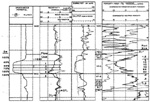
All
pertinent petrophysical data for well 11 are summarized on Figure
26. Sandstone
descriptors found on porosity logs are as follows:
VF = very fine grained |
C = coarse grained |
SLTY = silty |
F = fine grained |
VC = very coarse grained |
SLT = siltstone |
M = medium grained |
SHY= shaly |
SH = shale |
Subsea elevation of -1,030 ft (-314 m) is marked in the depth track.
Well 11 Water Saturations
Flow unit 4 is macroporous but wet (Sw = 100%); this indicates an oil-water contact. Flow unit 3 is macroporous and has intermediate water saturation (Sw = 70%). This looks like a transition zone. Flow units 2 and 1 are mesoporous and are at immobile water saturation (Sw = 45%). This is verified by the well testing about 100 bo/d and 300 Mcfg/d (16 m3 oil and 8,500 m3 gas per day) with no water from perforations in these flow units and by a bulk-volume-water plot following. This lack of water production is remarkable, considering that the well lies only about 25 ft (7 m) above the free water level.
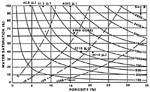
Figure 27 is the bulk-volume-water (Buckles) plot for well 11.
Well 4
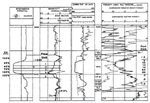
Well 4 hit the Morrow near the top of the oil column. It had the lowest saturations and best flow rates of all the wells studied, even though it had the thinnest reservoir. This is because it contained rock with large pore throats (r35 up to 50m) that was fully saturated with oil (Sw = 25-30%). The well tested 230 bo/d and 387 Mcfg/d (37 m3 oil and 11,000 m3 gas per day). Initial production was 51 bo/d and 411 Mcfg/d (8 m3 oil and 12,000 m3 gas per day). The difference could be due to a loss of reservoir thickness near the well bore, judging from the thinness of the reservoir.
Figure 28 summarizes the petrophysical characteristics of well 4.
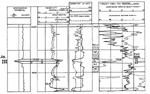
Well 8
Wells
8 and 1 both are interpreted as encountering transition zones, based on porosity
types and log-calculated saturations. Well 8 encountered the Morrow just above
the water level. Pore throats are meso- to macroporous. The two upper flow units
probably are close to immobile water saturation. However, the two basal zones (3
and 4) have high saturations of mobile water. This explains why the well cut
water on initial potential testing. This water production should increase with
time as the water leg rises.
Figure 29 summarizes the petrophysical characteristics of well 8.
Well 1
Well 1 (Figure 30) is similar to well 8, except that flow unit 2 of well 1 shows an anomalous low resistivity. The interval tested 32 bo/d and 15 Mcfg/d (5 m3 oil and 425 m3 gas per day) with no water. Therefore, the zone by definition is at immobile water saturation (Swi = 40%). The discrepancy suggests that the log resistivity was too low due to bed resolution problems. If true resistivity is 9 ohm-m2/m (used for the calculation), then the true water saturation is less than 40%.
Caveat
While
these petrophysical methods of analyzing wells are reliable and widely
applicable in water-wet reservoirs, there is at least one source of potential
error: the assumption that there are no lithologic changes that affect
log-calculation parameters without affecting permeability-porosity
relationships. Examples include vuggy or fracture porosity and variable shale
effects. If such changes occur, then we must modify the relationships between
calculated saturations and producibility.
Water Saturation Profile for Sorrento Field
General Statement
Morrow sandstone reservoirs reportedly display multiple oil-water contacts in several fields in the area (Sonnenberg, personal communication). Reliably recognizing separate reservoirs in a field requires considering capillary pressures, heights above free water, and observed water saturations. One convenient way to do this is to plot water saturation against structural elevation while differentiating pore throat sizes.
Sw-Elevation Plot
An Sw-elevation plot (Figure 31) for study wells 4, 8, and 11 defines a trend of decreasing water saturation with increasing height. Well 1 is not on the same trend. Differences in water saturation attributable to differences in capillary pressures are apparent but are not great enough to explain the discrepancy. Ignoring possible hydrodynamic effects, the difference in trends probably represents two separate oil columns and therefore two reservoirs.
Barwis, J.H., J.G. McPherson, and J.R.J. Studlick, 1989, Sandstone Petroleum Reservoirs: New York, Springer-Verlag, 583 p. Contains case histories of fields with reservoirs that represent each of the major depositional environments.
Beard,
D.C., and P.K. Weyl, 1973, Influence of texture on porosity and permeability of
unconsolidated sand: AAPG Bulletin, vol. 57, no. 2, p. 349-369.
Burley, S.D., J.D. Kantorowicz, and B. Waugh, 1985, Clastic diagenesis, in P.J. Brenchley and B.P.J. Williams, eds., Sedimentology: Recent Developments and Applied Aspects: London, Blackwell Scientific Publications, p. 189-228.
Choquette,
P.W., and L.C. Pray, 1970, Geologic nomenclature and classification of porosity
in sedimentary carbonates: AAPG Bulletin, vol. 54, no. 2, p. 207-250. Classic
reference for basic concepts regarding carbonate porosity.
Coalson, E.B., D.J. Hartmann, and J.B. Thomas, 1990, Applied Petrophysics in Exploration and Exploitation: Notes from short course sponsored by Univ. of Colo.-Denver, var. pages.
Galloway, W.E., 1984, Hydrogeologic regimes of sandstone diagenesis, in D.A. McDonald and R.C. Surdam, eds., Clastic Diagenesis: AAPG Memoir 37, p. 3-14.
Galloway, W.E., and D.K. Hobday, 1983, Terrigenous Clastic Depositional Systems: Applications to Petroleum, Coal, and Uranium Exploration: New York, Springer-Verlag, 438 p. Summarizes reservoir characteristics of major sandstone depositional environments, especially with respect to sand body geometries.
Harrison, W.J., and R.N. Tempel, 1993, Diagenetic pathways in sedimentary basins, in A.D. Horbury and A.G. Robinson, eds., Diagenesis and Basin
Hartmann, D.J., and E.B. Coalson, 1990, Evaluation of the Morrow sandstone in Sorrento field, Cheyenne County, Colorado, in S.A. Sonnenberg, L.T. Shannon, K. Rader, W.F. von Drehle, and G.W. Martin, eds., Morrow Sandstones of Southeast Colorado and Adjacent Areas: RMAG Symposium, p. 91-100.
Hayes, J.B., 1983, Sandstone diagenesis as an exploration tool: AAPG Clastic Diagenesis School, June 27-July 1, Monterey, California.
James, S.W., 1989, Diagenetic history and reservoir characteristics of a deep Minnelusa reservoir, Hawk Point field, Powder River basin, Wyoming, in E.B. Coalson, S.S. Kaplan, C.W. Keighin, C.A. Oglesby, and J.W. Robinson, eds., Petrogenesis and Petrophysics of Selected Sandstone Reservoirs of the Rocky Mountain Region: RMAG Symposium, p. 81-96.
_____, M.M. Dodge, and W.E. Galloway, 1984, Regional controls on diagenesis and reservoir quality in Lower Tertiary sandstones along the Texas Gulf Coast, in
Muller, M.M., and E.B. Coalson, 1989, Diagenetic and petrophysical variations of the Dakota sandstone, Henry field, Green River basin, Wyoming, in E.B. Coalson, S.S. Kaplan, C.W. Keighin, C.A. Oglesby, and J.W. Robinson, eds., Petrogenesis and Petrophysics of Selected Sandstone Reservoirs of the Rocky Mountain Region: RMAG Symposium, p. 149-158.
Neasham, J.W., 1977, The morphology of dispersed clay in sandstone reservoirs and its effect on sandstone shaliness, pore space, and fluid flow properties: Proceedings of the SPE Annual Meeting, October 9-12, paper SPE-6858.
North, F.K., 1985, Petroleum Geology: London, Allen & Unwin, 607 p.
Patchett,
J.G., and E.B. Coalson, 1982, The determination of porosity in sandstone and
shaly sandstone, part 2: effects of complex mineralogy and hydrocarbons: 23rd
Annual SPWLA Logging Symposium, July 6-9, paper T, 50 p.
Pittman,
E.D., 1992, Relationship of porosity to permeability to various parameters
derived from mercury injection-capillary pressure curves for sandstone: AAPG
Bulletin, vol. 76, no. 2, p. 191-198.
Scherer,
M., 1987, Parameters influencing porosity in sandstones: a model for sandstone
porosity prediction: AAPG Bulletin, vol. 71, no. 5, p. 485-491.
Shelley, R.C., 1985, Elements of Petroleum Geology: San Francisco, W.H. Freeman, 449 p.
Sneider, R.M., and H.R. King, 1984, Integrated rock-log calibration in the Elmworth field, Alberta, Canada: part I: reservoir rock detection and characterization, in J.A. Masters, ed., Elmworth--Case Study of a Deep Basin Gas Field: AAPG Memoir 38, p. 205-214.
Sonnenberg, S.A., 1985, Tectonic and sedimentation model for Morrow sandstone deposition, Sorrento field area, Denver basin, Colorado: The Mountain Geologist, October, p. 180-191.
Stonecipher, S.A., and J.A. May, 1990, Facies controls on early diagenesis: Wilcox Group, Texas Gulf Coast, in D. Meshri and P.J. Ortoleva, eds., Prediction of Reservoir Quality Through Chemical Modeling, I: AAPG Memoir 49, p. 25-44.
Stonecipher, S.A., R.D. Winn, Jr., and M.G. Bishop, 1984, Diagenesis of the Frontier Formation, Moxa Arch: a function of sandstone geometry, texture and composition, and fluid flux, in D.A. McDonald and R.C. Surdam, eds., Clastic Diagenesis: AAPG Memoir 37, p. 289-316.
Surdam,
R.C., T.L. Dunn, D.B. MacGowan, and H.P. Heasler, 1989, Conceptual models for
the prediction of porosity evolution with an example from the Frontier
Sandstone, Big-horn basin, Wyoming, in E.B. Coalson, S.S. Kaplan, C.W. Keighin,
L.A. Oglesby, and J.W. Robinson, eds., Sandstone Reservoirs: Rocky Mountain
Association of Geologists, p. 7-21.
Thomas, L.K., P.L. Katz, and M.R. Tek, 1968, Threshold pressure phenomena in porous media: SPE Journal, June, p. 174-184.
Wilson,
M.D., 1994a, Non-compositional controls on diagenetic processes, in M.D. Wilson,
ed., Reservoir Quality Assessment and Prediction in Clastic Rocks: SEPM Short
Course 30, p. 183-208. Discusses the effect that variables such as temperature
and pressure have on diagenesis of sandstones. A good reference for predicting sandstone reservoir system quality.
_____, 1994b, Assessing the relative importance of diagenetic processes and controls, in M.D. Wilson, ed., Reservoir Quality Assessment and Prediction in Clastic Rocks: SEPM Short Course 30, p. 259-276.
_____ and E.D. Pittman, 1977, Authigenic clays in sandstones: recognition and influence on reservoir properties and paleoenvironmental analysis: Journal of Sedimentary Petrology, vol. 47, no. 1, p. 3-31.