
 Print this page
 Click
to view page images in PDF format.
Click
to view page images in PDF format.
 Quartz
 Cementation in Sandstones: Reappraising the Controls
Richard. H. Worden
Department of Earth Sciences, University of Liverpool, Liverpool, L69 3GP, UK
[email protected]
Quartz cementation, seemingly a mineralogically and texturally uncomplicated
process, has led to interesting disputes in recent years. The old allochemical
models, linked to large-scale fluid flow, were superseded by simpler isochemical
models. These latter models have been pushed to the point of predictive
capability, at least partly because they may be linked to basin modelling. All
models require assumptions and simplifications. Problems and disputes have
arisen with the isochemical models since some of the assumptions and
simplifications, essential to facilitate quartz cement prediction, have been
treated as being fundamentally true. Some of the assumptions that have been
employed are listed in Table 1 with an assessment of their veracity.
The move away from descriptive allochemical models to quantitative isochemical models is to be applauded but only if the assumptions involved in quantification are constantly reappraised. The drive to quantification has led to many older precepts being either ignored or actively challenged. Some of the assumptions seem to have become articles of faith that are followed regardless of substantial bodies of evidence. Scientific hegemony of a model or approach is only welcome if all assumptions and their corollaries can withstand constant examination.
Thus it is held that since quartz grains in oilfields are assumed to be water
wet, and since it is assumed that quartz cementation is rate limited by
precipitation, then quartz cementation must not be inhibited in oilfields.
Well-documented case studies prove that this is corollary is incorrect.
The initial fabrication of quartz cementation growth rates involved an
assumption that quartz growth was continuous from the time-equivalent of the
lowest fluid inclusion temperature through to the present day, irrespective of
gaps in the temperature record. The assumption may be reasonable but it is now
commonly held that quartz growth must be continuous since the models tend to
produce the right answer. The possibility of episodic but transiently faster
quartz growth is now ignored even though it would lead to quite different
kinetic output.
Chemical compaction was formerly known as pressure dissolution but the role of effective stress in intergranular dissolution has been questioned recently and temperature alone (±mica crystals at grain boundaries) has been assumed to drive chemical compaction. An interesting hypothetical spin-off of the temperature-driven chemical compaction model is that basin subsidence may be the result of heating and not increasing effective stress. However, it now seems as if effective stress is a prerequisite for intergranular dissolution since there is no real alternative chemical driving force. Basin subsidence due to heating remains a bizarre corollary of models that ignore effective stress.
There remain many possible sources of quartz cement in sedimentary basins (Figure
1). While it is possible that internal sources dominate the budget,
there are still the supply and transport steps to consider as well
precipitation. While silica may be locally sourced, influx of fluids may drive
silica-release reactions. Addition of oil will influence the rates of processes
but local wettability will always be an important control on the rate of quartz
cement growth. Quartz growth maybe continuous or episodic – the case is not
yet proven.
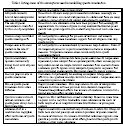 Table 1 Listing Some of the Assumptions Used in Modeling
Quartz Cementation
Table 1 Listing Some of the Assumptions Used in Modeling
Quartz Cementation
 Figure 1: Detailing the key steps, the main options influencing the steps and
some intrinsic controls that influence the process of quartz
Figure 1: Detailing the key steps, the main options influencing the steps and
some intrinsic controls that influence the process of quartz cementation. The
bold items represent commonly assumed controls.
cementation. The
bold items represent commonly assumed controls.
Copyright © 2004. The American Association of Petroleum Geologists. All Rights Reserved.