
 Print this page
 Click to view abstract in PDF format.
Evidence for Multiple-Phase
Mass Transport During  Hydrocarbon
 Vertical Migration
By
Gary K. Rice and John Q. Belt
GeoFrontiers Corporation, Dallas, Texas, USA
Understanding mass
transport mechanics, or how each hydrocarbon group migrates from the reservoir
formation to the surface, is essential for integrating near-surface hydrocarbon
data with seismic survey data, subsurface geological information, and
geomorphological data.
Migration Mechanisms:
Work on vertical migration mechanisms
during the past decade has increased our understanding of how hydrocarbons may
be transported from petroleum reservoirs to the surface. While current vertical
migration models deal with low-molecular-weight hydrocarbons migrating as gases
(Arp, 1992) (Klusman and Saeed, 1996), medium to heavy weight petroleum
hydrocarbons also are present at the surface (Hebert, 1988) (Brooks, et al.,
1986) (Brooks and Kennicutt, 1988). Some heavier hydrocarbons are not
sufficiently volatile for significant quantities to be transported as a gas
phase. A phase refers to a pure material or a
single homogeneous mixture of materials. For example, miscible gases form a
single phase and miscible liquids form a single phase. Two immiscible liquids;
e.g., hexane and water, form two phases. In
addition, comparing
Figures 1 and
2 shows one offshore example where light hydrocarbon surface expressions
were quite different from heavy hydrocarbon surface expressions (Belt and Rice,
1996a, 1996b). Different surface patterns suggest light and heavy hydrocarbons
possibly migrate to the surface through different pathways. One explanation for
migration through different pathways is different migration phases.
The “other phase”
occurring in vertical migration may be liquid. Certainly, liquid hydrocarbon
seeps have been documented offshore (Kennicutt, et al., 1988) and less
frequently, on land. Possibly, less-than-visible quantities of heavy
hydrocarbons migrate to the surface by similar vertical migration mechanisms.
This paper addresses preliminary results of on-going research investigating
causes for different surface expressions of light and heavy petroleum
hydrocarbons.
Gas-Phase Migration:
Gas-phase migration is the vertical
migration of low-molecular-weight hydrocarbons referred to as paraffins.
Paraffins are composed of both straight-chained hydrocarbons, or normal
paraffins, and branch-chain hydrocarbons, or isoparaffins. Paraffins are the
second most common component found in petroleum, after cycloparaffins (Hunt,
1979a). Low-molecular-weight paraffins can vertically migrate through both
microfractures and macrofractures. Therefore, seismic survey data and subsurface
isopach maps indicate the trend and spatial extent of petroleum bearing
formations that can be integrated with mapped low-molecular-weight hydrocarbon
concentrations greater than background.
Evidence for
Liquid-Phase Vertical Migration:
Hydrocarbons, possibly vertically migrating as a liquid phase, include medium-
and heavy-molecular-weight hydrocarbons such as aromatics, polynuclear
aromatics, and cycloparaffins. Cycloparaffins, which are the most abundant
hydrocarbons in petroleum, are present only as cyclopentanes, cyclohexanes, and
cycloheptanes (Hunt, 1979b). Current data indicate medium- and
heavy-molecular-weight hydrocarbons require larger conduits, or macrofractures,
in the form of faults or joints. This requirement for larger fractures is
consistent with a different, possibly liquid, phase migration. Anomalous mapped
concentrations indicate the near-surface location of seeping fractures.
Therefore, seismic survey data, subsurface geological structure maps, and
geomorphological data from drainage patterns should be thoroughly evaluated to
help confirm and locate these structural migration pathways in the subsurface.
Modeled Examples: Both offshore and land examples illustrate the integration of gas phase migration and possibly liquid phase migration with seismic survey data, subsurface structure and isopach data, and geomorphological information. Land examples are more complex than offshore due to vertical migration through a water table plus migration above the water table. Selected examples characterize integration and multi-phase vertical migration at both the reconnaissance and detailed phases of a prospect.
Figure Captions
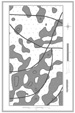 Figure
1. Offshore light weight hydrocarbon Distribution.
Figure
1. Offshore light weight hydrocarbon Distribution.
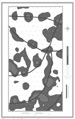 Figure
2. Offshore medium weight hydrocarbon distribution.
Figure
2. Offshore medium weight hydrocarbon distribution.
References
Arp,
G. K., 1992, Effusive Microseepage: A First Approximation Model for Light
Hydrocarbon Movement in the Subsurface, Association of Petroleum Geochemical
Explorationists, Bulletin 8, p. 1-17.
Belt,
J. Q., Jr., and G.K. Rice, 1996a, Offshore 3D Seismic, Geochemical Data
Integration, Main Pass Project, Gulf of Mexico, Oil & Gas Journal., April 1,
1996, p. 76-81.
Belt, J. Q., Jr., and G.K. Rice, 1996b, Advantages Seen in Integrated Offshore 3D Seismic, Geochem Data, Oil & Gas Journal, April 8,1996, p. 100-102.
Brooks, J.M., M.C. Kennicutt II, and B.D. Carey, Jr., 1986, Oil & Gas Journal., October 20, pp 66-72.
Brooks, J.M. and M.C. Kennicutt II, 1988, Oil & Gas Journal., September 12, p. 101-106
Hebert, C.F., 1988, Ballina Plantation Prospect, Louisiana, A Case Study in Fluorescence Geochemical Exploration, Association of Petroleum Geochemical Explorationists Bulletin, v. 4, p. 102-119
Hunt, J.M., 1979a, Petroleum Geochemistry and Geology, W.H. Freeman and Company, San Francisco, p. 31 Hunt, J.M., 1979b, ibid, p. 35
Kennicutt
II, M.C., J.M. Brooks, and G.J. Denoux, 1988, Leakage of Deep, Reservoired
Petroleum to the Near Surface on the Gulf of Mexico Continental Slope, Marine
Chemistry, v. 24, p. 39-59.
