
 Print this page
A PRELIMINARY INVESTIGATION ON THE ECONOMICS OF ONSHORE  GAS
GAS HYDRATE PRODUCTION BASED ON THE MALLIK FIELD DISCOVERY
S. Hancock1, T. Collett2, M.
Pooladi-Darvish3, S. Gerami3, G. Moridis4, T.
Okazawa5, K. Osadetz6,
S. Dallimore7, and B. Weatherill1
1 APA Petroleum Engineering Inc., 1400, 800 Fifth Ave. SW, Calgary, Alberta, Canada, T2P 3T6
2 U.S. Geological Survey, Box 25046, MS-939, Denver, Colorado 80225, U.S.A.
3 University of Calgary, 2500 University Dr., Calgary, Alberta, Canada, T2L 2K8
4 Lawrence Berkeley National Laboratory, University of California, Berkeley, California 94720, U.S.A.
5 Imperial Oil Resources, 3535 Research Rd. NW, Calgary, Alberta, Canada, T2L 2K8
6 Geological Survey of Canada, 3303 - 33 St. NW, Calgary, Alberta, Canada, T2L 2A7
7 Geological Survey of Canada, P.O. Box 6000, Sidney, British Columbia, Canada, V8L 4B2
Natural gas hydrate accumulations have been mapped worldwide, predominantly offshore in deepwater coastal margins areas, but also onshore in arctic permafrost areas. Gas hydrates have been the subject of extensive investigation for many years, primarily in environmental and geo-technical areas. For exploration companies, gas hydrates have generally been considered to be a nuisance, causing difficulties in drilling shallow hole sections in frontier exploration wells. However, many countries are now considering gas hydrates as a potentially significant natural gas resource to meet future energy requirements.
 Figure
Natural gas is seen as a major component of the North American future energy requirement. With increasing natural gas demand and prices, smaller conventional gas pools, as well as tight gas (extreme low permeability reservoirs) and coalbed methane projects will become more attractive. In addition, higher stabilized prices will support the development of northern gas reserves through major pipeline developments, and importation of liquefied natural gas from overseas sources. Offshore platform based or floating liquid natural gas processes and other gas-to-liquids technologies, as well as compressed natural gas tankers, will also allow development of remote gas reserves in other frontier areas. Ultimately, for gas hydrates to be considered as a reserve instead of a resource, the economics of gas hydrate production in North America must be competitive in this environment.
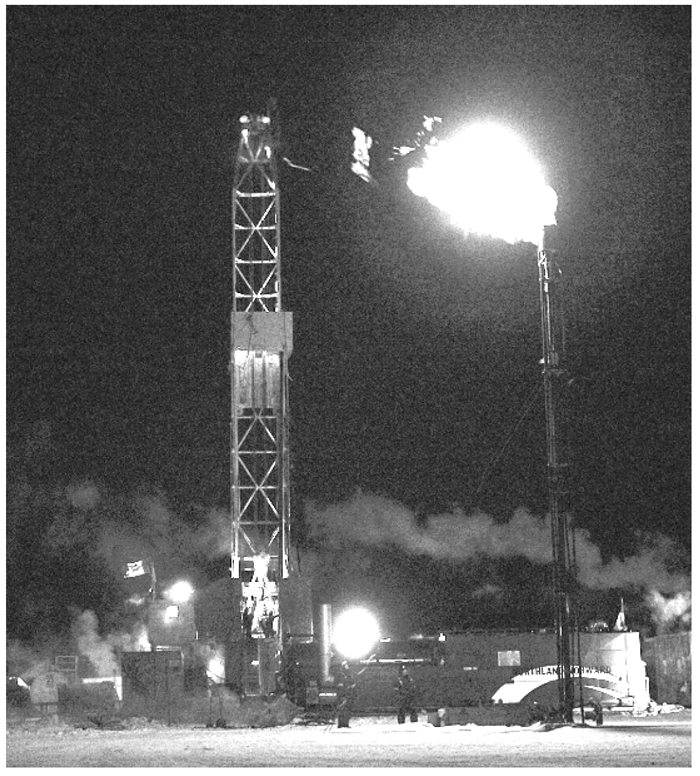
This interest in the resource potential of gas hydrates lead to an extensive program of scientific and production testing investigations at the Mallik field site in the Mackenzie delta region of Canada, in 1998 and again in 2002. These investigations were conducted by a consortium of companies and agencies including the Japan Oil, Gas and Metals Corporation; the Geological Survey of Canada; the United States Geological Survey; the United States Department of Energy; GeoForchungsZentrum Potsdam; Imperial Oil Limited; and others. While much remains to be learned from study of the Mallik gas hydrate science and testing programs, reasonable predictions of gas hydrate dissociation rates and field production forecasts can be made for simple exploitation schemes. This investigation examines the potential production rates, capital and operating costs, and operational issues for a hypothetical gas hydrate reservoir based on the Mallik field geology. The production methods investigated have used pressure depletion techniques only, thermal and chemical stimulations have not been considered. While this is not considered to be an exhaustive economic review of an optimum field development plan, these preliminary results can be considered to be a starting point for comparison of a potential onshore gas hydrate development to other market sources of natural gas .
.