Print this page
| Introduction | ||
| Definition |  Shale Shale domes are anticlinal features
formed as a result of shale diapirism. They are common in
basins containing significant volumes of clay and silt.
Associated traps are found in the dome over the diapir,
in sands pinching out, up-turned, or truncated against
the diapir, and in small rollover anticlines caused by
shrinkage of the diapir. domes are anticlinal features
formed as a result of shale diapirism. They are common in
basins containing significant volumes of clay and silt.
Associated traps are found in the dome over the diapir,
in sands pinching out, up-turned, or truncated against
the diapir, and in small rollover anticlines caused by
shrinkage of the diapir. |
|
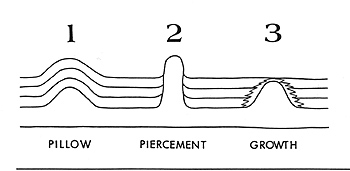
| Classification | Shale domes occur in three groups. The diagram below shows the three
|
|
| Pillow domes | The first group, pillow domes, is important in the
Caspian Sea area of southern Russia, but domes of this
type have not been positively identified in the U.S. Gulf
Coast. A shale dome on Eugene Island Blocks 198, 199,
202, and 203 may be of this type. Also, several of the
questionable shale domes along the Sigsbee Escarpment may
also have nonpenetrative shale cores. |
|
| Piercement domes | The second group, late rising piercement shale domes,
tend to be both rare and small in the Gulf Coast basin.
An example is the slender spire of Vicksburg shale
encountered at 10,530 ft depth in the old Sinclair No. 2
Houston well in the Donna Field, Hidalgo County, Texas.
That shale is 4000 ft. vertically out of place. The
diameter of the shale spire is less than one quarter
mile. Late emplaced piercement shale spires have been
encountered in other U.S. basins, particularly on the
Pacific Coast. Where seen in outcrops, they are composed
of brecciated blocks of indurated shale in a contorted
mudstone matrix. The mudstone matrix characteristically
has a petroliferous odor. They are locally called
"stink rocks" along the Washington and Oregon
coasts. The petroliferous odors suggest that these late,
high rise shale spires were mobilized by natural gas. |
|
| Piercement dome genesis | All of the late piercing shale spires reported in the
worldwide literature appear to have the common
characteristic of having the bases of the spires within a
13,000 to 16,000 feet depth range. Inasmuch as this depth
range approximates the depth of generation of petroleum
in many basins, it appears likely that gas generated in
shale locally drove out sufficient pore water to create
very low density shale with resultant isostatic
instability and shale diapirism. Despite the apparent
genetic association with natural gas, late penetrating
shale domes apparently have not caused the entrapment of
much oil or gas. |
|
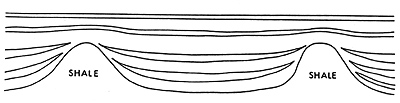
| Growth domes | Domes in the third group, growth, are the most
abundant, both worldwide and in the Gulf Coast Basin. The
rise of these domes apparently kept up with
sedimentation. The tops of the rising domes were shallow
enough to influence the facies of the adjacent and
overlying rock layers. |
|
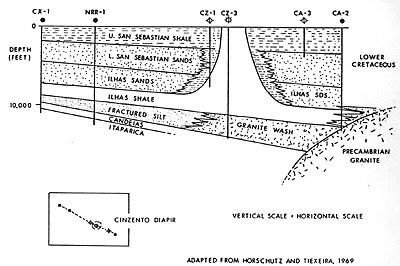
| Example of growth dome | Several of the shale diapirs in the Reconcavo basin
in Brazil apparently grew faster than sedimentation so
that the wasting of the emergent shale cores resulted in
deposition of older (shale age) fossils in the younger
surrounding beds. See diagram below.
|
|
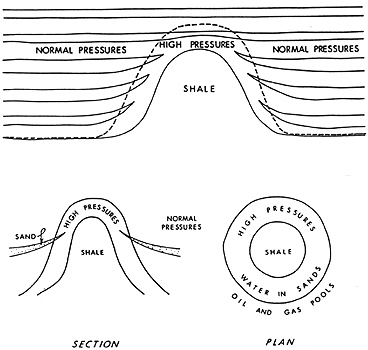
| Growth dome sheaths | A common characteristic of the shallow-to-emergent
growth domes is that sands are thin to absent close to
the shale cores. The pinchouts of the flanking sands have
generally resulted in sheaths of low permeability rocks
around the shale cores.
|
|
| Growth dome overpressures | Many of the shale cores are overpressured, and the
overpressures generally extend to the outer limit of the
low permeability sheaths. This feature is shown in the
two diagrams below.
|
|
 Table of
Contents Table of
Contents |
Shrinkage
of Shale Cores in Shale Domes  |