
 Print this page
Effective Petroleum  Source
 Rocks of
the World: Stratigraphic Distribution and Controlling
Depositional Factors
Rocks of
the World: Stratigraphic Distribution and Controlling
Depositional Factors
H.D. Klemme and G.F. Ulmishek
Search and Discovery Article #30003 (1999)
(Condensed from their article published in the AAPG Bulletin, v. 75, 1991, p. 1809-1851; reprinted in part and adapted for online presentation.
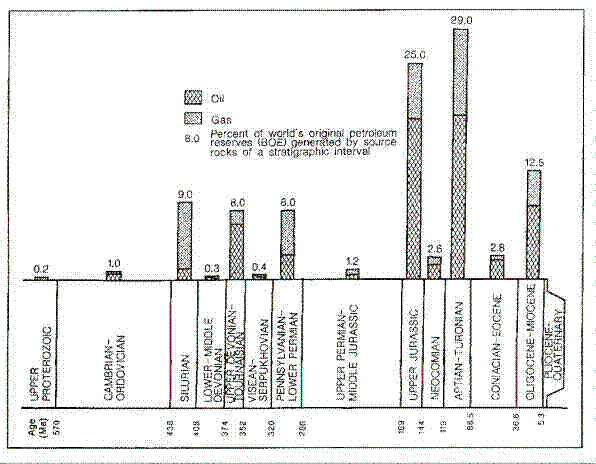
More than 90% of original
recoverable oil and gas reserves in the world has been generated
from source rocks of six stratigraphic intervals--(1) Silurian
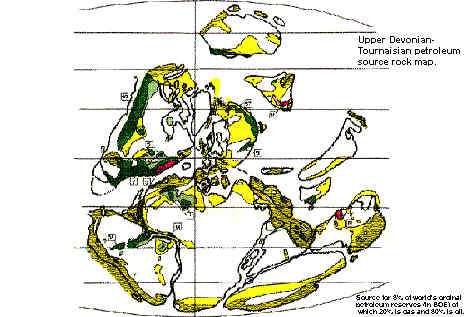
(generated 9% of the world's reserves), (2) Upper
Devonian-Tournaisian (8% of reserves), (3) Pennsylvanian-Lower
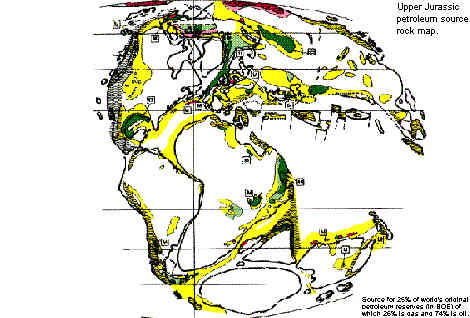
Permian (8% of reserves), (4) Upper Jurassic (25% of reserves),
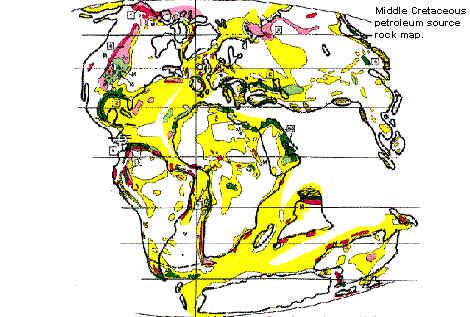
(5) middle Cretaceous (29% of reserves), and (6)
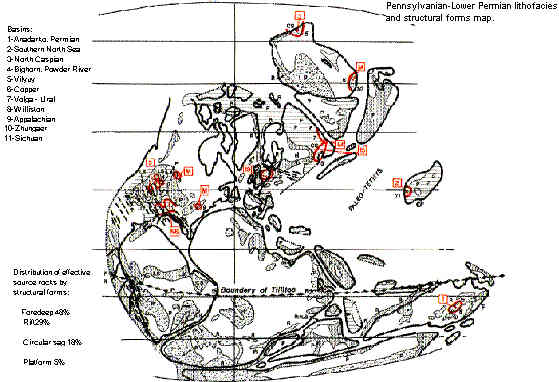
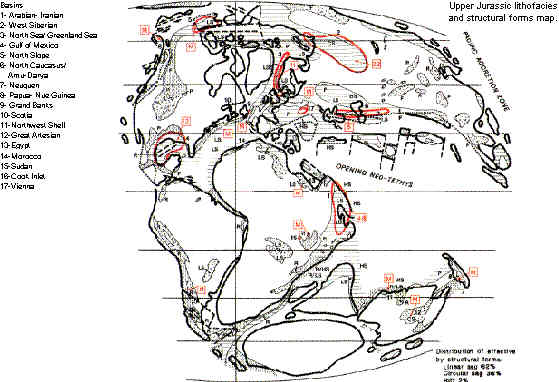
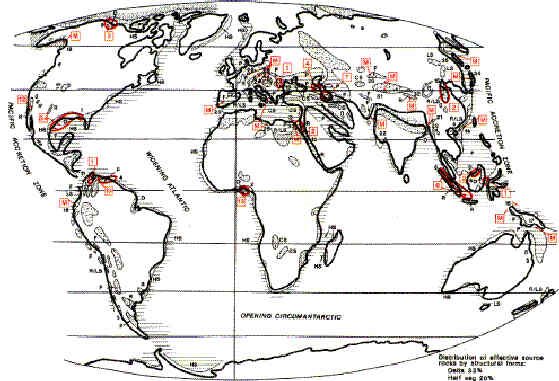
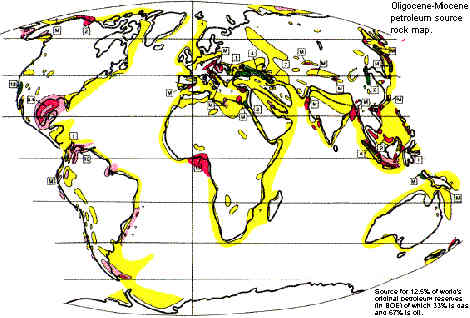
Oligocene-Miocene (12.5% of reserves) (Fig. 1). Facies and structural form maps (Animation,
or Time-Lapse Sequence, A) for the six intervals are shown in
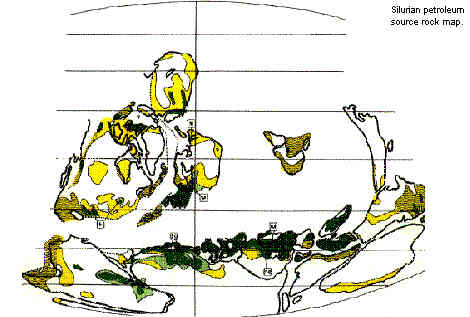
quasi-animation form, as are corresponding petroleum source rock
maps (Animation, or Time-Lapse Sequence, B). Together, these intervals
represent only one-third of Phanerozoic time. The concentration
of source rocks in these several stratigraphic intervals
demonstrates uneven distribution of source rocks in time, and
obviously it does not result from a single mechanism because the
areal distribution, localization in specific structural forms,
and even the geochemical character of source rocks changed from
one interval to another. Key features of source rocks of these
intervals in basins of development are summarized in Tables 1-6. The primary factors that controlled
the areal distribution of source rocks, their geochemical type,
and their effectiveness are geologic age, paleolatitude of the
depositional areas, structural forms in which the deposition of
source rocks occurred, and the evolution of biota. Silurian,
Upper Devonian-Tournaisian, Upper Jurassic, and middle Cretaceous
source rocks were deposited during generally transgressive
stages. In contrast, the deposition of Pennsylvanian-Lower
Permian and Oligocene-Miocene source rocks took place during
marine regressions. Favorable combinations of a number of
factors--tectonic, climatic, hydrologic, and biologic--resulted
in high effectiveness of source rocks of the six principal
intervals. Thus, the intermittent appearance of widespread
effective source rocks was not caused by any cyclic geologic
process.
The most important change in
the character of source rocks during the Phanerozoic was the
appearance and expansion of source rocks containing type III
kerogen and coal. The effectiveness of these source rocks also
grew, reaching its maximum in the Oligocene-Miocene. However, the
areal extent and effectiveness of source rocks with type II
kerogen, primarily black shale facies, decreased during the same
time. Low latitudes were more favorable for deposition of source
rocks with kerogen types I and II. In contrast, more source rocks
containing kerogen type III and coal were deposited in high
latitudes (except for the Oligocene-Miocene interval). A very
high effectiveness of source rocks with kerogen types I and II
deposited in low latitudes is connected with the widespread
presence of carbonate reservoir rocks and evaporite seals that
helped trap and retain petroleum.
Platforms open to the oceans
controlled the deposition of effective source rocks during the
early and middle Paleozoic. In the Mesozoic, the main source rock
deposition shifted to the silled basins located in circular and
linear sags. In the Pennsylvanian-Early Permian, rifts and
foredeeps controlled the principal deposition of petroleum source
rocks. In the Oligocene-Miocene, the source rock deposition
occurred in these same two structural forms and also in deltas
and half sags.
We suggest that biologic
evolution played an important role in the history of source rock
deposition. Different groups of producers evolved and colonized
new ecologic niches that expanded areas of bioproduction. Source
rocks with terrestrial organic matter appeared. However, the
contemporaneous evolution of consumers and decomposers resulted
in the decrease of variety of conditions suitable for
preservation of organic matter with type II kerogen. The areal
expansion of organic matter production and the simultaneous
attenuation of conditions of its preservation in the ocean
resulted in a change from source rocks with exclusively marine
organic matter in the early Paleozoic to source rocks with
dominant terrestrial organic matter in the Tertiary.
The maturation rate of
source rocks, similar to their rate of deposition, was also quite
uneven in geologic time. The major stage of maturation of
Paleozoic source rocks was associated with the Hercynian orogeny
and widespread deposition of thick molasses. The next principal
maturation stage occurred during the Late Cretaceous and Tertiary
in connection with the Alpine orogeny and deposition of thick
clastic wedges of this age.
Figure 2 summarizes deposition of source
rocks, their maturation, and entrapment. As would be expected,
the line of effective source rocks deposition is mostly located
above the line of trapped petroleum reflecting the dominance of
upward-directed vertical migration; however, the relative
position of these lines is reversed at the base of the Upper
Jurassic. This means that all effective source rocks deposited
before the Late Jurassic could not have provided all of the oil
and gas trapped in the sub-Upper Jurassic section. This
relationship emphasizes the importance of the downward migration
of petroleum.
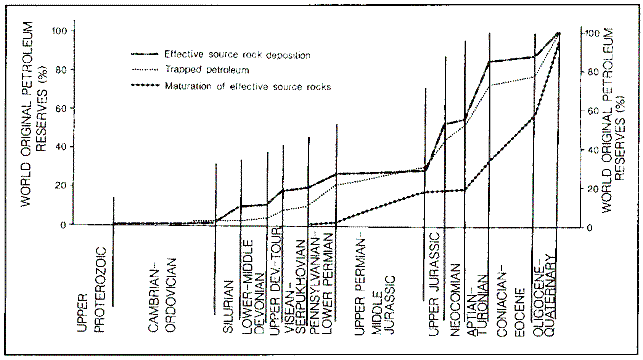
The cumulative maturation
line demonstrates the generally young age of most of the world's
discovered oil and gas. Almost 70% of the world's oil and gas
reserves was generated since the Coniacian, and nearly 50% of the
reserves was generated and trapped since the Oligocene. About 6%
of the world's petroleum reserves is biogenic gas from
still-immature source rocks; the bulk of this gas occurs in
northern West Siberia.
The high effectiveness of
source rocks with type II kerogen that were deposited in low
latitudes resulted in rich oil and gas reserves of the Tethyan
realm, a Silurian-Holocene latitudinal seaway between Gondwana
and the northern group of continents (Fig.3). On the north, the realm is bounded by the
Hercynian collision zone and includes foreland basins genetically
connected with Tethyan tectonics. In addition to clastic rocks,
the realm contains widespread carbonate reservoirs and evaporite
seals. The source rock deposition was aided by the successive
opening and collisional closing of proto-Tethys, paleo-Tethys,
and neo-Tethys that developed rift/sag structural forms favorable
for the formation of silled basins. The Tethyan basins are
developed over less than one-fifth of the world's land area and
continental shelves, yet they contain over two-thirds of the
original petroleum reserves.
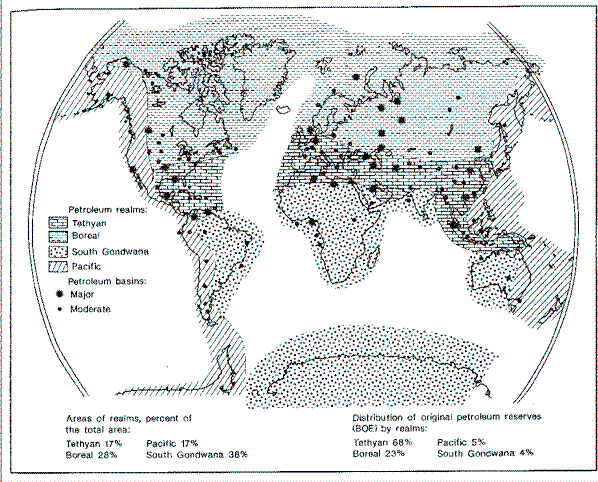
The Boreal realm is second
in richness. Its petroleum reserves are in Paleozoic carbonate
and clastic reservoirs and in Mesozoic clastic reservoirs.
Paleozoic petroleum primarily is connected with Upper
Devonian-Tournaisian source rocks deposited on platforms in low
paleolatitudes. Most Mesozoic petroleum was generated from Upper
Jurassic and middle Cretaceous source rocks deposited in sags
over rifts.
The Pacific and south Gondwana realms are relatively poor in oil and gas. The principal petroleum reserves of the Pacific realm are in Tertiary rifts and deltas of the active margin and in foredeep basins connected with orogenies of the eastern Pacific rim. In the south Gondwana realm, major petroleum reserves are confined to Mesozoic-early Tertiary rifted passive margin basins and to late Tertiary deltas. Much of the petroleum in both realms is high-wax oils resulting from either type I or type III kerogen.
Figure 1 - Stratigraphic
distribution of effective source rocks given as a percentage of
the world's original petroleum reserves generated by these rocks. (Fig. 1 in Klemme and
Ulmishek, 1991).
Figure 2 - Cumulative
chart of effective source rock deposition, source rock
maturation, and petroleum trapped in the stratigraphic succession given as a
percentage of world's original petroleum reserves. (Fig. 28 in Klemme and
Ulmishek,
1991).
Figure 3 - Petroleum realms of the world. (Fig. 29 in Klemme and Ulmishek, 1991).
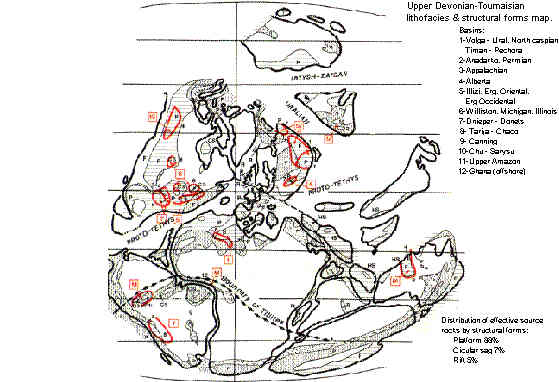
Animation, or Time-Lapse Sequence, A
| Silurian lithofacies and structural forms map.
(Fig. 4 in Klemme and Ulmishek, 1991). Upper Devonian-Tournaisian lithofacies and structural forms map. (Fig. 6 in Klemme and Ulmishek, 1991). |
Pennsylvanian-Lower Permian lithofacies and
structural forms map. (Fig. 8 in Klemme and Ulmishek, 1991). Upper Jurassic lithofacies and structural forms map. (Fig. 10 in Klemme and Ulmishek, 1991). |
Middle Cretaceous lithofacies and structural
forms map. (Fig. 12 in Klemme and Ulmishek, 1991). Oligocene-Miocene lithofacies and structural forms map. (Fig. 14 in Klemme and Ulmishek, 1991). |


Animation, or Time-Lapse Sequence, B
| Silurian petroleum source rock map.
(Fig. 5 in Klemme and Ulmishek, 1991). Upper
Devonian-Tournaisian petroleum Middle
Cretaceous petroleum |
Pennsylvanian-Lower Permian petroleum source
rock map. (Fig. 9 in Klemme and Ulmishek, 1991). Upper Jurassic petroleum Oligocene-Miocene
petroleum |
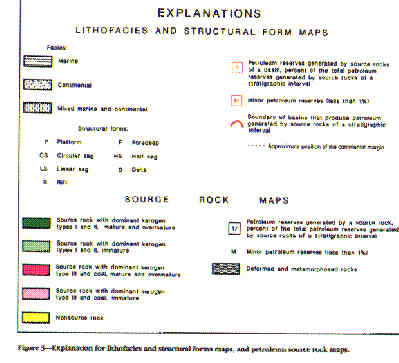
Explanation for lithofacies and structural form
maps.(for Animation, or
Time-Lapse Sequence, A and explanation of petroleum
source maps, Animation, or Time-Lapse Sequence, B.)(Fig.
3 in Klemme and Ulmishek, 1991). |

Major
Productive Basins Having Silurian Source Rocks (part of Table 1 in Klemme and
Ulmishek, 1991; please refer to it for citations).
Major
Productive Basins Having Upper Devonian-Tournaisian Source Rocks (part of Table 1 in Klemme and
Ulmishek, 1991; please refer to it for citations).
Major
Productive Basins Having Pennsylvanian-Lower Permian Source Rocks (part of Table 1 in Klemme and
Ulmishek, 1991; please refer to it for citations).
Major
Productive Basins Having Upper Jurassic Source Rocks (part of Table 1 in Klemme and
Ulmishek, 1991; please refer to it for citations).
Major
Productive Basins Having Middle Cretaceous Source Rocks (part of Table 1 in Klemme and
Ulmishek, 1991; please refer to it for citations).
Major
Productive Basins Having Oligocene-Miocene Source Rocks (part of Table 1 in Klemme and
Ulmishek, 1991; please refer to it for citations).
Rocks (part of Table 1 in Klemme and
Ulmishek, 1991; please refer to it for citations).
