
 Print this page
 Basin
Basin -Centered Gas Accumulation of the
Northern Green River Basin, Wyoming; Kent A. Bowker and John W. Robinson; Search and Discovery
Article #10001 (2000)
-Centered Gas Accumulation of the
Northern Green River Basin, Wyoming; Kent A. Bowker and John W. Robinson; Search and Discovery
Article #10001 (2000)
Jonah Field:
A Shallow Sweetspot in the Basin-Centered Gas Accumulation of the
Northern Green River Basin, Wyoming
Kent A. Bowker, Chevron USA Production Company, Houston and John W. Robinson, Snyder Oil Corporation, Denver
Search and Discovery Article #10001 (2000)
Online adaptation of the above-titled paper, which is part of the Official Program Book and Expanded Abstracts Volume prepared for the 1997 Rocky Mountain Section, AAPG. This volume is available from the Rocky Mountain Association of Geologists, which holds the copyright and which kindly gave permission for this presentation. S&D editorial staff expresses its appreciation to Kent Bowker, who willingly agreed for this paper to be presented online and provided all data via FTP.
SUMMARY
Recently acquired data
are beginning to illuminate the nature of the large,
overpressured, basin-centered gas accumulation in the northern
Green River Basin, Wyoming. Jonah field is a shallow,
compartmentalized gas accumulation within the larger
basin-centered accumulation.
The upper portion of
the regional gas cell is within the Upper Cretaceous strata of
the Lance Formation and Mesaverde Group. These units are composed
of fluvial-channel sandstones and siltstones, floodplain shales
and minor coals that were deposited on a broad alluvial plain
between the Wyoming Thrust Belt and the then-emerging Wind River
Mountains. Jonah field is located on the gentle northeast-dipping
flank of the basin. Dispersed carbonaceous material and
discontinuous coal beds within the Upper Cretaceous section are
the sources of the hydrocarbons.
The upper boundary of
the gas accumulation at Jonah coincides closely with the top of
the Lance (± 8500 ft), whereas in other portions of the basin
the top of the gas cell is near the top of the Mesaverde (±
10,500 ft). A fault that forms the abrupt southern boundary of
the accumulation may hold the key to understanding the field.
Fractures, formed in response to a left-lateral shear zone
located at the southern boundary, may be the reason for the
shallower accumulation and apparent higher permeability at Jonah
verses other portions of the basin.
INTRODUCTION
The basin-centered gas
play of the northern Green River basin (sometimes referred to as
the Hoback basin) has become one of the most active and exciting
in the Rocky Mountain region. Over fifteen operators have been
active in the play since the re-discovery of Jonah field by
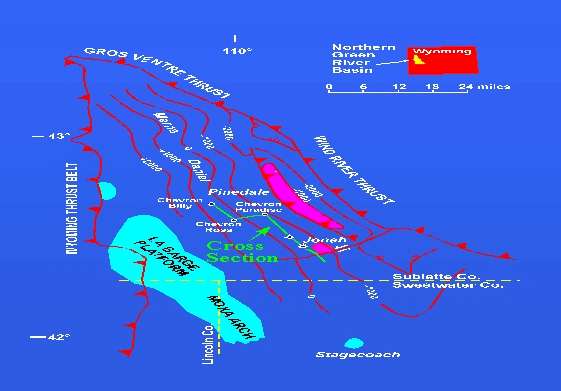
McMurry Oil Company in 1993 (Figure 1). A succinct history of the
field’s development is published in Oil and Gas Investor
(Klann, 1997). Jonah field is currently producing more than 100
MMCFGD (with associated condensate), with additional wells being
drilled and placed on line monthly. There has also been an
increase in activity on the nearby Pinedale anticline (Figure 1), a huge (and unique in the
basin) foreland structure located on the far eastern edge of the
basin. Wildcat wells have been drilled, or are planned, in every
corner of the basin. Gas has been produced (and in some cases
actually sold, as with Chevron’s Billy 33-16 and Ross 33-7)
from wells located throughout the basin; but all efforts outside
Jonah and Pinedale have lead to no real commercial success.
Because there are no other Pinedale-type structures in the basin,
current exploration efforts are concentrating on finding another
Jonah-like accumulation. Therefore, having a thorough
understanding of Jonah field is essential for prospecting in the
northern Green River basin.
Most of the published
work on the geology of the northern Green River basin was
authored by Ben Law, Chuck Spencer and their colleagues at the
USGS and is summarized in Law and Spencer (1989). These workers,
following up on earlier work supported by the DOE (which was
directed at using nuclear explosives to stimulate gas reservoirs
at Pinedale and Merna; Martin and Shaughnessy, 1969), recognized
the presence of up to a 5000 ft gas column in the Upper
Cretaceous strata throughout the basin. Additional work on the
Pinedale area was supported by the Gas Research Institute
(Greenfield et al., 1981). Recent reports on Jonah include
Montgomery and Robinson (1997) and Finch et al. (1997). The
recent drilling in the basin has shown that the petroleum geology
of the basin is much more complex than believed previously. For
example, the top of the basin-centered gas cell has much more
"topography" than was recognized previously and the top
does not correspond to either the current or past geothermal
gradients.
STRATIGRAPHY, SEDIMENTOLOGY AND PETROLOGY
The huge basin-centered
gas accumulation is present within overpressured Upper Cretaceous
fluvial strata of the Lance Formation and upper Mesaverde Group
(Ericson Sandstone and Rock Springs Formation;
Figure 2). The Tertiary Ft. Union
Formation, which is normally pressured and is not part of the
basin-center gas cell, may also prove productive in some portions
of the basin. The Almond Formation is not present in most of the
northern Green River basin; the northernmost occurrence of Almond
bar sandstone appears to be at Stagecoach field (Figure 1). The Lance ranges in thickness
from a zero-line on the east flank of the La Barge uplift to over
5500 ft thick below the leading edge of the Wind River thrust.
The upper Mesaverde is partially truncated by the K-T
unconformity at the eastern edge of the La Barge uplift where it
is less than 1000 ft thick, but thickens to over 3500 ft at the
Wind River thrust. The upper Mesaverde has tested gas in several
areas of the basin, but it has not proven to be a commercial
producer.

The Lance and upper Mesaverde are composed of fluvial channel sandstones and siltstones, floodplain shales, and minor coals that were deposited in a broad alluvial plain located between the Wyoming Thrust Belt and emerging Wind River Mountains (Figure 1). Sediment transport was generally to the southeast and east. Individual sandstone units average 25 ft thick, with some amalgamated sandstone packages more than 100 ft thick.
Lance and upper Mesaverde sandstones range from predominantly litharenite to sublitharenite, with chert making up most of the lithic grains. Most of the sandstones are very fine grained, but they can grade up to medium grained in the basal portion of channel-fill deposits. Channel lag, containing a large percentage ripped-up clasts of overbank muds, are also common in the basal portions of channel fill units. These channel-lag horizons can be mistaken for shale beds when examining a gamma ray log across the interval.
The Lance sandstones at Jonah average 80% quartz (including chert grains), 3% calcite, 2% feldspars, 1% dolomite and 14% clay minerals. Of the clay fraction, chlorite and illite both average 40%, with kaolinite and occasionally a trace of smectite making up the remaining portion.
RESERVOIR PROPERTIES
Productive sandstones
in the Lance Formation at Jonah are extremely tight. Porosity in
pay zones ranges from 8 to 12% and in situ permeability
(measured from pre-frac pressure-transient tests) ranges from 3
to 20 microdarcys. In upper Mesaverde sandstones that have tested
gas, the porosity is between 8 and 10%. The one pre-frac
pressure-transient test run in the Mesaverde (Chevron, Billy
33-16) indicates a permeability of 8 microdarcys. Pore-throat
radii in productive Lance intervals at Jonah average 0.3 microns.
The only water production at Jonah is "dew," which
forms in response to the pressure drop when the gas is produced,
and indicates that the reservoir is at irreducible water
saturation (about 25% to 35% Sw). Mercury injection-based
capillary pressure curves indicate that, to obtain water
saturation at irreducible in rock this tight, the gas column must
be greater than 2000 ft.
Few natural fractures have been observed in the limited Lance cores and imaging logs from Jonah field. However, fractures (or some other permeability-enhancing mechanism) must be present in the reservoir to account for the production rates seen in the field.
Pore-pressure gradients
within the gas-saturated cell at Jonah range from 0.55 to 0.70
psi/ft. At Merna (Figure 1), a gradient of 0.97 psi/ft was
reported at the base of the Mesaverde (Spencer, 1983). The top of
the overpressured gas cell appears to coincide with the top of
sustained gas shows, however, sustained gas shows may simply
indicate increased permeability within the overpressured cell.
The upper boundary of the gas accumulation in Jonah coincides
closely with the top of Lance (± 8500 ft), whereas in other
portions of the basin the top of the gas cell is near the top of
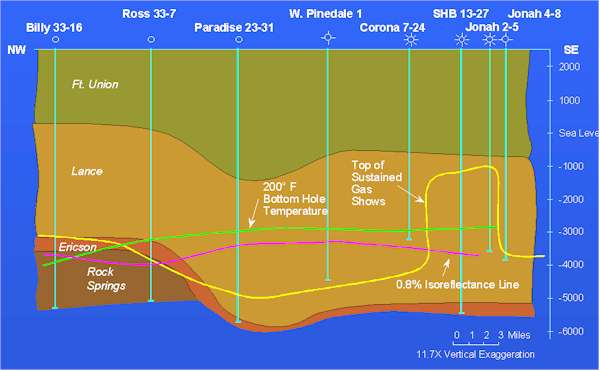
the Mesaverde Group (± 10,500 ft) (Figure 3). Jonah field and the Pinedale
anticline are the only areas where the top of sustained gas shows
has been found above 10,500 ft.
STRUCTURAL GEOLOGY
The northern Green
River basin is a simple NW-SE trending asymmetric basin with a
gentle northeast-dipping west flank. The Pinedale anticline is
the only major structural inversion in the basin. There are
relatively minor anticlinal flexures at Merna and Daniel (Figure 1). All of these features are of
Laramide age but they don’t involve basement rocks directly,
though the structural grain imposed by basement lineaments may
have affected the location of these thin-skinned structures. The
youngest structural feature in the basin is the Continental
Fault, a down to the WSW normal fault located just west of the
Wind River thrust. The Continental fault may indicate that the
basin is currently under Wasatch-influenced, west-directed
extension. Jonah field is located on the basin’s
northeast-dipping homocline, which dips 425 ft/mile. Acquisition
of a proprietary 3-D seismic survey over the field has added
greatly to our understanding of the influence of structure on gas
production. A left-lateral strike-slip fault zone (again,
thin-skinned) forms the southern boundary of Jonah. This fault
zone also appears to bound the south plunge of the Pinedale
anticline. Across this fault zone there is 2500 ft of relief on
the top of the overpressured gas cell (Figure 3). Other faults are observed in
the seismic data, and some of these may form the productive
limits on the other margins of the field.
HYDROCARBON SOURCE AND GENERATION
Dispersed carbonaceous
material and discontinuous coal beds within the Lance and upper
Mesaverde are the source of hydrocarbons found within these
strata. Early in the study of Jonah, it was believed that very
little, if any, hydrocarbon migration had taken place and that
the relatively shallow gas accumulation at Jonah was a result of
a thermal hot-spot; i.e., the critical maturation temperature
(about 250° F) was reached higher in the sedimentary column at
Jonah relative to other portions of the basin, resulting in a
shallower accumulation. Wellbore temperature and vitrinite
reflectance data collected by Chevron and Snyder show, however,
that there isn’t, nor has there been, a thermal anomaly at
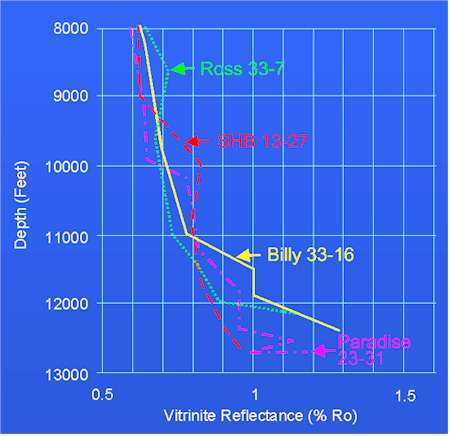
Jonah (Figure 3). Throughout the basin, gas
produced from the Mesaverde and lowermost portions of the Lance
becomes isotopically heavier with depth, supporting the
contention that very little migration has taken place (and that
the gas is sourced from Type III, or coaly, organic matter), that
is except for the middle and upper Lance at Jonah. Limited
stable-isotope data from Jonah indicate that the gas produced
from this interval does not show this "heavier with
depth" trend. In addition, this shallower gas is produced
from above the 0.8 Ro
line
(believed to mark the onset of gas generation and migration from
Type III organic matter) (Figure 3). Hence, the gas being produced
at Jonah appears to have migrated from sources lower in the Lance
or upper Mesaverde.
Vitrinite-reflectance
profiles across the basin are similar (Figure 4) and show a consistent rate of
maturation to a depth of 11,000 ft, where the rate of maturation
increases suddenly. Law et al. (1989) also noted this
"kinky" vitrinite- reflectance profile in the northern
Green River and other Larimide basins. Burial history curves for
the basin suggest the onset of generation in the early Tertiary;
hydrocarbon generation ceased with the widespread Pliocene
exhumation of the Rockies. Produced gases from wells located
throughout the basin have a high percentage of C2+ components
(with the concentration of heavier hydrocarbons increasing with
depth, even in the upper and middle Lance at Jonah) and may be
close to the dewpoint throughout the pressure cell; i.e., the
entire pressure cell may be a retrograde gas reservoir.
DISCUSSION AND CONCLUSIONS
The origin of the
sweetspot at Jonah field is not completely understood, but
additional development and step-out drilling and interpretation
of 3-D seismic will allow us to put a clearer picture together.
Existing data preclude interpretation of a classic structural or
stratigraphic trap at Jonah. Borehole temperature data taken from
static pressure surveys indicate that there is no thermal anomaly
at Jonah that could have formed a localized generation window (Figure 3). There is no systematic
variation in sandstone petrology or gross sandstone isopachs in
the Lance Formation that would form a classic stratigraphic trap.
Several key factors are
thought to contribute to the presence of Jonah field. There is an
abrupt southern limit to the field where the top of sustained gas
shows changes depth from 8500 ft to 11,240 ft in wells drilled
0.5 mile apart (Figure 3). This change is enigmatic but
could be the result of several factors, including: isolation of
the pressure compartment by a lateral seal such as a fault or
shear zone, a decrease in permeability caused by diagenesis, or a
breach of the top seal by faulting or non-deposition of the
sealing horizon. There are no long-term pressure build-up data
available from wells south of the field, so it is not certain if
the pressure cell actually deepens to the south, however,
information collected during drilling (drilling rates and gas
shows) and completion operations (pump-in pressures) indicate the
Lance is less permeable where sustained gas shows are lacking.
Explaining the abrupt southern boundary of Jonah is probably the
key to understanding the origin of the field.
Based on limited core
data, fracture stimulation pressures and production profiles, the
Lance reservoir appears to be fractured. Pre-frac
pressure-transent tests from wells both in and out of Jonah
indicate that the Lance and upper Mesaverde have in
situ matrix permeabilities of 3 to 20
microdarcys. This suggests that fractures play a significant role
in gas deliverability and may be the cause of the 2500 ft-thick
gas column at Jonah. Wells at Jonah have to be massively
frac-stimulated to achieve economic flow rates. These fracs
probably connect the wellbore to the natural fractures. In wells
located outside Jonah, there is no fracture network with which to
connect the wellbore, hence these wells (even though they too are
frac stimulated) are uneconomic. The natural fractures probably
formed in response to left-lateral shear along a fault/shear zone
that trends west-southwest out of the Wind River Mountains and
defines the southern boundary of the field (Figure 1). This fault is part of the
far-field transmission of stress related to the emplacement of
the Pinedale and Wind River thrusts. Stress within the allochthon
(the block on the north side of the fault) generated the
fractures.
The top of any
basin-center gas deposit is defined by the point where the sum of
the buoyancy and pore pressures within the underlying
gas-saturated sedimentary column is matched by the capillary
pressure of the overlying water-saturated column. At Jonah, this
regional balance was upset by the fracturing (and, hence,
increased permeability) created by movement along the
left-lateral fault zone described above: gas migrated up through
the fractures into the now more permeable rock (more permeability
means lower capillary pressure) of the middle and upper Lance
until it reached a new equilibrium point.
The presence of a
basin-centered gas accumulation in Cretaceous strata in the
northern Green River basin has been known for many years, but the
gas was considered to be an uneconomic resource due the depth of
the accumulation. The discovery of Jonah field demonstrates that
pressure compartments, with up to 2500 ft of gas-saturated
section, can exist above the regional gas accumulation. Such
compartments may be a new and under-exploited type of target in
many Rocky Mountain basins. Understanding the Jonah sweetspot is
a key to prospecting for similar sweetspots in overpressured,
basin-centered structural settings worldwide.
REFERENCES
Finch, R.W., W.W. Aud and J.W. Robinson, 1997, Evolution of completion and fracture stimulation practices in Jonah field, Sublette County, Wyoming: Rocky Mountain Assoc. of Geologists Guidebook of Oil-field Technologies in the Rocky Mountains, in press.
Greenfield, H., U. Ahmed, M.T. Holland and J.F. Schatz, 1989, Resource evaluation and production research on tight sands in the Pinedale unit, Sublette County, Wyoming: GRI Final Report 81/0049, 157 p.
Klann, S., 1997, Jonah’s tale: Hart’s Oil and
Law, B.E., and C.W. Spencer, eds., 1989, Geology of tight
Law, B.E., V.F. Nuccio and C.E. Barker, 1989, Kinky vitrinite reflectance well profiles: evidence of paleopore pressure in low-permeability,
Martin, W.B. and J. Shaughnessy, 1969, Project Wagon Wheel: Wyoming Geological Assoc. Guidebook, 21, 145-152.
Montgomery, S.L., and J.W. Robinson, 1997, Jonah field, Sublette County, Wyoming:
Spencer, C.W., 1983, Overpressured reservoirs in the Rocky Mountain region [abs.]: AAPG Bulletin, 67, 1356-1357.
Figures
Figure 1. Index and structure map of top Lance Formation, northern Green River basin. Line of cross section (Figure 3) is shown.
shows, 0.8% Ro line and 200° F current-temperature line. Line of section shown in Figure 1.