Print this page
 Click to view article in PDF format.
GCImpedance Inversion Transforms Aid Interpretation*
Satinder Chopra¹ and Ritesh Kumar Sharma¹
Search and Discovery Article #41622 (2015)
Posted June 1, 2015
*Adapted from the Geophysical Corner column, prepared by the authors, in AAPG Explorer, May, 2015, and entitled "The Transforms: A Big Aid in Interpretation". Editor of Geophysical Corner is Satinder Chopra ([email protected]). Managing Editor of AAPG Explorer is Vern Stefanic. AAPG © 2015
¹Arcis  Seismic
 Solutions, TGS, Calgary, Canada ([email protected])
Seismic inversion for acoustic impedance is widely used in our industry today, mainly due to the ease and accuracy of interpretation of impedance data, but also because it allows an integrated approach to geological interpretation. This month's column refers to "inversion" as the transformation of seismic amplitude data into acoustic impedance data.
Seismic data represent an interface property wherein reflection events seen due to relative changes in acoustic impedance of adjacent rock layers. Such observed amplitude changes may not indicate if the amplitude changes relate to lithology variations above or below an interface. Acoustic impedance is a physical rock property, given as the product of density and velocity. Well logs measure both these entities directly, so that by dividing the density log with the sonic log, acoustic impedance log is obtained. Thus while acoustic impedance is a layer property, seismic amplitudes are attributes of layer boundaries.
Now, if quantitative interpretation of seismic data in terms of thin stratal interval properties (impedance) is to be attempted, then instead of the interface reflection properties, we resort to inversion. Acoustic impedance, being a layer property, simplifies lithologic and stratigraphic identification and may be directly converted to lithologic or reservoir properties such as porosity, fluid fill and net pay. In such cases then, inversion allows direct interpretation of three-dimensional geobodies. Inversion plays an important role in seismic interpretation, reservoir characterization, time lapse seismic, pressure prediction and other geophysical applications.
|
♦General statement ♦Figures ♦ Method♦Examples ♦Conclusions ♦Acknowledgment
♦General statement ♦Figures ♦ Method♦Examples ♦Conclusions ♦Acknowledgment
♦General statement ♦Figures ♦ Method♦Examples ♦Conclusions ♦Acknowledgment
♦General statement ♦Figures ♦ Method♦Examples ♦Conclusions ♦Acknowledgment
♦General statement ♦Figures ♦ Method♦Examples ♦Conclusions ♦Acknowledgment
♦General statement ♦Figures ♦ Method♦Examples ♦Conclusions ♦Acknowledgment
♦General statement ♦Figures ♦ Method♦Examples ♦Conclusions ♦Acknowledgment |
Since the inversion process transforms Due to the band-limited nature of the The low frequency trend of acoustic impedance is usually derived from well logs or stacking velocities, and used as a priori information during the inversion process. This helps enhance the lateral consistency of the impedance data so produced. The weak high frequency signal components indicate notches or roll-offs on the higher end of the amplitude spectra of Several different techniques methodologies are commonly used to perform impedance inversion. Whatever inversion approach is adopted, impedance volumes so generated have significant advantages. These include:
These different impedance inversion techniques are:
In simple terms we also can say that there is a certain level of uncertainty in the reservoir models that are built from different impedance outcomes. Of course, we try and lower the uncertainty by introducing some constraints in the inversion process. In geostatistical inversion we try and describe these possible outcomes, and by examining them we get an idea of the uncertainty inherent in the inversion process for the dataset under process.
seismic traces that have a phase change of minus 90 degrees. Once the operator is determined, it is run on the input seismic data so as to obtain impedance data – colored inversion is fast and easy to implement.
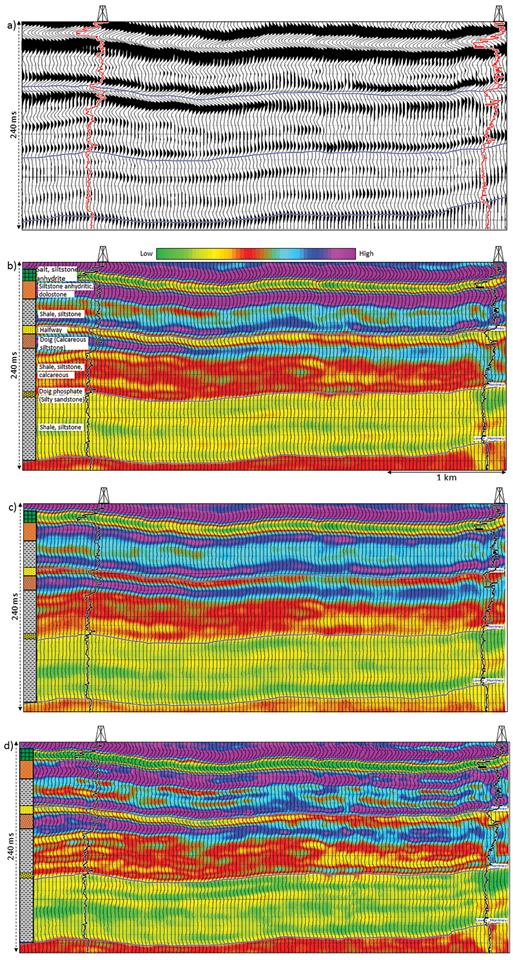
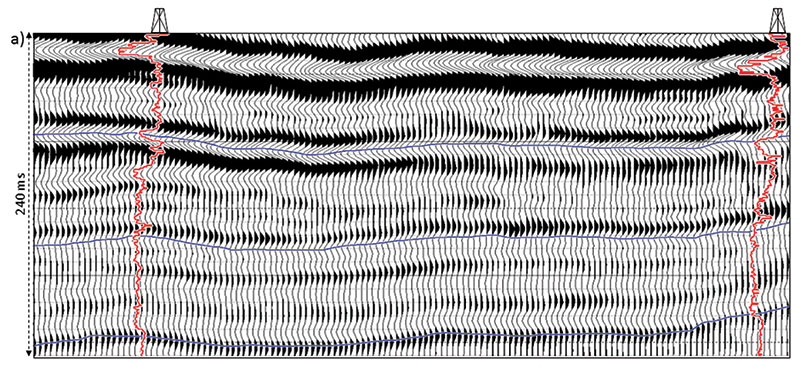
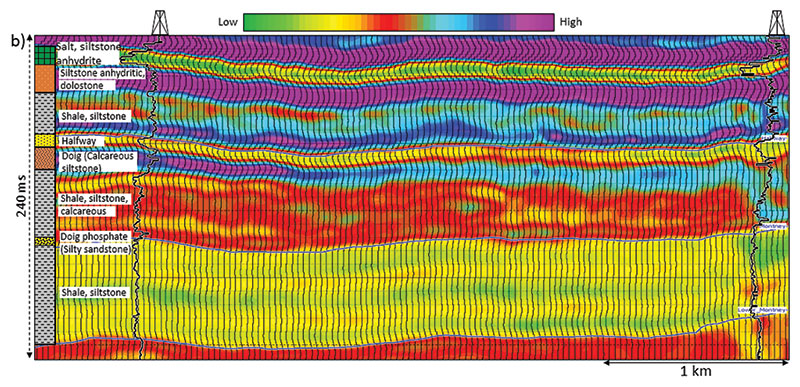
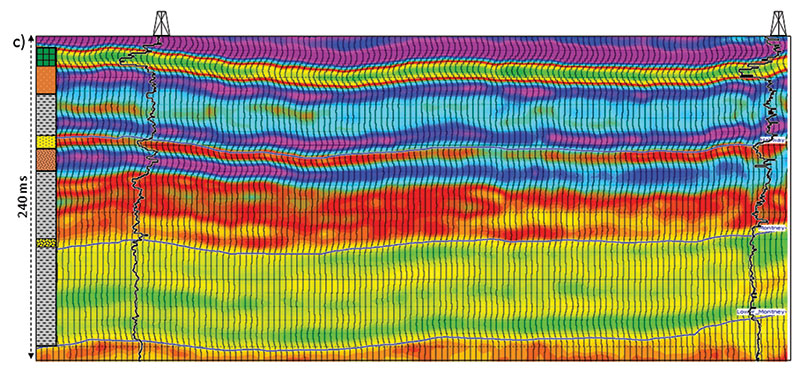
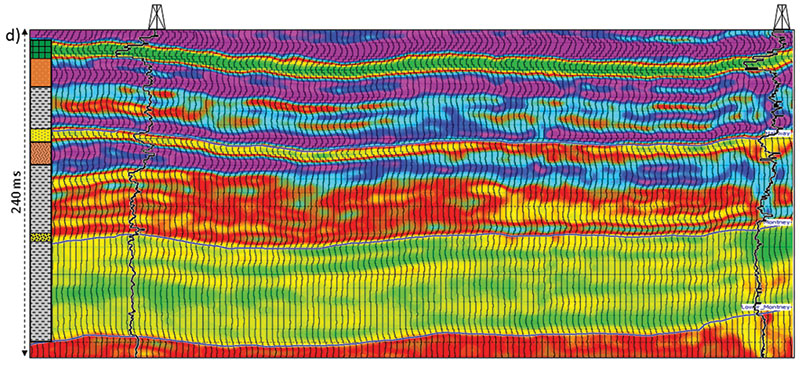
In Figure 1, we show a segment of a The Upper Montney interval can be seen at the lower level of lithostrip to the left of the impedance section shown in Figure 1b. Overlying the Upper Montney interval is the Doig Formation, which is divided into three litho units, namely, the lower phosphate zone, middle siltstone shale zone, and the upper calcareous siltstone. Overlying the Doig Formation is the Halfway clean sandstone unit. The Halfway and the Doig interval comprise the Middle Triassic zone. A siltstone and shale interval overlies the Halfway, which in turn has a thin layer (20 meters) of salt above it. This salt is interbedded with anhydrites and siltstone and shows a slight lowering in velocity on the sonic curve, but has an appreciable lowering of density in the same zone. As a result, the impedance curves log curves overlain on Figure 1a exhibit a lowering of impedance in the salt interval. A close examination of the reflection events in the Montney, Doig and Halfway zones shows some lateral amplitude variation – however, it is difficult to interpret this in terms of impedance variation corresponding to lithology, porosity or fluid changes in those intervals. A quick run of three different types of inversion was carried out, and the equivalent displays shown in Figures 1b, c and d. The recursive inversion display shown here exhibits the lateral impedance variation within the Montney, Doig and Halfway intervals, as well as the salt zone. Their corresponding correlation with the overlaid impedance log curves on the sections is encouraging. Figure 1c shows the colored inversion display, wherein we notice that while the blue siltstone zone above the Halfway is somewhat better defined, variation in the Montney zone may not be very convincing. Finally in Figure 1d, we show the model-based impedance inversion display. We notice that the impedance variation in the Montney interval appears more detailed than the recursive or colored displays. The transformation of We would like to thank AAPG members James Keay and Hossein Nemati for helpful discussions that led to the making of the lithology strip show in Figure 1b. |