Print this page
 Click to view article in PDF format.
GCAttribute Analysis of Mid-Continent Washes*
Ryan Fairfield¹ and Renjun Wen²
Search and Discovery Article #41616 (2015)
Posted April 20, 2015
*Adapted from the Geophysical Corner column, prepared by the authors, in AAPG Explorer, April, 2015. Editor of Geophysical Corner is Satinder Chopra ([email protected]). Managing Editor of AAPG Explorer is Vern Stefanic. AAPG © 2015
¹SM Energy, Tulsa, Oklahoma, USA ([email protected])
²Geomodeling Technology Corp, Calgary, Canada
The Anadarko Basin granite wash play has been considered difficult to interpret both geologically and geophysically. Consequently, the application of  seismic
 attribute analysis to Mid-Continent washes has not been widely published.
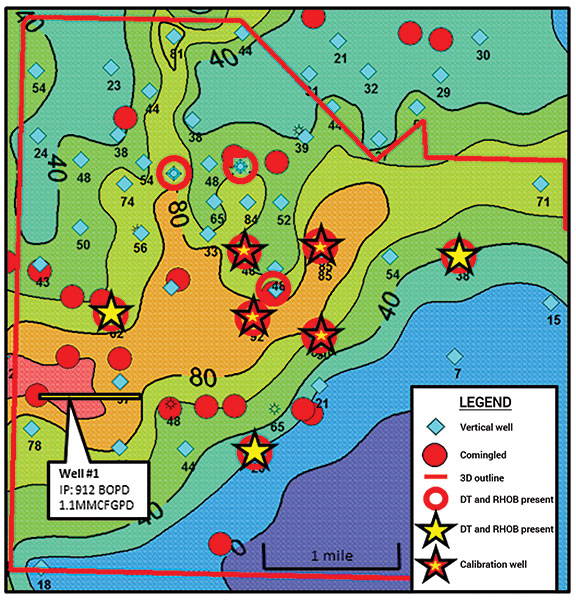
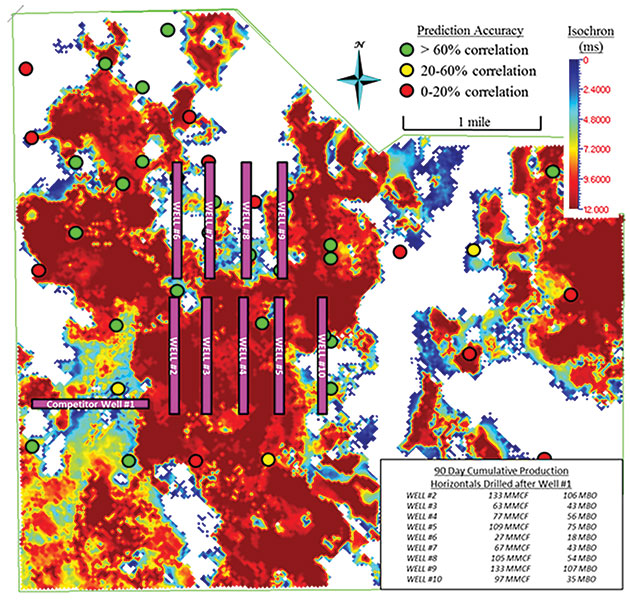
SM Energy's Mid-Continent granite wash asset covered a portion of a prolific Missourian age wash trend. In 2010, a competitor drilled a successful horizontal well, Well #1, in the interval with excellent initial production rates (Figure 1). Adequate well control existed to generally map the trend across the acreage – however, some uncertainty remained regarding the extent of the sand trend in areas that lacked well control. In order to gain insight into these areas, a seismic attribute study was conducted over a 14-square-mile portion of SM Energy's 3-D seismic holdings.
|
♦General statement ♦Figures ♦Background ♦Method ♦Workflow ♦Conclusions ♦Acknowledgment
♦General statement ♦Figures ♦Background ♦Method ♦Workflow ♦Conclusions ♦Acknowledgment
♦General statement ♦Figures ♦Background ♦Method ♦Workflow ♦Conclusions ♦Acknowledgment
♦General statement ♦Figures ♦Background ♦Method ♦Workflow ♦Conclusions ♦Acknowledgment
♦General statement ♦Figures ♦Background ♦Method ♦Workflow ♦Conclusions ♦Acknowledgment
♦General statement ♦Figures ♦Background ♦Method ♦Workflow ♦Conclusions ♦Acknowledgment
♦General statement ♦Figures ♦Background ♦Method ♦Workflow ♦Conclusions ♦Acknowledgment
♦General statement ♦Figures ♦Background ♦Method ♦Workflow ♦Conclusions ♦Acknowledgment |
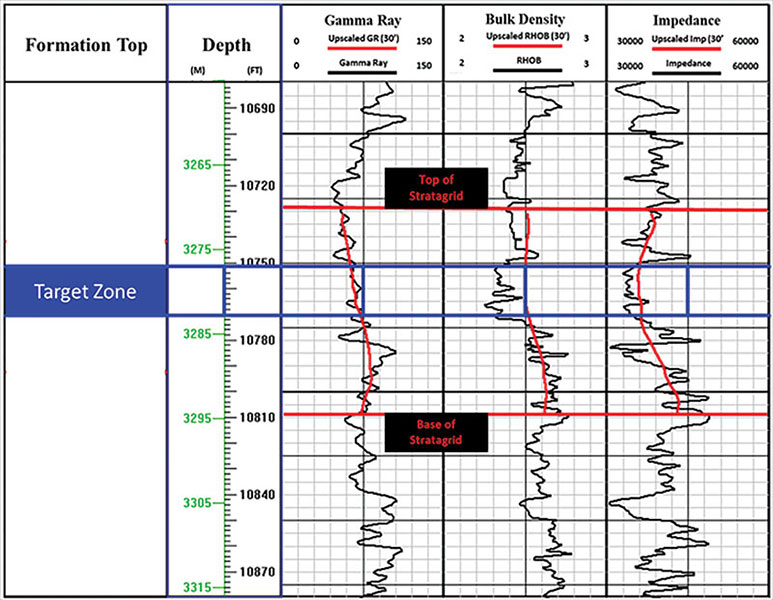
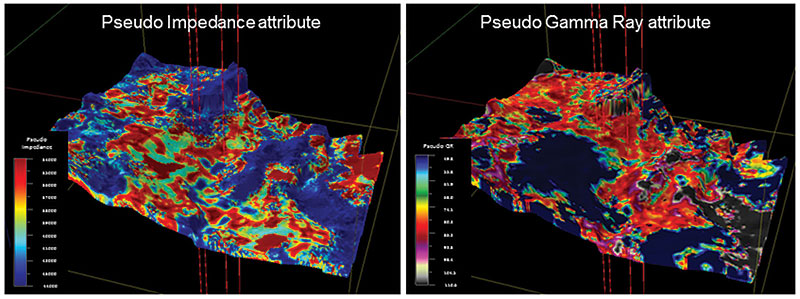
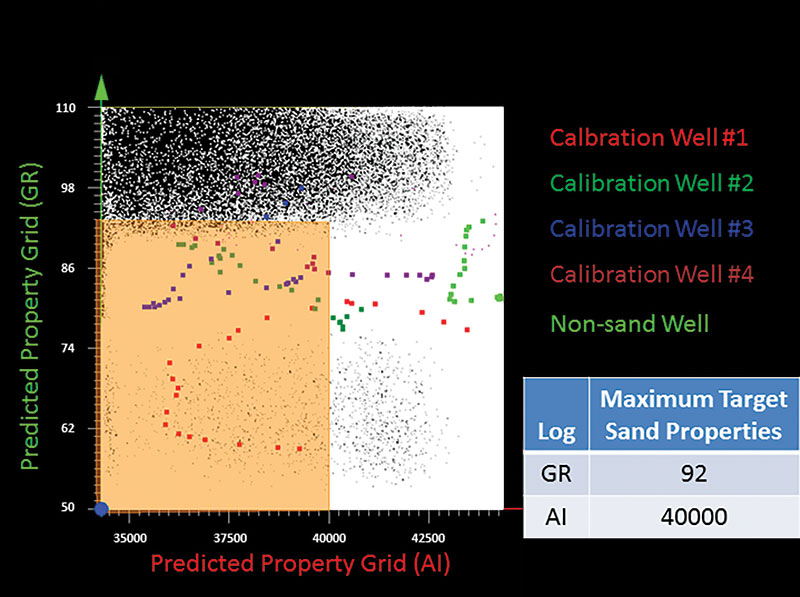
The mature, oil and gas-producing Anadarko Basin granite wash play is a series of stacked fanglomerate reservoirs with sands of varying mineralogies derived from the erosion of the Wichita-Amarillo Mountain Front. The reservoir, which is the focus for this study, is a Missourian age wash. Petrophysical properties from local well control suggest that the reservoir sand in the study area consists of a more traditional mineralogical makeup (quartz and carbonate) rather than the feldspar rich, arkosic sands which exist in a deeper portion of the play. For the purpose of this study, low acoustic impedance and low gamma-ray are assumed to indicate clean, porous sand within the reservoir. Thicknesses of the sand trend range from seven feet at its thinnest recorded location to over 90 feet in the heart of the trend. Average porosities of the target sand (estimated from neutron/density porosity logs) are 10-12 percent. Here is a summary of the workflow used to predict critical rock properties through the application of statistical analysis of 3-D 1) Generate post-stack 2) Interpret top and base of target, tied by synthetic 3) Build strata-grid from interpreted time horizons conformable to target area and extract each attribute to the strata-grid. 4) Upscale well logs similar to the 5) Correlate 6) Apply neural network prediction to combine the statistically significant 7) Use cross-plots and define the target sand. 8) Generate geobodies to compare seismically-derived sand thickness estimation to well logs. 9) Visually compare morphology of geobodies to well log-derived sand thickness map. 1) Generation of Post Stack The 3-D 2) Attain an Accurate Synthetic to Thirty-eight vertical well penetrations with digital logs existed within our study area. Only 11 of those contained compressional sonic and bulk density logs. Of those, eight were of sufficient log quality to create a reliable synthetic tie. A wavelet was extracted at each well location and was then convolved with the reflectivity coefficient series for the respective well. For a majority of the wells, a 60 percent or greater correlation coefficient was achieved over the full length of the logs, while a few wells approached 70 percent correlation. These were considered good correlation values for the study area. It was from these wells that the location of the target sand was identified within the 3) Generate a Strata-Grid, Extract A "strata-grid" was created using the interpreted horizons to encompass the target sand. Each of the post stack An appropriate upscaling window size was finally adopted after testing the sensitivity of the size to the correlation coefficient between 4) Correlate Generated 5) Cross-Plot of Predicted Property Grids, Refinement of Cross-Plot Polygon and Geobody Extraction First, the target zone within the predicted gamma-ray and impedance grids were cross-plotted with samples from the calibration wells highlighted (Figure 4). Upper-range sand cutoff values from the upscaled gamma-ray and impedance logs were estimated, allowing for a polygon to be drawn around the sand points. The polygon shape and size was further refined by plotting extracted predicted property grid values at blind well locations. By highlighting those values on the cross-plot, we interactively QC'd the shape of the cross-plot polygon by turning on the wells with no known sand, which should fall outside the sand polygon. A geobody map was generated from this polygon, representing the sand properties defined by the subject logs. 6) Attempts to Avoid Spurious Correlations Spurious correlations are a constant concern in attribute analysis. If First, at least two logs need to be chosen that can discriminate porous sand in cross-plot space by themselves. Second, the morphological shapes of these chosen logs should be different to avoid redundancy in correlated Criteria 1 and 2 were addressed in the discussion on upscaling window size selection. Rather than using one well for calibration, which may not capture the variability of the target sand in the study area, a total of four wells with good quality logs and great examples of the target sand were used, which meets criterion 3. Not all variability of the sand was captured – but, as previously mentioned, due to log quality in other wells only these four input wells could be used. It also is important that the target reservoir be sufficiently sampled to make the correlation coefficients statistically significant. A statistical sample of points was able to be attained from within the sand zone itself. A minimum of 15 is necessary, while greater than 50 were attained in this study. 7) Validating the Results through Reliability Analysis of Blind Wells Recall, the primary focus of this study was determining morphology more so than the absolute thickness of the reservoir. However, a blind well analysis was conducted to assess reliability of the prediction. A sand isochron was extracted at each well location that was used in the original well log-derived sand thickness map. Using a well-derived conversion velocity of 12,000 feet per second, an isopach of the attribute-derived sand was estimated. Of the 38 wells used in the study, 23 wells had a 60 percent or better prediction to the log-derived sand thickness (Figure 5). Many of the wells that correlated poorly were near predicted edges of the sand trends, which may end abruptly; thus under- or over-estimating. 8) Activity and Results SM Energy completed its first horizontal producer in the play, Well #2, with 90-day cumulative production of 133 MMCFG and 106 MBO. Well #3 was completed several months after Well No. 2 and likely underperformed due to depletion. Wells #4 and #5 followed with production improving to the east. Five additional horizontal wells were drilled by other operators with outcomes that appear to correlate to the predicted sand map generated by this workflow. Four wells were drilled to the north with mixed results – however, the best well does lie in a predicted sand trend. Additionally, Well #10 was proposed to SM Energy and this attribute work was instrumental in the decision to not participate in the well. Using commercially available Furthermore, when doing a simple visual comparison of the attribute-derived porous sand map to the log-derived sand map, there are undeniable morphologic similarities. This demonstrates the ability for analyses of this type to extrapolate desirable sand trends away from existing well control. This workflow shows the potentially valuable information that standard, full-stack 3-D The authors thank CGG for permission to use its data in this study, as well as the input of AAPG member Matt Stone of Petro-Hunt LLC. |