Print this page
 Click to view article in PDF format.
GC5-D  Interpolation
 Compensates for Poor Sampling*
Daniel Trad¹
Search and Discovery Article #41504 (2014)
Posted December 22, 2014
*Adapted from the Geophysical Corner column, prepared by the authors, in AAPG Explorer, December, 2014. Editor of Geophysical Corner is Satinder Chopra ([email protected]). Managing Editor of AAPG Explorer is Vern Stefanic. AAPG © 2014
¹CGG, Calgary, Canada ([email protected])
Three-D seismic surveys always suffer from poor sampling along at least one spatial dimension – that is why many techniques have been developed over the years to interpolate data, in particular before final migration. Five-dimensional (5-D) interpolation is a wide umbrella covering methods that simultaneously interpolate all space dimensions – and although it is not possible to get the same quality from interpolated traces as the traces recorded in the field, 5-D interpolation has proven to be quite successful. This is reflected in its application in increasingly challenging scenarios with more demanding requirements.
A few years ago interpolation was used to remove sampling artifacts in the stacked image from pre-stack migration; today it is used to improve amplitude analysis in common image gathers and time-lapse studies, which are much more demanding. Although there are many implementations and flavors, the most commonly used algorithms for 5-D interpolation are based on Fourier transforms. They exploit two facts about seismic data:
Interpolation is simply achieved by removing low amplitude energy in the wavenumber domain – with the constraint that the signal has to be well-preserved.
|
♦General statement ♦Figures ♦Interpolators ♦5-D Interpolation♦Current trends
♦General statement ♦Figures ♦Interpolators ♦5-D Interpolation♦Current trends
♦General statement ♦Figures ♦Interpolators ♦5-D Interpolation♦Current trends
♦General statement ♦Figures ♦Interpolators ♦5-D Interpolation♦Current trends
♦General statement ♦Figures ♦Interpolators ♦5-D Interpolation♦Current trends |
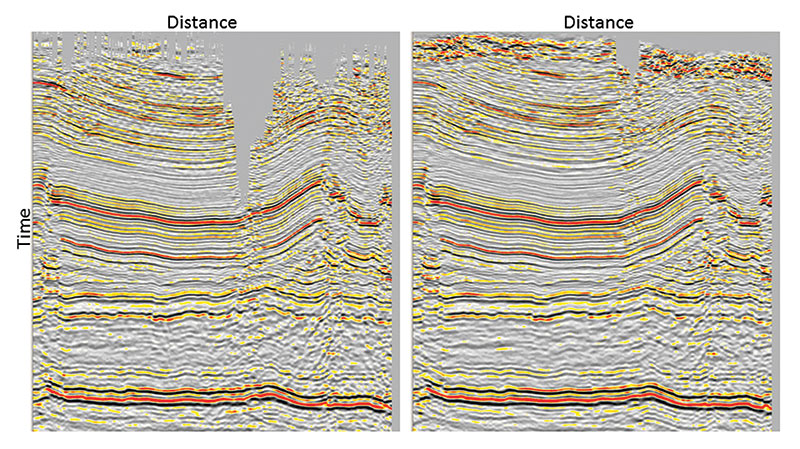
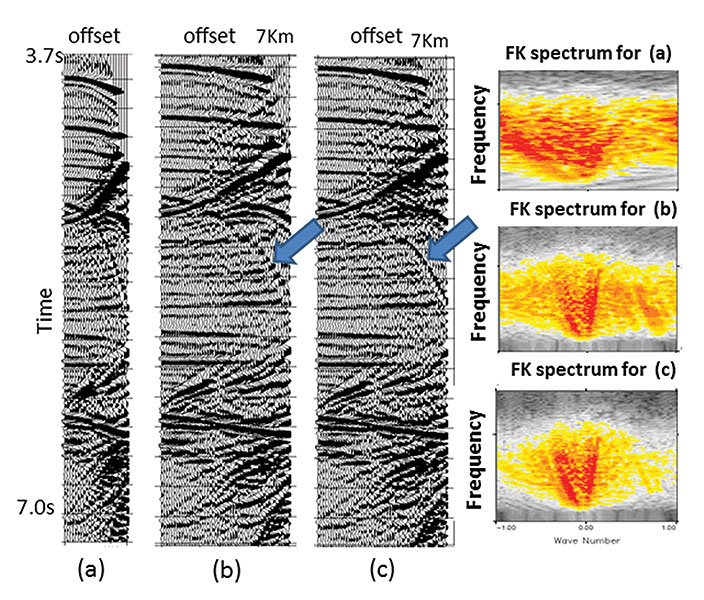
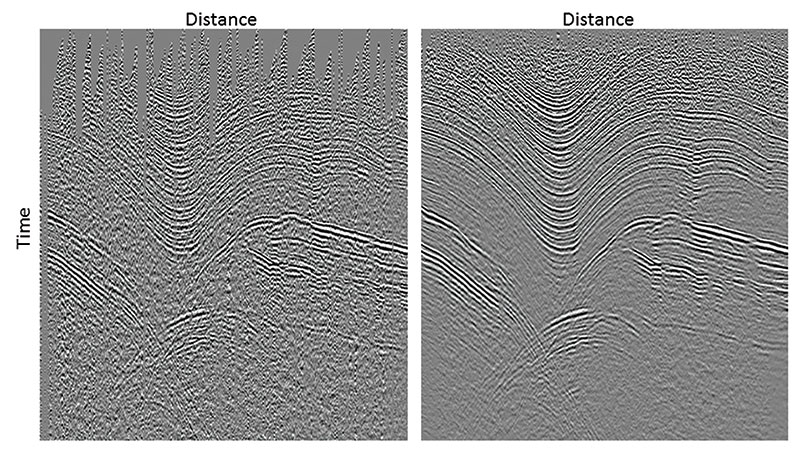
Differences with Interpolators The breakthrough on 5-D These restrictions are band limitation and smoothness in the spectrum. Although in practice we can only approximately enforce these constraints, Figure 1 shows a prestack migration result with and without 5-D In many aspects, 5-D Figure 2 shows a synthetic case from a complex salt environment, which is more difficult than most real scenarios because it has regular sampling and aliasing in all dimensions. In this case the use of standard band limitation plus an artificial sampling perturbation to the 5-D An area where 5-D However, there are many complications that often compromise the quality of 5-D interpolation may not converge, either because events become too complicated and break the sparseness assumption, or because the optimization problem becomes too large for the algorithm to converge in reasonable time.Diffractions are particularly good indicators of Another aspect that often deteriorates results is noise. In principle, random noise does not affect Five-D A general trend has been to reduce issues related to binning by using algorithms that can handle exact coordinates. These methods require special care in the use of weights to handle amplitude preservation, but they are becoming easier to use and more flexible. Another trend is to use more information by handling two versions of the data either for noise attenuation or for multicomponent data. Finally, new techniques like least-squares migration attempt the use of basis functions that can capture geological information. Although these techniques can be very expensive from the computational point of view, they have the advantage of including the physics of wave propagation, and therefore may allow geophysicists to go beyond 5-D |