Print this page
 Click to view article in PDF format.
GCIntegrated Data Enhance Dolomite Mapping*
Ritsh Kumar Sharma¹, Satinder Chopra¹, and Amit Kumar Ray¹
Search and Discovery Article #41440 (2014)
Posted September 22, 2014
*Adapted from the Geophysical Corner column, prepared by the authors, in AAPG Explorer, September, 2014. Editor of Geophysical Corner is Satinder Chopra ([email protected]). Managing Editor of AAPG Explorer is Vern Stefanic.
¹Arcis  Seismic
 Solutions, TGS, Calgary, Canada ([email protected])
Carbonate sedimentary rocks that have been dolomitized and laterally sealed by tight undolomitized limestone frequently are seen to produce hydrocarbons. The process of dolomitization increases the crystal size and pore size, and thus enhances its porosity and permeability.
As dolomites are less ductile relative to limestones and sandstones, their porosity and permeability also are enhanced by fracturing. Additionally, as they are less reactive than calcites, dolomites are less likely to lose porosity with depth due to dissolution or re-precipitation. For this reason, dolomites often make better reservoirs in carbonates.
Of course the reservoir geometry usually depends on the process of dolomitization and stratigraphic architectures – however, the differentiation between limestones and dolomites is a challenge. The purpose of this article is to describe a workflow for discriminating limestones and dolomites, and to map the lateral extent of dolomite reservoir rocks that have a thickness below the seismic resolution.
|
♦General statement ♦Figures ♦Method ♦Example ♦Conclusion ♦Acknowledgment
♦General statement ♦Figures ♦Method ♦Example ♦Conclusion ♦Acknowledgment
♦General statement ♦Figures ♦Method ♦Example ♦Conclusion ♦Acknowledgment
♦General statement ♦Figures ♦Method ♦Example ♦Conclusion ♦Acknowledgment
♦General statement ♦Figures ♦Method ♦Example ♦Conclusion ♦Acknowledgment |
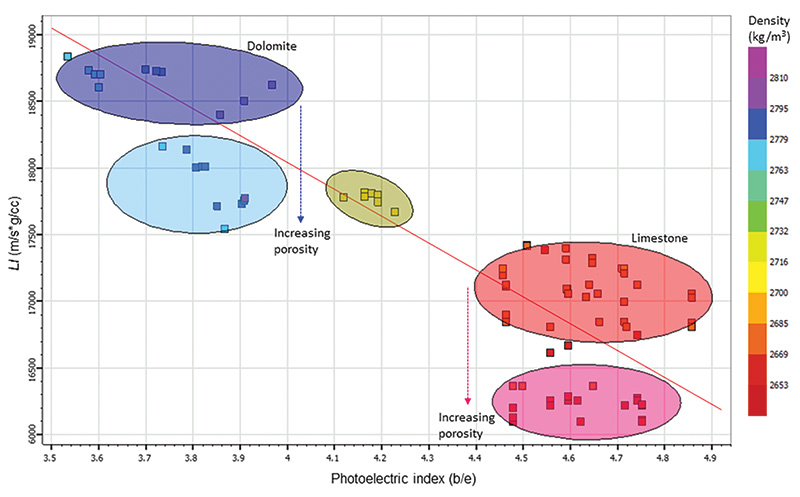
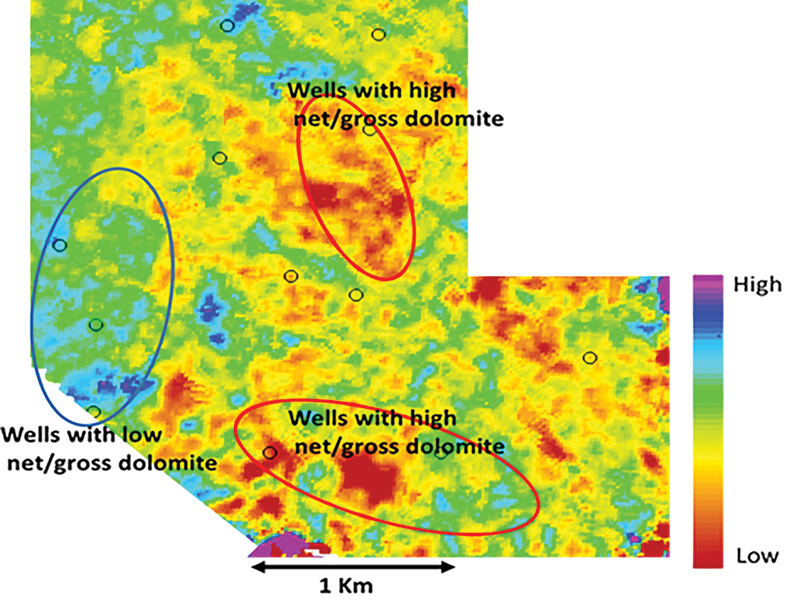
One accepted model for dolomitization is that when hot magnesium-rich brines flow along conduits (faults and fractures) in limestone, hydrothermal dolomites and the associated minerals and fabrics are formed. For the Upper Ordovician Trenton and Black River carbonates in eastern Canada the magnesium required for dolomite precipitation was supplied by magnesium-rich seawater-derived (Silurian and/or Devonian) saline waters from the dissolution of Silurian evaporates. These waters became heated during their descent along faults and fractures to reservoir depths at the center of the basin. Hot basinal brines migrated laterally through basal sandstones, ascended into the network of faults and fractures and precipitated fracture-related dolomite. Compared with clastic reservoirs, the characterization of dolomite reservoirs presents challenges, because many of the conventional methods – comprising attributes such as Lambda-Rho and Mu-rho – are not very effective. Consequently, we need to look for alternative methods for their characterization. While making measurements in the wells (logging), the latest density logging tools make it possible to differentiate between dolomites and limestones using the photoelectric index log. The tool has a gamma ray source that emits the radiation, which enters the formation (about an inch or so), gets scattered and loses energy. The intensity of the back-scattered radiation is picked up by the detectors installed on the tool. While the higher energy part of the backscattered radiation is related to the density, the low energy component is a measure of the average atomic number of the formation or the rock matrix properties (lithology). Fluids have very low atomic numbers, and so have little influence – the limitation, however, is the availability of Pe curves only at well locations. As there is no direct way of computing a 3-D volume of Pe from We demonstrate an integrated workflow in which well data and Instead of using these two separate attributes, it is possible to differentiate between limestone and dolomite by rotating the clusters in a counterclockwise direction. Such a rotation leads to a new Next, to be able to derive the Pe For deriving these attributes from As the target dolomite reservoir is thin, it is necessary to enhance the resolution of the Using the relationship between LI and Pe established from the well, we transform the LI volume into a 3-D volume of Pe, and use that to infer the dolomitic zones. To Rotation of data in P-impedance versus S-impedance crossplot space facilitates the computation of a single The derived Pe volume was analyzed, and a fairly good match was seen at the blind wells. It was found that throughout the area covered by the 3-D We thank Arcis |