Print this page
 Click to view article in PDF format.
GCExtracting Information from Texture  Attributes
 *
*
Satinder Chopra¹ and Kurt J. Marfurt²
Search and Discovery Article #41330 (2014).
Posted April 28, 2014
*Adapted from the Geophysical Corner column, prepared by the author, in AAPG Explorer, March, 2014.
Editor of Geophysical Corner is Satinder Chopra ([email protected]). Managing Editor of AAPG Explorer is Vern Stefanic.
¹Arcis Corp., Calgary, Canada ([email protected])
²University of Oklahoma, Norman, Oklahoma
There are a number of seismic attributes that are derived from seismic amplitudes to facilitate the interpretation of geologic structure, stratigraphy and rock/pore fluid properties.
1) The earliest attributes were extracted by treating seismic amplitudes as analytic signals for aiding feature identification and interpretation. As the computation of these attributes is carried out at each sample of the seismic trace, they are referred to as instantaneous attributes.
2) This development was followed by attributes that are derived by transforming seismic amplitudes into impedance or velocity. Also called seismic impedance inversion attributes, these attributes yield lithology or fluid information that can be calibrated with well logs.
3) A third class of attributes quantifies the lateral changes in waveform using an ensemble of windowed traces in the inline and crossline directions. Such geometric attributes include dip, coherence and curvature, and are routinely used to accelerate and quantify the interpretation of faults, fractures and folds from 3-D seismic data.
4) While texture attributes are less familiar to seismic interpreters, seismic texture forms the basis of seismic stratigraphy, giving rise to descriptions of "concordant," "blocky," "hummocky" and "chaotic" pictures.
|
|
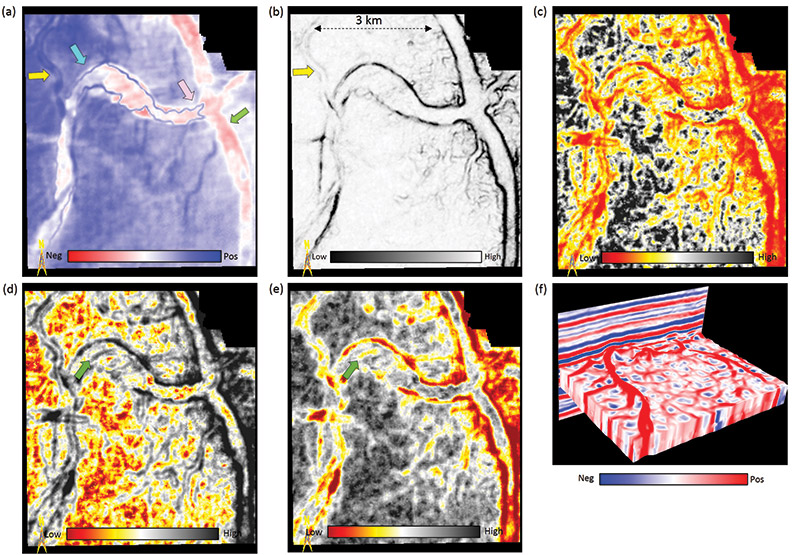
Quantitative texture analysis is one of the primary tools in remote sensing of forestry, agriculture and urban planning. The classic definition of texture defines a window, such as the human thumb, sampling subtle changes in elevation. Rubbing your thumb across nearby surfaces may give rise to textures you may describe as smooth, rough, silky, corrugated, wavy or chaotic. Most people can easily recognize pine, oak, maple, ash, mahogany, teak and many other woods from their grain, but may have difficulty explaining how they are able to distinguish them. For this reason, it is difficult to teach a computer to recognize such patterns. Most remote sensing and industrial applications use statistical measures of the gray-level co-occurrence matrix, or GLCM, which measures the repetition of a pattern from point-to-point. Thus a "brick pattern" in North America would have mortar every 12 inches horizontally and four inches vertically. GLCM seismic analysis might search for vertical patterns such as onlap, frequency and parallelism. In this article we search for lateral patterns in the seismic data along structural dip. We find three texture Somewhat confusingly, the GLCM energy is a measure of the energy of the GLCM matrix and not of the seismic data itself. For this reason, a checkerboard pattern, which has many adjacent red and black pixels, will have high GLCM energy, high homogeneity and low entropy. A smooth pattern will have high homogeneity, moderate energy and low entropy. We illustrate the application of these texture This main channel is seen to have a definite outline in blue on the seismic display, and at the location of the pink arrow it merges with the vertical channel to the right (green arrow), which appears to have undergone lesser differential compaction. A thin vertical channel seen on the seismic amplitude display in Figure 1a (yellow arrow) is seen with a better definition on the coherence. While coherence shows the edges of the channel, it gives little indication of the heterogeneity or uniformity of the channel fill. Notice the clear definition of this channel on the three texture Unlike geometric |
 General statement