Print this page
 Click to view article in PDF format.
GCAdding Texture  Attributes
 to the 3-D Mix*
Paul de Groot1, Farrukh Qayyum1, and Nanne Hemstra1
Search and Discovery Article #41244 (2013)
Posted November 25, 2013
*Adapted from the Geophysical Corner column, prepared by the author, in AAPG Explorer, November, 2013.
Editor of Geophysical Corner is Satinder Chopra ([email protected]). Managing Editor of AAPG Explorer is Vern Stefanic
1dGB Earth Sciences, Enschede, Netherlands ([email protected])
In a previous Geophysical Corner “A New Approach to Stratigraphic Interpretation”, Search and Discovery Article #41195, (http://www.searchanddiscovery.com/documents/2013/41195qayyum/qayyum.htm?q=+textStrip:41195) we introduced a new set of seismic attributes that play an important role in extracting detailed stratigraphic information from seismic data. The attributes in question were derived from a HorizonCube, an interpretation technique that provides fully interpreted seismic volumes where horizons are automatically tracked between a given set of framework horizons and faults. Here, we go further and examine one other set of attributes – specifically, texture attributes, and how they can combine with HorizonCube attributes for 3-D segmentation.
|
|
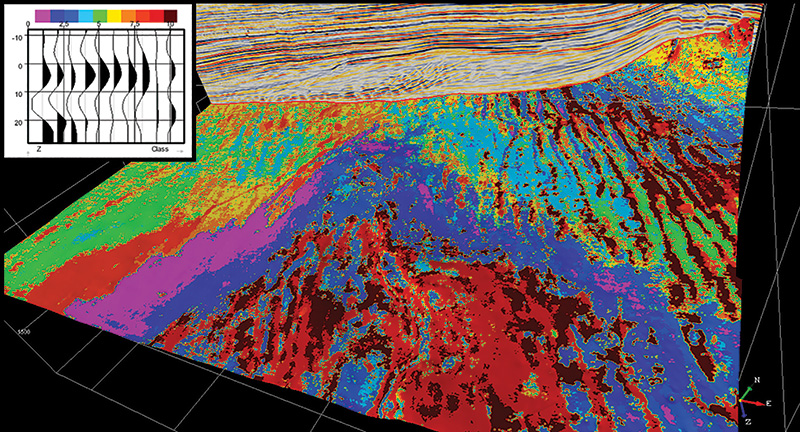
Neural network-based waveform segmentation workflows have proved to be a highly valuable instrument for seismic interpreters to quickly visualize seismic patterns in a relatively thin interval of interest (see Figure 1). These networks compare the input vector (the waveform) with a set of pre-calculated vectors that represent segment (cluster) centers. The resulting segmentation maps show the winning segment center for each position – and such maps often reveal patterns that can be interpreted in terms of geological features. Neural network-based segmentation also can be performed in 3-D. However, this cannot be done by feeding the neural network with waveforms, as is done in the horizon-guided approach. This is because waveforms change along the application window while segment centers are fixed.
The solution to this problem is to feed the neural work with phase-independent seismic
There are two particular sets of Attributes derived from a HorizonCube and that were described in the
previous article.attributes. Texture A GLCM is a 2-D matrix of N x N dimensions representing the amplitude values of the reference pixel versus the amplitudes of the neighboring pixel. The matrix is filled by comparing each amplitude in the input area (volume) with its direct neighbor and increasing the occurrence of the corresponding matrix cell. This is repeated for all amplitude pairs in the input cube, which then are converted into probabilities. The GLCM thus captures how probable it is to find pairs of neighboring amplitudes in the area (volume) around the evaluation point. Texture The GLCM input volume can be “dipsteered,” meaning that the input follows the stratigraphic layering, which results in sharper attribute responses for dipping strata. Three groups of texture In each group, the Figure 1 shows a horizon-guided UVQ waveform segmentation map that captured the seismic response below a maximum flooding surface in a wave-dominated Pliocene deltaic setting, offshore Netherlands. The UVQ network was trained to segment the interval of interest into 10 segments. The UVQ segmentation map reveals several key geomorphological patterns that help to understand the depositional environment and the influence of salt tectonics. The NW-SE oriented dark brown-red features on the right are sand ridges of 10-20 meters in height, developed parallel to the coast. These features are analogous to present day deposits observed along the Dutch coast. Furthermore, NE-SW oriented deepwater channel systems are recognized (purple-red, on the left). These narrow channel-levee systems are developed as a result of halo kinetic movement of Zechstein Salt in the northeast (upper right) corner of the image. Up-dip these channels cross-cut the sand ridges while down-dip they meander and bifurcate into the basin, where turbiditic deposits could be developed.
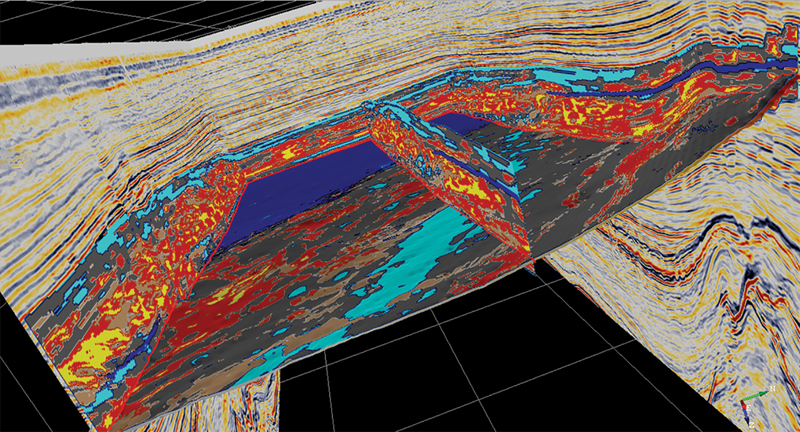
Figure 2 shows a seismic display for UVQ segmentation using both texture and HorizonCube
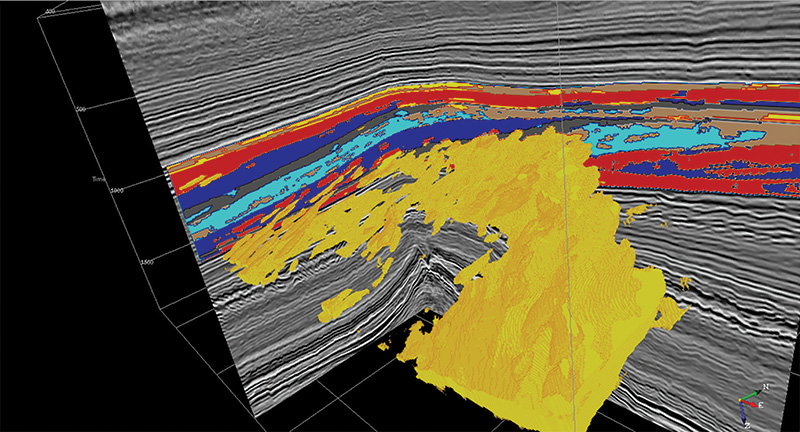
In addition to texture and energy HorizonCube |
 General statement