Print this page
 Click to view article in PDF format.
GCWhat is Seismic Interpretation?*
Alistair Brown1
Search and Discovery Article #41125 (2013)
Posted May 17, 2013
*Adapted from the Geophysical Corner column, prepared by the author, in AAPG Explorer, May, 2013. Editor of Geophysical Corner is Satinder Chopra ([email protected]). Managing Editor of AAPG Explorer is Vern Stefanic
1Consulting Reservoir Geophysicist, Allen, Texas ([email protected])
Seismic Interpretation is the extraction of subsurface geologic information from seismic  data
data . On that definition we all are agreed.
However, if we seek a more penetrating explanation, we find practitioners get tongue-tied and talk around the subject in a variety of ways. In this article I attempt to give a longer, more descriptive definition that will apply to every interpretation project involving reflection seismic data. The danger in seismic interpretation is in thinking that everything we see is geology!
Reflection seismic data comprise:
data defects.Seismic interpretation is the thoughtful procedure of separating these effects. The seismic wavelet starts as the pulse of seismic energy, which, generated by the energy source, travels down through the Earth, is reflected and travels back up to the surface receivers carrying the geological information with it. This recorded wavelet is a minimum phase of some frequency bandwidth, and during data processing it is converted (we hope) into a zero-phase wavelet, making interpretation easier and more accurate.
The interpreter is not directly interested in the wavelet itself but rather in the geological information that it carries. Thus, understanding the wavelet and distinguishing its characteristics from details of the geology is one of the critical tasks of today's interpreter.
|
|
Noise is ever-present in seismic data acquisition showing as footprint.
data acquisition crew.
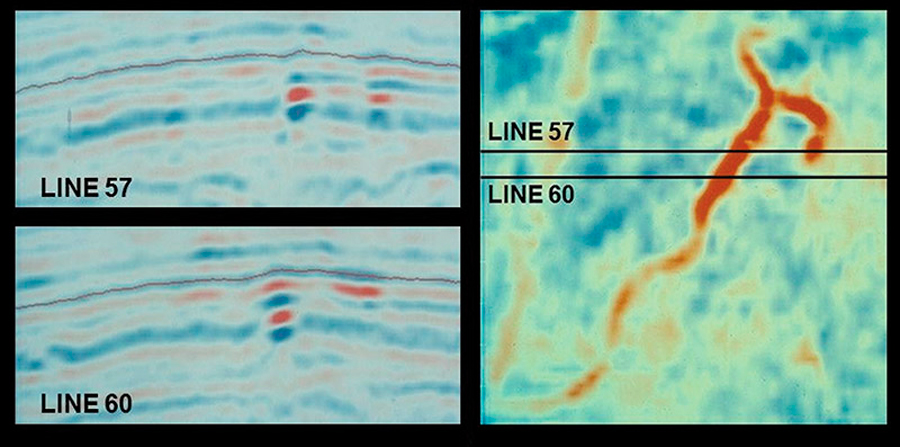
The interpreter must know enough about the acquisition and processing to recognize these undesirable features, and thus to not confuse them with the geology he/she seeks. Seismic energy is reflected from interfaces where the acoustic properties of the rocks change. These interfaces follow sedimentary boundaries created at the time of deposition of the sediments. Following the continuity of these reflections then defines for us the structure imposed on these boundaries by the tectonic forces of geologic history. Following this continuity and making structure maps is thus the most basic, and most traditional, activity of seismic interpretation. To aid in this endeavor the seismic interpreter can manipulate the The interpreter also may compress the display color bar to optically saturate and thus to render invisible more of the amplitude variations. Other Defining Stratigraphy and Reservoir Once the structure has been established, the interpreter turns his attention to stratigraphic interpretation and the detection of hydrocarbon fluids. Overwhelmingly important here is seismic amplitude - and the amplitude may be presented to the interpreter or extracted from the In order to increase the visibility of stratigraphic variations the interpreter will remove the structure - and the best way to do this is to make a Horizon Slice. The concept behind the Horizon Slice is the reconstitution of a depositional surface at a key point in geologic history. The structure used for the reconstitution is most commonly defined at the level of the objective. However, it is often better to define the structure at one level (conformable with the objective) and to use this to remove the structure at the objective level. This very effectively separates structure into step one and stratigraphy into step two. This procedure is illustrated in the accompanying
Figure 1. The horizon tracked on the two vertical sections follows a reflection with good When the seismic interpreter extends his analysis even further and enters the field of reservoir The more advanced forms of inversion seek to remove the wavelet, and this is therefore part of the fundamental idea of separating effects. However, the challenge here is to exactly understand the wavelet that has to be removed. This is difficult, and many inversions suffer and projects fail because of this issue. So seismic interpretation is the thoughtful separation (with workstation assistance) of the various effects that the subsurface and the seismic acquisition process have mixed together! |
 General statement