Print this page
  Click to view article in PDF format.
GC Microseismic
 Data from Hydraulic Fracturing Can Locate Faults*
Carlos Cabarcas1 and Oswaldo Davogustto2
Search and Discovery Article #41119 (2013)
Posted March 25, 2013
*Adapted from the Geophysical Corner column, prepared by the authors, in AAPG Explorer, February, 2013, and entitled "Micro MDPs Can Be a Big Tool in Fault Finding". Editor of Geophysical Corner is Satinder Chopra ([email protected]). Managing Editor of AAPG Explorer is Vern Stefanic
11Hilcorp Energy Company, and University of Oklahoma, Norman, Oklahoma
2University of Oklahoma, Norman, Oklahoma
Microseismic technology is crucial these days for understanding reservoirs and planning development programs:
microseismic is used to monitor seismic activity generated during hydraulic fracturing.
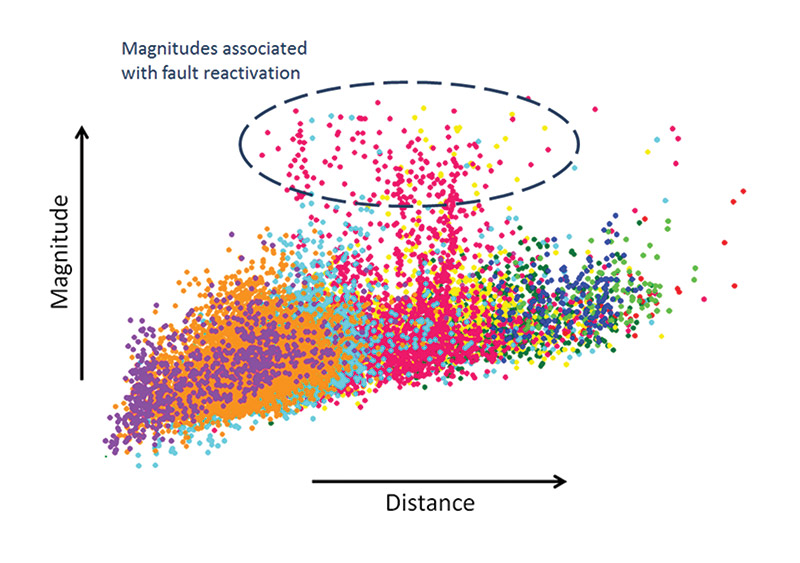
microseismic technology is referred to as magnitude.microseismic events are proportional to the size of the surface and the displacement involved in faulting. Assuming that surfaces and displacements associated with preexisting faults are bigger than those of hydraulically induced fractures, during hydraulic stimulation the registered higher magnitudes should characterize fault reactivation.Magnitude is usually one of the parameters derived from borehole microseismic measurements. Additionally, microseismic recording sensors only detect microseismic events occurring within a certain radius from them - usually no more than a few thousand feet.
One way to quantify this phenomenon is with a Magnitude vs. Distance Plot (MDP). This plot shows the relationship between the energy associated with a particular event and its distance from the monitor well. The MDP is a useful analysis tool in microseismic interpretation for all the information it summarizes on a simple graphic display.
Events with a combination of highest magnitude and highest distance away from the monitor well define the maximum detection distance, which can be used to plan the maximum distance for monitor well placement in future jobs. The rest of the recorded events populate the middle upper left portion of the MDP graph, forming a quasi-triangular pattern. The presence of faults in the subsurface - and their reactivation during hydraulic stimulation - thus becomes noticeable on MDPs, because magnitudes of events associated with fault reactivation are usually higher than the rest.
|
|
We use the Magnitude vs. Distance Plot (MDP) to discern fault reactivation in this More than a year after the stimulation of the well associated with
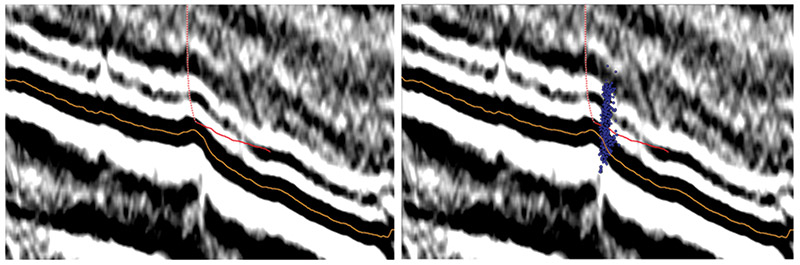
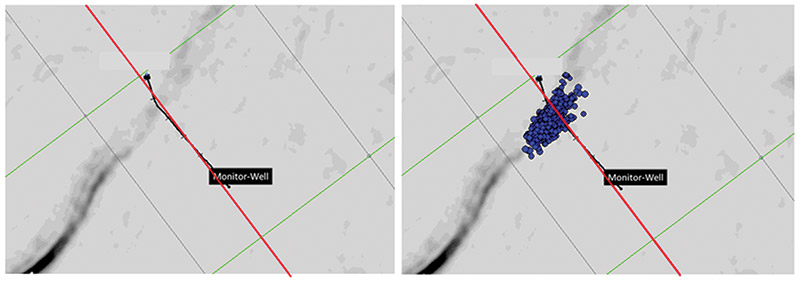
Figure 1, newly available 3-D reflection seismic data provided a better image of the subsurface near the well. Unfortunately, due to resolution limitations, the broadband frequency data from this 3-D reflection seismic survey does not provide unequivocal evidence for the presence of a fault. By coupling the 3-D seismic data with the In Figure 2 we show sections with and without the By computing similarity on the 3-D seismic volume and extracting a surface slice from seismic data at the zone of interest, we interpret the presence of a fault crossing the path of the treatment well. The good correlation between Figure 3 also shows that the azimuth of the event cloud associated with the fault reactivation is different from the azimuth inferred from previous stimulation stages. This characteristic, solely based on We suggest that in the absence of additional supporting data, an azimuth change observed from The example presented here serves to validate and support the use of We also show that 3-D seismic is a powerful tool to mitigate drilling and completion risks as those encountered when faults are not anticipated along the well path. Availability of 3-D seismic data beforehand could have improved well placement and possibly resulted in lower completion costs and better well performance. We would like to thank the management of Hilcorp Energy Company for permission to publish this work, as well as its support on the application of new technologies. In addition, we would like to thank Seitel Inc. for permission to publish their seismic profiles, and Dawn Henderson for her help editing this document. |
 General statement