Print this page
  Click to view article in PDF format.
GCImpedance  Inversion
 May Help Characterize Reservoir*
Satinder Chopra1and Ritesh Kumar Sharma1
Search and Discovery Article #41099 (2012)
Posted December 17, 2012
*Adapted from the Geophysical Corner column, prepared by the author, in AAPG Explorer, December, 2012, and entitled "A Solid Step Toward Accurate Interpretations". Editor of Geophysical Corner is Satinder Chopra ([email protected]). Managing Editor of AAPG Explorer is Vern Stefanic. AAPG©2012
1 Arcis Corp., Calgary, Canada ([email protected])
In the November 2012 Geophysical Corner we discussed the unsupervised seismic waveform classification method, which provides qualitative information on lithology in terms of facies variation in a given subsurface target zone. While this information is useful, more work needs to be done for characterizing such formations of interest in terms of porosity and fluid content. For this purpose, impedance inversion of seismic data could be used, which essentially means transforming seismic amplitudes into impedance values. Here we discuss here such impedance characterization of the formations of interest.
|
|
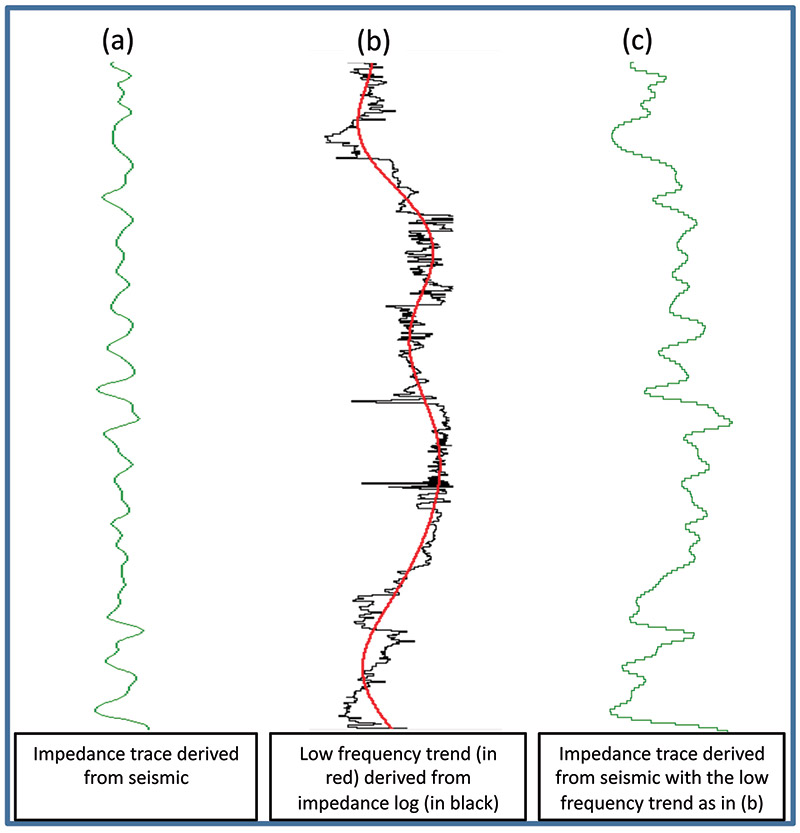
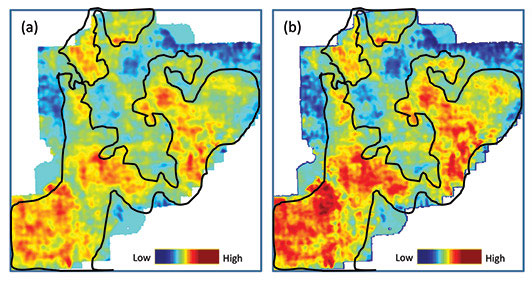
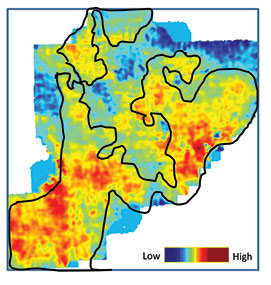
Sonic logs, on the other hand, have a very broad frequency bandwidth, extending from 0 to well over many kilohertz. While the high frequencies show the high-resolution information on the log, the low frequencies exhibit the basic velocity structure or the subsurface compaction trend. As these low frequencies are not present in the When In Figure 1, the addition of the low-frequency trend is demonstrated to the inverted impedance trace from In the November 2012 Geophysical Corner we discussed the In Figure 2a we show a horizon slice from the relative acoustic impedance volume derived from the input The May 2008 Geophysical Corner described a thin-bed reflectivity We derived the reflectivity from the Impedance We thank Arcis |
 General statement