Print this page
  Click to view article in PDF format.
GCAn Effective Way to Find Formation Brittleness*
Ritesh Kumar Sharma1 and Satinder Chopra1
Search and Discovery Article #41024 (2012)
Posted September 10, 2012
*Adapted from the Geophysical Corner column, prepared by the author, in AAPG Explorer, September, 2012. Editor of Geophysical Corner is Satinder Chopra ([email protected]). Managing Editor of AAPG Explorer is Vern Stefanic; Larry Nation is Communications Director. AAPG©2012
1 Arcis Corp., Calgary, Canada ([email protected])
The discrimination of fluid content and lithology in a reservoir is an important characterization that has a bearing on reservoir development and its management. For the unconventional reservoirs, such as shale gas formations, besides other favorable considerations that are expected of them, it is vital that reservoir zones are brittle. Brittle zones frac better, and fracing of shale gas reservoirs is required for their production.
Among the different physical parameters that characterize the rocks, Young's modulus (E) is a measure of their brittleness. Attempts are usually made to determine this physical constant from well log data, but such measurements are localized over a small area. For studying lateral variation of brittleness in an area, 3-D  seismic
 data needs to be used, because computation of Young's modulus from seismic data requires the availability of density (ρ). The computation of density, in turn, requires long offset data, which usually is not available.
In this study, we propose a new attribute (Eρ) in the form of a product of Young's modulus and density, which can be determined from seismic data without the requirement for long-offsets. For a brittle rock, both Young's modulus and density are expected to be high, and so the Eρ attribute would exhibit a high value and serve as a brittleness indicator.
|
|
Mechanical Characterization of The determination of lithology and fluid content distribution in a reservoir is a desirable objective for its characterization and subsequent management. Physical properties such as porosity and permeability make it possible to evaluate a hydrocarbon reservoir - however, the properties that have a direct impact on the relevant elastic constants, among others, are bulk modulus, shear modulus and Young's modulus.
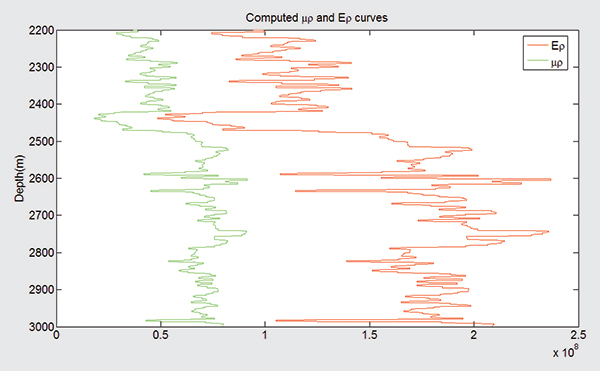
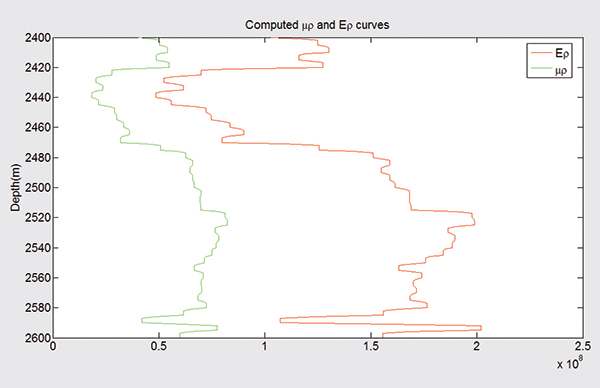
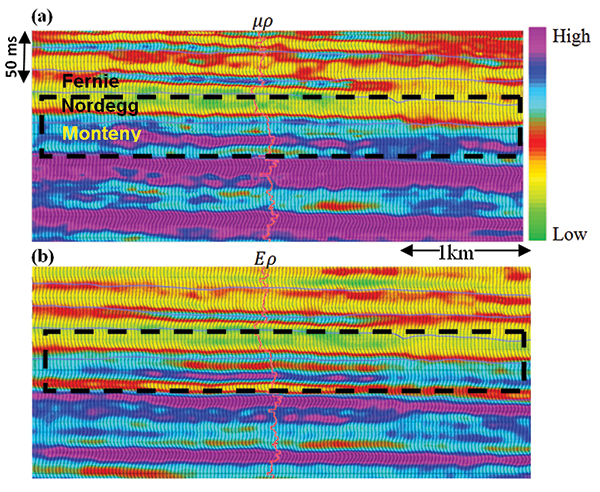
Historically, geoscientists have attempted to delineate the fluid and lithology content of a reservoir on the basis of these physical properties. An estimation of the physical properties described above requires P-impedance, S-impedance and density. For computing these prerequisites, prestack inversion of surface In the absence of density, efforts have been made for characterization of a reservoir in terms of lithology and fluid content. For this purpose, P-impedance and S-impedance are used for litho-fluid discrimination, as the former is sensitive to fluid, whereas the latter is not. The determination of The stiffness of a Considering the importance of a lithology indicator as well as an attribute that could yield information on the brittleness of a reservoir, we propose a new attribute, Eρ, which is the product of Young's modulus and density. It can be derived from the P-impedance and S-impedance and can be shown to be a scaled version of μρ. For a brittle In Figure 1 we show a comparison of the μρ and Eρ curves for a well in northern Alberta. Notice the Eρ curve emphasizes the variation corresponding to lithology change more than in the μρ curve. For ease in interpretation, we segment the input log curves - and the results shown in Figure 2 stand out nice and clear. For implementation of this analysis on The Nordegg-Montney interface is a regional unconformity that separates the Jurassic and Triassic strata in the area. The Montney Formation is composed of fine-grained siltstone grading to fine-grained sandstones, with limited shale content. There is a diagenetic dolomitic overprinting on the siltstones and sandstones. In local areas of the Montney there is a coquina facies made up of bivalves. As the first step, simultaneous impedance inversion was run on the preconditioned 3-D In Figures 3a and 3b, we show segments of vertical sections from the μρ and Eρ volumes, respectively. Notice Eρ has a higher level of detail than the μρ attribute. The upper parts of the figures exhibit lower values of the attributes as they correspond to the sandstone presence, whereas the higher values are seen in the lower part, verifying the availability of dolomitic siltstone in this zone. We have proposed a new attribute (Eρ) in the form of a product of Young's modulus and density, which is a good lithology indicator. We describe it as a scaled version of the μρ attribute and illustrate that it intensifies the variation in lithology. This attribute can be derived seismically, and we have shown that with it we can determine the brittleness of a formation. We thank Athabasca Oil Corporation for giving us permission for presentation of the results shown in this study. We also thank Arcis |
 General statement