Print this page
  Click to view article in PDF format.
GCTying 2-D  Seismic
 Lines in Overthrust Settings*
Rob Vestrum1
Search and Discovery Article #41007 (2012)
Posted August 27, 2012
*Adapted from the Geophysical Corner column, prepared by the author, in AAPG Explorer, August, 2012, and entitled "In Overthrust Settings, Tie, Tie (2-D) Again". Editor of Geophysical Corner is Satinder Chopra ([email protected]). Managing Editor of AAPG Explorer is Vern Stefanic; Larry Nation is Communications Director. AAPG©2012
1 Thrust Belt Imaging, Calgary, Canada ([email protected])
In the rough terrain of overthrust settings, 2-D seismic data continues to be a standard tool for subsurface mapping - and not only because of economic reasons. Two-D and 3-D seismic surveys are complementary in land environments, because each data type has its own strength and weakness.
Three-D seismic data gives us a three-dimensional image volume of the subsurface, with no out-of-plane energy problems or potential to miss structural details between 2-D profiles. With such limitations in 2-D seismic data, one might argue that a better exploration strategy would be to just shoot 3-D surveys and not bother with 2-D seismic data, which may be getting obsolete. However, in land seismic acquisition with rough terrain and heavy vegetation, access restrictions make the logistics difficult and expensive to acquire 3-D seismic data with high density. Two-D surveys give us overall higher fold and much higher resolution - and the improved resolution in the shallow section helps us tie surface geology to the subsurface reflectors.
Where 2-D and 3-D data overlap, the 2-D lines can complement the 3-D interpretation with a higher-resolution perspective. So, for scientific as well as economic reasons, 2-D seismic data will continue to be a mainstay in resource exploration in compressional and transpressional geologic settings. One of the major pitfalls when interpreting 2-D seismic data is dealing with out-of-plane reflections, especially when trying to tie intersecting lines in structured areas. Structural geologists and interpretation geophysicists can understand the problem of reflection event correlation across intersecting depth profiles and overcome the difficulty by considering the direction of propagation of seismic energy.
|
|
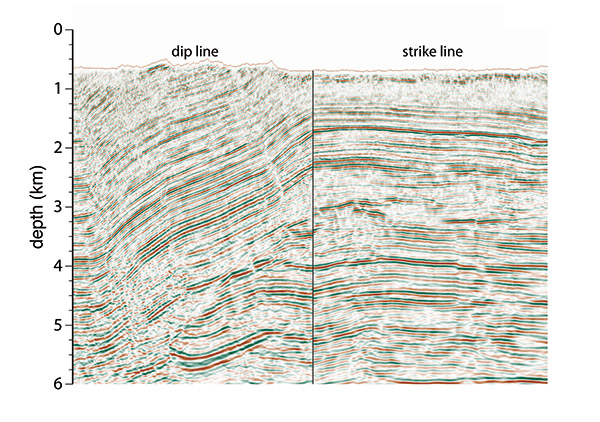
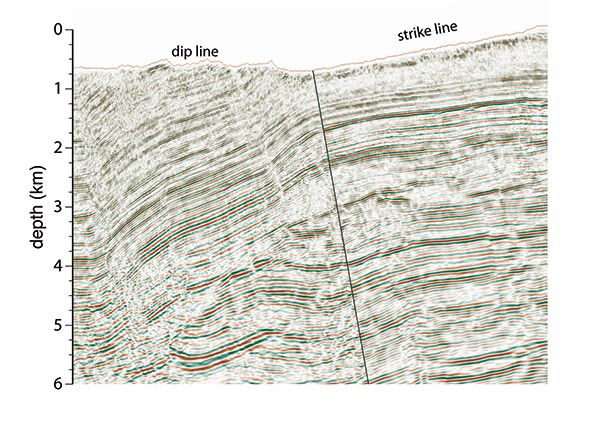
Tying 2-D Profiles in Structure When processing Figure 1 shows two intersecting depth-migrated lines over a thrusted structure in the foothills of the Andes. The left half of the figure shows the dip line. The dips in the overthrust range between 10 degrees and 30 degrees. The right side if the figure is the intersecting strike line. Note that there is a reasonably good tie between the two lines below 3.5 kilometers depth, where there are relatively flat layers in the footwall. Above the fault (~3.3 kilometers depth at the intersection), the Since we illuminate the After the rotation (Figure 2), the reflector alignment is significantly improved between dip and strike lines in the hanging wall. The footwall When tying 2-D lines in structure, one must not only consider possible differences in static shifts and the phase of the We thank Arcis |
 General statement