Click to view article in PDF format.
GCDifferentiating Fluid and Rock Boundaries with Seismic*
Bob Hardage1
Search and Discovery
Article #40962 (2012)
Posted June 25, 2012
*Adapted from the Geophysical Corner column, prepared by the author, in AAPG Explorer, June, 2012, and entitled "Seismic and Boundaries: Is It Fluid or Rock". Editor of Geophysical Corner is Satinder Chopra
([email protected]).
Managing Editor of AAPG Explorer is Vern Stefanic; Larry Nation is Communications Director. AAPG©2012
1 Bureau of Economic Geology, The University of Texas at Austin ([email protected])
General Statement
Identifying and mapping fluid-contact boundaries within a reservoir system with seismic technology are common objectives when doing a characterization of a hydrocarbon reservoir – and monitoring the movement of fluid boundaries during secondary and tertiary recovery processes of oil always has been essential for optimizing oil production. When attempting to analyze a fluid-contact boundary, a seismic interpreter must confront a challenging problem – how do you determine if a particular seismic reflection event is caused by a contact boundary between two different fluids, or by the contact between two different rock  types
types ? Starting in the 1980s people began to see that an efficient way to answer this question was to acquire both P-wave and S-wave seismic data across a rock/fluid system that had to be interpreted.
|
 General statement General statement
Figures
Examples
Conclusion
Reference
General statement
Figures
Examples
Conclusion
Reference
General statement
Figures
Examples
Conclusion
Reference
|
Figure Captions
Examples
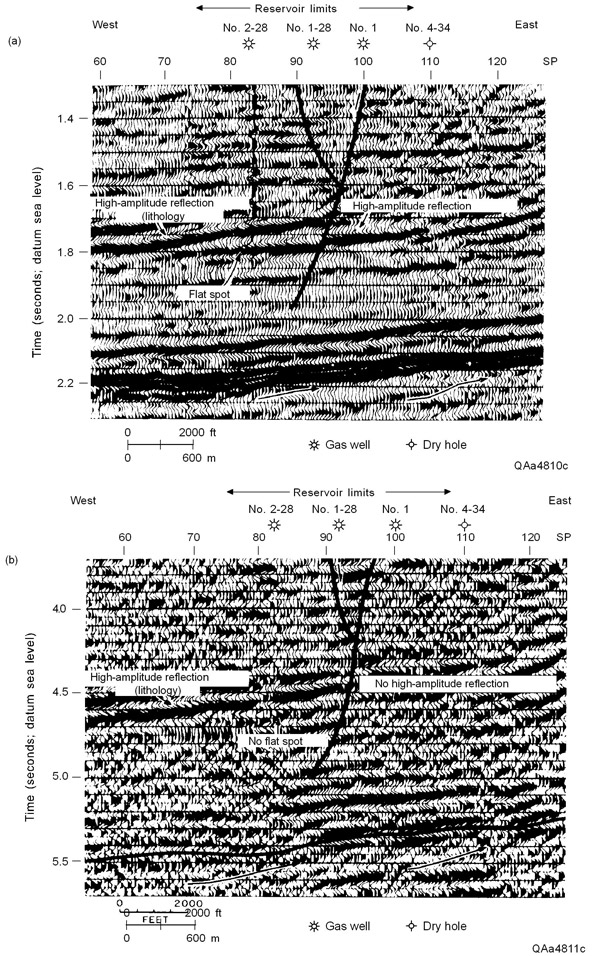
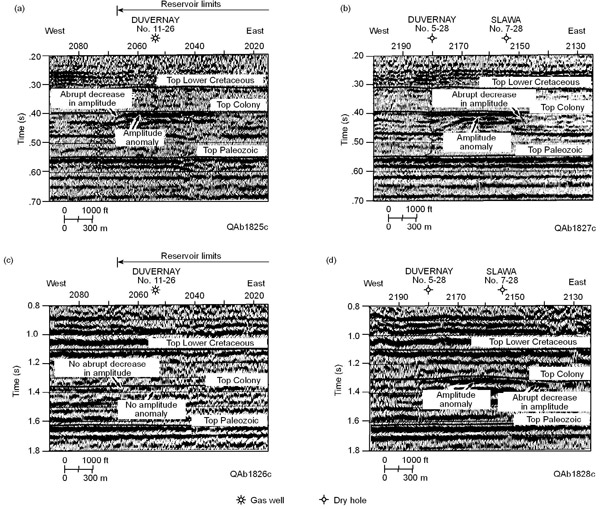
An example of a petrophysical interpretation that can be made from a combined analysis of P-wave and S-wave data is illustrated in Figure 1. These seismic profiles, published in 1985, follow the same track across a known gas field. Three reflection events are labeled on the P-wave profile; two of these profiles are absent on the S-wave profile. The common reflection that appears on both the P-wave and S-wave data is caused by a contact between two different rock types and is labeled as “lithology.” The two events that appear on the P-wave data but not on the S-wave data are contact boundaries between brine and gas. A second example that also appeared in the 1980s is presented as Figure 2. In this prospect area, the challenge was to determine if bold reflection events seen on P-wave data were caused by gas or by coal. If the cause was gas, the reflecting interface was a contact boundary between two fluids – gas and brine – embedded in the targeted sand interval. If the cause was coal, the reflecting interface was a contact boundary between two different lithologies – coal and its host sand. Wells were drilled that confirmed the following important findings:
- When a reflection event appeared on both P-wave and S-wave data, the event was caused by the contact between two different lithologies.
- When a reflection event appeared on P-wave data but not on S-wave data, the event was caused by a fluid-contact boundary (brine and gas in this instance).
Conclusion
The P-wave and S-wave seismic data displayed on Figure 1 and Figure 2 illustrate some important principles.
- First, P-wave seismic wavefields reflect from boundaries created by the contact between two different lithologies and also from the contact between two different pore fluids embedded in a constant-matrix host rock.
In contrast, S-wave seismic wavefields reflect from boundaries between contrasting lithologies but do not reflect from fluid contact boundaries unless there is a significant change in bulk density across the fluid boundary. Even when there is an appreciable change in bulk density between two contacting fluids, an S-wave reflection tends to be weak compared to the bold nature of its companion P-wave reflection from that same fluid-contact boundary.
- Second, when it is critical to identify and monitor fluid-contact boundaries, both P-wave and S-wave seismic data should be utilized.
S-wave data are needed to identify which P-wave reflections are associated with fluid boundaries; P-wave data are needed to map and quantify calendar-time changes in any reflection event that has been identified as a fluid-contact boundary. These well-established seismic principles are becoming more important now that there is increasing emphasis to sequester CO2 in brine-filled reservoirs.
Reference
Ensley, R.A., 1984, Comparison of P- and S-wave seismic data: A new method for detecting gas reservoirs: Geophysics, v. 49, p. 1420-1431. seismic data: A new method for detecting gas reservoirs: Geophysics, v. 49, p. 1420-1431.
Return
to top. |

 Print this page