Print this page
  Click to view article in PDF format.
GCDifferentiating Fluid and Rock Boundaries with Seismic*
Bob Hardage1
Search and Discovery Article #40962 (2012)
Posted June 25, 2012
*Adapted from the Geophysical Corner column, prepared by the author, in AAPG Explorer, June, 2012, and entitled "Seismic and Boundaries: Is It Fluid or Rock". Editor of Geophysical Corner is Satinder Chopra ([email protected]). Managing Editor of AAPG Explorer is Vern Stefanic; Larry Nation is Communications Director. AAPG©2012
1 Bureau of Economic Geology, The University of Texas at Austin ([email protected])
Identifying and mapping fluid-contact boundaries within a reservoir system with seismic technology are common objectives when doing a characterization of a hydrocarbon reservoir – and monitoring the movement of fluid boundaries during secondary and tertiary recovery processes of oil always has been essential for optimizing oil production. When attempting to analyze a fluid-contact  boundary
 , a seismic interpreter must confront a challenging problem – how do you determine if a particular seismic reflection event is caused by a contact boundary between two different fluids, or by the contact between two different rock types? Starting in the 1980s people began to see that an efficient way to answer this question was to acquire both P-wave and S-wave seismic data across a rock/fluid system that had to be interpreted.
|
|
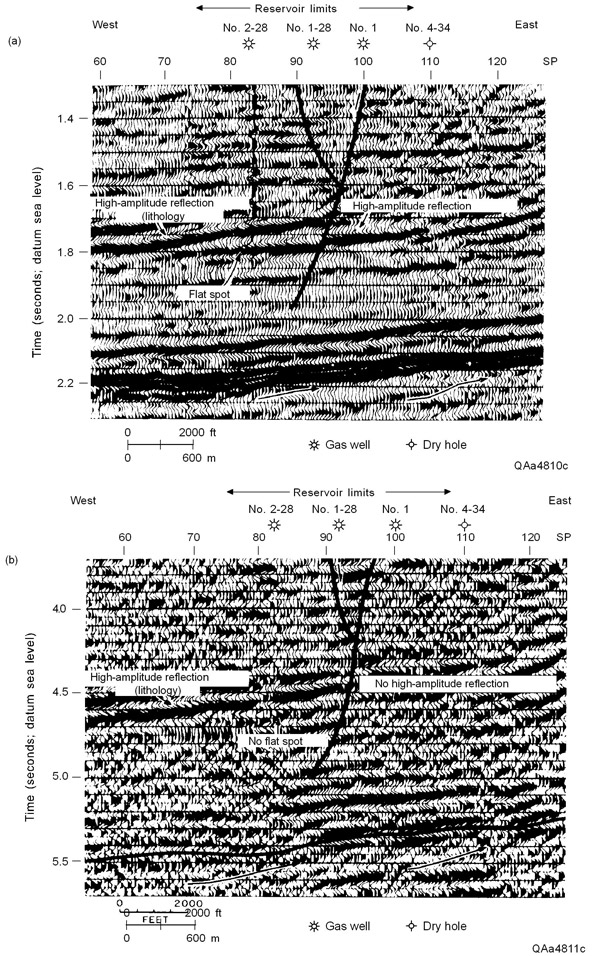
An example of a petrophysical interpretation that can be made from a combined analysis of P-wave and S-wave data is illustrated in Figure 1. These seismic profiles, published in 1985, follow the same track across a known gas field. Three reflection events are labeled on the P-wave profile; two of these profiles are absent on the S-wave profile. The common reflection that appears on both the P-wave and S-wave data is caused by a contact between two
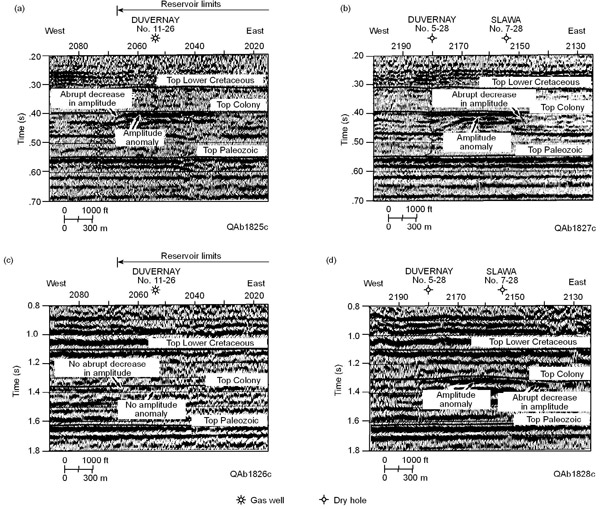
The P-wave and S-wave seismic data displayed on Figure 1 and Figure 2 illustrate some important principles.
In contrast, S-wave seismic wavefields reflect from boundaries between contrasting lithologies but do not reflect from fluid contact boundaries unless there is a significant change in bulk density across the fluid
S-wave data are needed to identify which P-wave reflections are associated with fluid boundaries; P-wave data are needed to map and quantify calendar-time changes in any reflection event that has been identified as a fluid-contact Ensley, R.A., 1984, Comparison of P- and S-wave seismic data: A new method for detecting gas reservoirs: Geophysics, v. 49, p. 1420-1431. |
 General statement