Print this page
  Click to view article in PDF format.
GCMulticomponent Seismic Augments Seismic Stratigraphy Interpretation*
Bob Hardage1
Search and Discovery Article #40888 (2012)
Posted February 20, 2012
*Adapted from the Geophysical Corner column, prepared by the authors, in AAPG Explorer, February, 2012, and entitled “Multicomponent Seismic Proves Its Value”. Editor of Geophysical Corner is Satinder Chopra ([email protected]). Managing Editor of AAPG Explorer is Vern Stefanic; Larry Nation is Communications Director.
1 Bureau of Economic Geology, The University of Texas at Austin ([email protected])
A fundamental thesis of elastic wavefield seismic stratigraphy (or multicomponent seismic stratigraphy) is that S- wave
wave seismic data have equal value to P-wave data for geological interpretation. Seismic stratigraphy analyses, then, should be based on interpreting P and S data in combination (the full elastic wavefield) rather than restricting interpretation to only single-component P-wave data (traditional seismic stratigraphy).
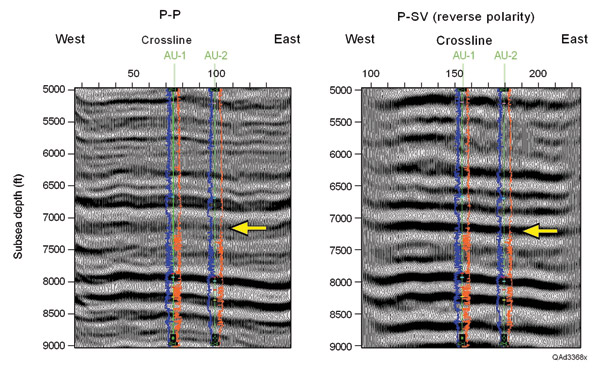
An example illustrating differences between P-wave and S-wave definitions of reflecting interfaces and the rock physics principles that cause this behavior are discussed here. The particular S-wave mode used in this example is the converted-shear (PSV) mode.
|
|
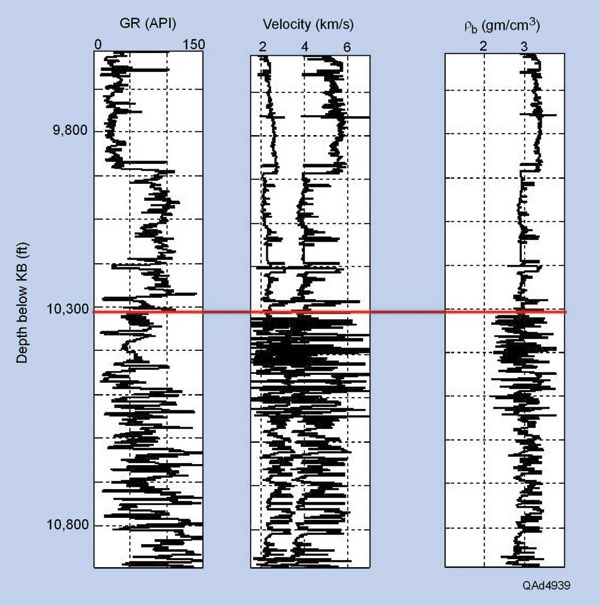
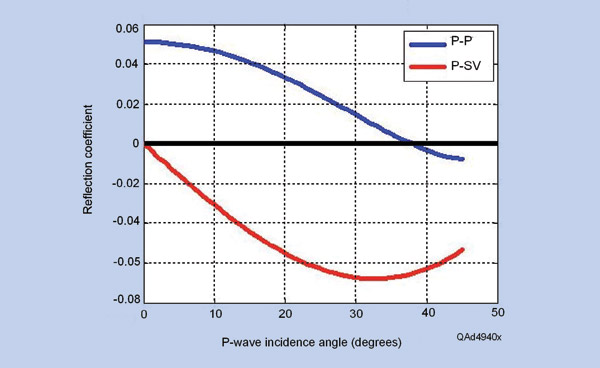
Marked contrasts between compressional- Well log data across the Wolfcamp interval local to this seismic profile are displayed on Figure 2. P-P and P-SV reflectivity behaviors are analyzed across the Wolfcamp interface, shown at a depth of approximately 10,300 feet, to demonstrate the geological reason for the difference in P-P and P-SV reflection amplitude strengths exhibited on Figure 1. Compressional- For example, P-P reflectivity exceeds 0.04 only for incidence angles between 0 and 15 degrees, but P-SV reflectivity has a magnitude greater than 0.04 for incidence angles between 15 degrees and 45 degrees – an angle range that is twice as large as that of the high-amplitude P-P response. Because the multicomponent seismic data across this study area were acquired with a full range of incidence angles, the difference in P-P and P-SV amplitude behavior shown on Figure 1 has a valid rock-physics basis. P-P amplitudes should be weaker than P-SV amplitudes, and the data exhibit that behavior. The principle documented by this example is that an elastic wavefield seismic stratigraphy interpretation based on both P-P and P-SV data can provide a different – and often a more valid – geological model of seismic sequence boundaries and seismic facies than can a single-mode seismic stratigraphy interpretation based on P-P data only. Future applications of seismic stratigraphy probably will rely more and more on full-elastic wavefield seismic data than on only single-component seismic data. |
 General statement