Print this page
  Click to view article in PDF format.
GCReflector Convergence and Rotation Attributes Facilitate Seismic Stratigraphy Interpretation*
Satinder Chopra1 and Kurt J. Marfurt2
Search and Discovery Article #40876 (2012)
Posted January 30, 2012
*Adapted from the Geophysical Corner column, prepared by the authors, in AAPG Explorer, January, 2012, and entitled “The Final Touch: Attributes Prove Their Worth”. Editor of Geophysical Corner is Bob A. Hardage ([email protected]). Managing Editor of AAPG Explorer is Vern Stefanic; Larry Nation is Communications Director.
1 Arcis Corp., Calgary, Canada ([email protected])
2 University of Oklahoma, Norman, Oklahoma
Seismic stratigraphy requires interpreters to analyze the geometrical configurations and termination patterns of seismic  reflection
 events. Maps of distinct families of these reflection behaviors usually can be interpreted to determine where distinct depositional processes occur across the mapped area. Reflection patterns such as toplap, onlap, downlap and erosional truncation are used as architectural elements to reconstruct the depositional environments imaged by seismic data.
Using such seismic-depositional environment maps – together with well control and modern and paleo analogues – allows interpreters to produce probability maps of “most-likely” lithofacies. Although coherence and curvature are excellent for delineating some seismic stratigraphic features, they have limited value in imaging classic seismic stratigraphy features such as onlap, progradation and erosional truncation.
Here we examine how newer volumetric attributes facilitate seismic stratigraphic analysis of large 3-D seismic volumes.
|
|
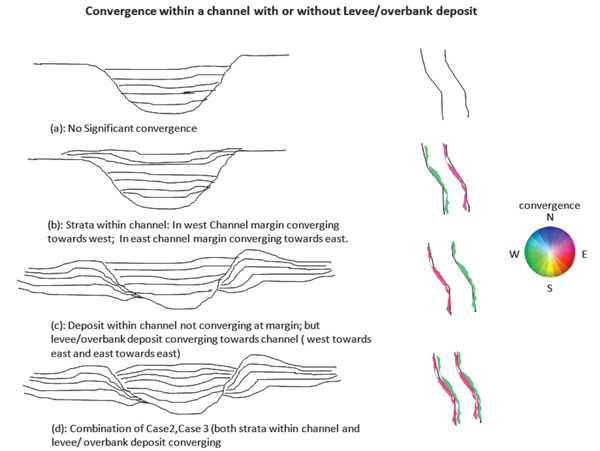
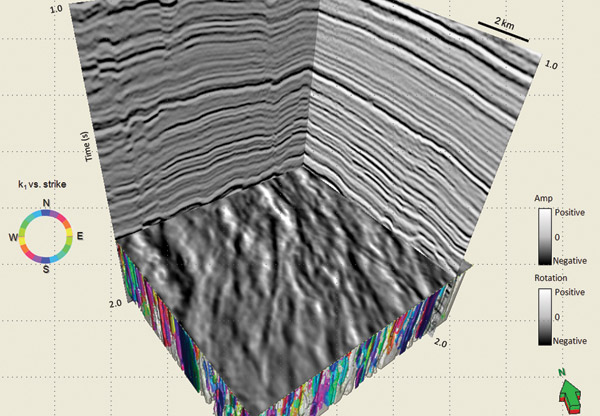
Changes in reflector dip, Next, the mean and standard deviations of these vector dips are calculated in small windows about each data sample. Conformable reflections will have small standard deviations of their In 2000, Barnes computed a vertical derivative of apparent dip along a user-defined azimuth, and used that calculation to define whether reflections diverged or converged. In this methodology, converging reflections show a decreasing change in dip while divergent reflections show increasing change in dip. Marfurt and Rich (2010) built upon this method and generated 3-D estimates of reflector-convergence azimuths and magnitudes. In order to represent the vector nature of reflector convergence in different azimuthal directions, they employed a 2-D color wheel to indicate reflector dip and azimuth. Compressive deformation and wrench faulting cause fault blocks to rotate. The extent of rotation depends on the size of the block, the lithology and the stress levels. As individual fault blocks undergo rotation, higher stresses and fracturing may occur at block edges. Natural fractures are partially controlled by such fault-block rotation and partially depend on how individual fault segments intersect. Fault-block rotation also can control depositional processes by providing increased accommodation space in subsiding areas and enhancing erosional processes in uplifted areas. In view of the importance of fault block rotation, interpreters need a seismic attribute that allows the rotation of fault blocks to be better analyzed. In Figure 1, we show the behavior of
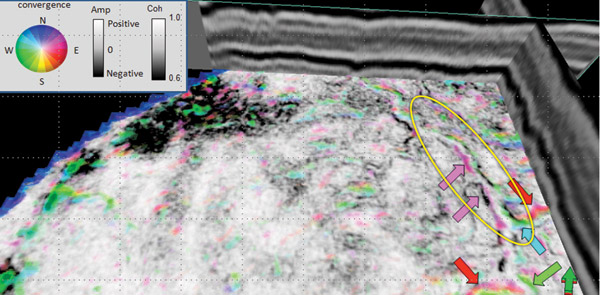
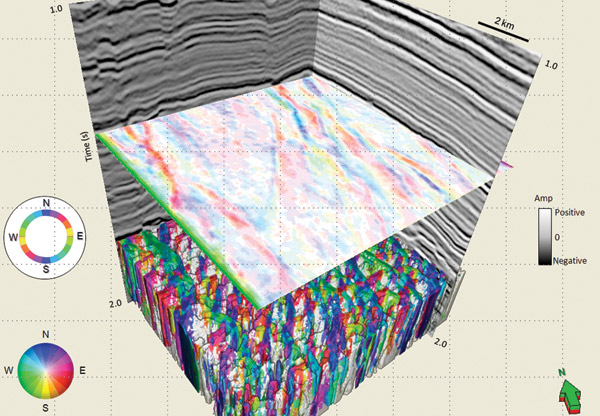
We carried out the computation of both reflector convergence and Using the scenarios presented in Figure 1, our interpretation of the zone within the yellow dotted ellipse is that levee/overbank deposits converge toward the channel margin to the northeast (magenta) and southwest (green). In Figure 3 we show a time slice through a reflector-rotation volume. Notice the horst and graben features show considerable contrast and can be interpreted as distinct geologic regimes. An equivalent display is shown in Figure 4, with a time slice through a reflector-convergence attribute. In this case, the thickening and thinning of reflectors appear to be controlled by rotated fault blocks. Application of two attributes, namely reflector convergence and reflector rotation, are shown for two different 3-D seismic volumes. These attributes provide complementary information to that provided by amplitude, coherence and curvature attributes. Reflector convergence measures the magnitude and direction of thickening and thinning of reflections. Reflector rotation about faults is demonstrated to be valuable for mapping wrench faults. We thank Arcis Corporation for permission to show the data examples, as well as for the permission to publish this work. Barnes, A.E., 2000, Weighted average seismic attributes: Geophysics, v. 65/1, p. 275-285. Marfurt, K.J., and J. Rich, 2010, Beyond curvature-volumetric estimates of reflector rotation and convergence: 80th Annual SEG Annual Meeting, 17-22 October 2010, Denver, Colorado, Document 2010-1467, 6 p. |
 General statement