Print this page
  Click to view article in PDF format.
GCEstimating Seafloor Strength with C4  Data
Data *
*
Bob Hardage1
Search and Discovery Article #40792 (2011)
Posted September 19, 2011
*Adapted from the Geophysical Corner column, prepared by the author, in AAPG Explorer, September, 2011, and entitled “Deep Thinking: 4C Proves Value on Seafloor”. Editor of Geophysical Corner is Bob A. Hardage ([email protected]). Managing Editor of AAPG Explorer is Vern Stefanic; Larry Nation is Communications Director.
1 Bureau of Economic Geology, The University of Texas at Austin ([email protected])
Marine 4C seismic technology was developed to assist hydrocarbon exploration and development – but 4C data have important marine engineering applications that have not been exploited. The data discussed here illustrate how 4C data can be used to define geomechanical properties of a seafloor where engineers need to install production facilities.
Emphasis is placed here on determining bulk moduli and shear moduli of seafloor sediment. Bulk modulus, K, for a homogeneous medium is given by the equation:
K = [(VP)² – (4/3)(VS)²]
Shear modulus, μ, for the same homogeneous material is defined by:
μ = (VS)².
In these expressions, VP and VS are, respectively, P-wave and S-wave velocities in seafloor sediment, and is the bulk density of a sediment sample.
|
|
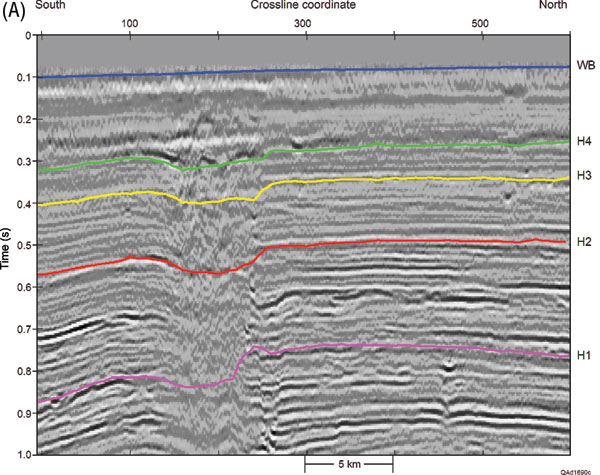
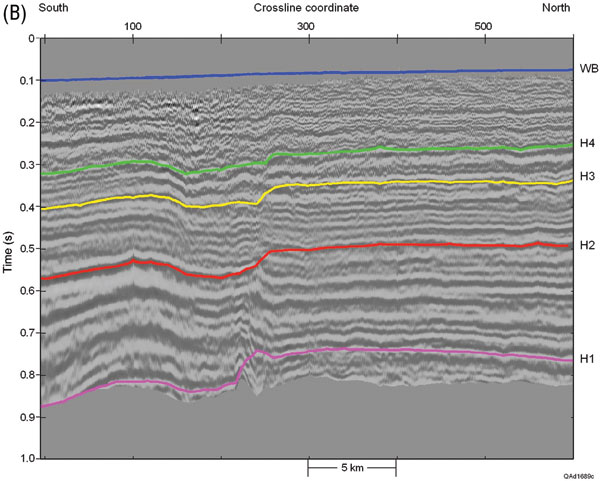
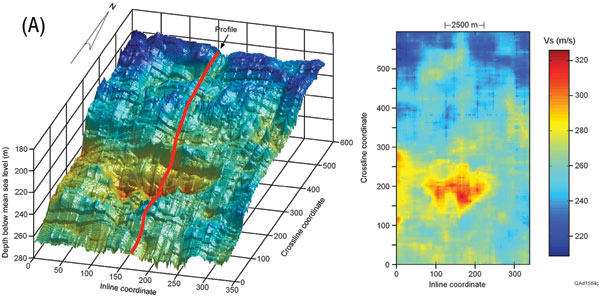
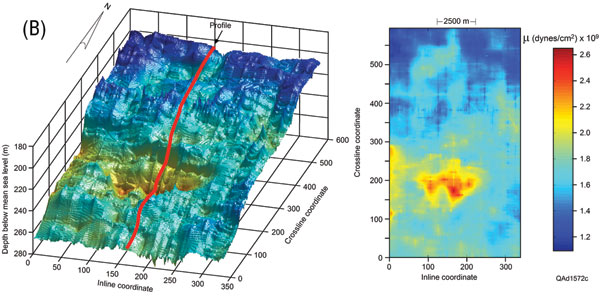
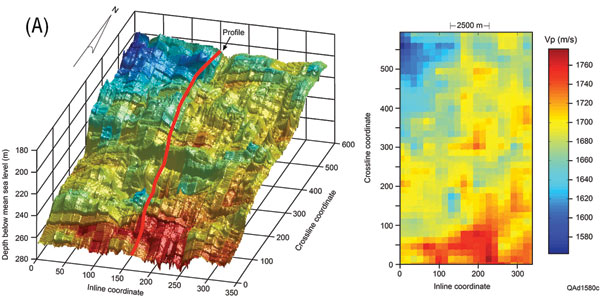
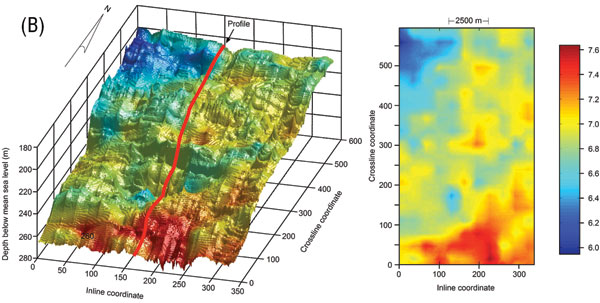
Figure 1 presents shallow The profile crosses a gas-invaded zone centered on crossline coordinate 200. P-P horizons H1 through H4 are interpreted to be depth-equivalent surface to P-SV horizons H1 through H4. For simplicity, the bulk density term in the two equations above is assumed to have a constant value of 1.8 gm/cm³ across the Figure 2 displays Each elastic constant is shown as a 3-D surface and also in plan view. The position of the example profile (Figure 1) is marked across each 3-D surface and illustrates the relationship between the gas-invaded zone seen on the P-P image and a normal fault that extends across much of the image area in the vicinity of crossline coordinate 200. These figures show there is a one-to-one relationship between VP and bulk modulus, and between VS and shear modulus, for these high-porosity, near-seafloor, unconsolidated sediments. Referring to equation 2, it is no surprise that VS and μ have a one-to-one correlation. The one-to-one relationship between VP and K is caused by the fact VP is much larger than VS within this shallowest seafloor layer. In areas having hard seafloor sediment and for deeper layers where the VP/VS ratio has values appropriate for consolidated rocks, the VS term of equation 1 will be significant, and there will not be such a close correlation between K and VP. The multicomponent The intent of this example is only to document that even simple velocity analyses of 4C
Copyright © AAPG. Serial rights given by author. For all other rights contact author directly. |
 General statement