
 Print this page
  Click to view article in PDF format.
GCAcquisition Footprint Removal for Better Fault and Curvature Attributes*
Satinder Chopra1, Kurt J. Marfurt2, and Somanath Misra1
Search and Discovery Article #40719 (2011)
Posted March 18, 2011
*Adapted from the Geophysical Corner column, prepared by the authors, in AAPG Explorer, March, 2011. Editor of Geophysical Corner is Bob A. Hardage ([email protected]). Managing Editor of AAPG Explorer is Vern Stefanic; Larry Nation is Communications Director.
1Arcis Corp., Calgary, Canada ([email protected])
2University of Oklahoma, Norman, Oklahoma
Seismic attributes are particularly effective for extracting subtle geologic features from relatively  noise
noise -free seismic data. However, seismic data are usually contaminated by both random and coherent noise, even when the data have been migrated reasonably well and are multiple-free. As you can see here, certain types of noise can be minimized during interpretation through careful structure-oriented filtering and post-migration suppression of data-acquisition footprints.
Another problem sometimes encountered by interpreters is the relatively low frequency bandwidth of seismic data. Although significant efforts are made during data processing to enhance frequency content of reflection signals, such efforts often fall short of the objective. Thus suitable ways need to be adopted to achieve improved frequency content of reflection data during data interpretation. We discuss both of these problems here – the suppression of acquisition footprints from seismic data, and frequency enhancement of data before final interpretation is done.
|
|
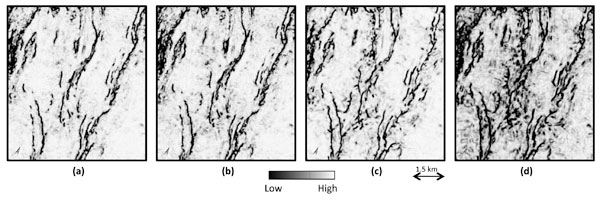
Mean filters and median filters are commonly used during interpretation to suppress Dip-steered mean filters work well on prestack data in which discontinuities appear as smooth diffractions, but they tend to smear faults and stratigraphic edges on migrated data. Dip-steered median mean filters work somewhat better, but they too can smear faults. Structure-oriented filters operate parallel to reflectors and do no filtering or smoothing perpendicular to a reflector. Suppression of Acquisition Footprint An acquisition footprint is defined as any amplitude or phase anomaly observed in seismic data that correlates to surface data-acquisition geometry rather than to subsurface geology. Spatially periodic changes in stacking fold, source-receiver azimuths and source-receiver offsets cause spatial periodicity in enhanced seismic signal and in One of the simplest methods for suppressing data-acquisition footprints is to apply kx-ky filters on seismic amplitude time slices. We show an example of this type of Thin-bed spectral inversion is a process that removes time-variant wavelets from seismic data and extracts reflectivity to image bed thicknesses far below seismic resolution. In addition to enhanced images of thin reservoirs, these frequency-enhanced inverse images are useful for mapping subtle onlaps and offlaps, thereby facilitating the mapping of parasequences and the direction of sediment transport. In addition to viewing spectrally broadened seismic data in the form of reflectivity, data also can be filtered to any desired frequency bandwidth that allows useful information to be better seen for interpretational purposes. Depending on the quality of data being interpreted, as well as access to the methods discussed here, data need to be preconditioned to optimize To illustrate the importance of data preconditioning, Figure 2 shows stratal slices from coherence volumes run on (a) input data, (b) input data with inverse Q filtering, (c) spectrally whitened input data, and (d) input data transformed to filtered thin-bed reflectivity inversion. Notice these coherence slices show increased resolution in this a-b-c-d order of data preconditioning, with the highest lateral resolution seen for coherence computed from filtered thin-bed reflectivity inversion. We emphasize that computation of attributes is not a process that involves pressing some buttons on a workstation, but requires careful examination of input seismic data in terms of signal-to- In our studies, we find that:
Some of these data-conditioning methods may not be available to an interpreter; we hope these examples assist in decisions about how seismic interpretation software and workstation capabilities may need to be adjusted to improve data interpretations. We wish to thank Arcis Corporation for permission to present these results. |
 General statement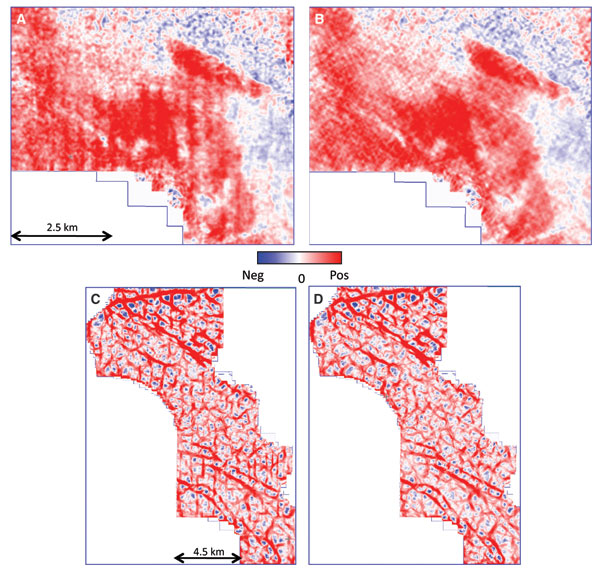

Copyright © AAPG. Serial rights given by author. For all other rights contact author directly.