Print this page
  Click to view article in PDF format.
GCThe Balance between Geophysics and Geology in Seismic Interpretation*
Alistair R. Brown1
Search and Discovery Article #40616 (2010)
Posted October 22, 2010
*Adapted from the Geophysical Corner column, prepared by the author and entitled "Balance between G&G is Critical," in AAPG Explorer, December, 2005. Appreciation is expressed to Alistair Brown, editor of Geophysical Corner, and to Larry Nation, AAPG Communications Director, for their support of this online version.
1Consulting reservoir geophysicist, Dallas, TX ([email protected])
Everyone is a product of his/her own experience. Hence geophysicists tend to favor geophysical methods and geologists tend to favor geological methods. It is only natural. However, we all know that the search for and development of oil and gas involves both disciplines. We all need to be geoscientists. We all need to meld geophysics and geology in an effective manner. We need to be integrated. I regularly have cause to admonish a course student of mine for "over-geologizing" the solution. He or she imposes a geological concept or model on the seismic interpretation rather than "letting the data speak." The majority of seismic interpreters come from a geological background, so they have to learn the intricacies of geophysics. With modern 3-D data there is a lot more to learn than there used to be. We have to appreciate the value of seismic  amplitude
 , the resolution of the data, how to recognize data defects, the precision of workstation autotrackers, the complexities of seismic horizon identification, and the mystifying plethora of seismic attributes.
|
|
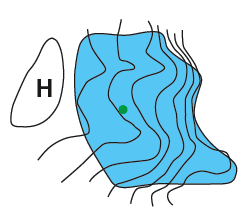
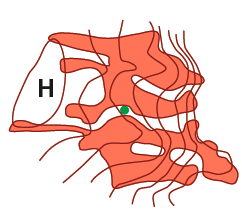
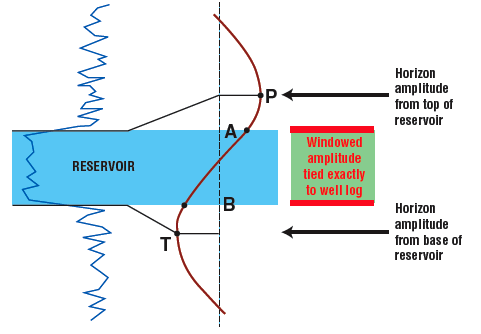
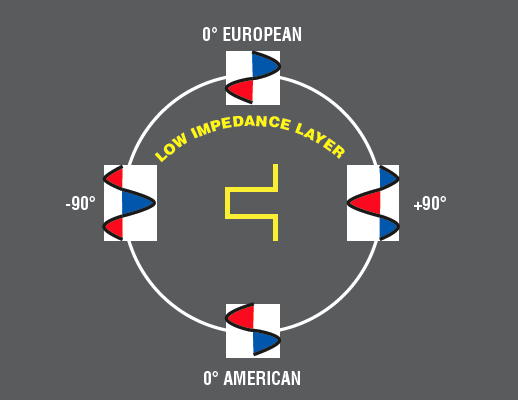
In a prospect in Latin America, a high A more detailed geophysically oriented analysis of the high Many seismic interpreters take a formation top on a log, measured in depth, convert it to time and pick at that exact position on the seismic section. A simple synthetic seismogram constructed from a sonic log using a Ricker wavelet may be used as an aid. These conventional approaches neglect errors caused by seismic velocity, hole conditions, tuning effects, data The velocity function normally comes from a well velocity survey or a vertical seismic profile in the well being tied or in a nearby well. Errors of measurement and lateral variations mean that the velocity used is rarely exactly correct. The The reservoir we wish to study in this example has good contrast at top and base; therefore, tying the well should be simple. If the reservoir is less than quarter-wavelength in thickness (as they so often are), the reflections from top and base cannot get close enough together so that they are both mislocated (Figure 3). The top reflection is early and the base reflection is late. The diagram in Figure 3 is drawn for perfect velocity, but we still do not use a simple depth-to-time tie to pick the top of the reservoir on the seismic data. An understanding of tuning effects tells us we must pick the reservoir top at point P rather than point A. This is not only geophysically correct, but point P is where the Let me give an example of how we could over-geologize the interpretation here. We want an This tie is further complicated by data Knowledge of
Copyright © AAPG. Serial rights given by author. For all other rights contact author directly. |