Print this page
 Click to view article in PDF format.
GCHorizontal Wave Testing*
Bob Hardage1
Search and Discovery Article #40502 (2010)
Posted January 19, 2010
*Adapted from the Geophysical Corner column, prepared by the author, in AAPG Explorer, December, 2009, and entitled “Horizontal Wave Testing Helps”. Editor of Geophysical Corner is Bob A. Hardage ([email protected]). Managing Editor of AAPG Explorer is Vern Stefanic; Larry Nation is Communications Director. Please refer to closely related article by Bob Hardage, 2010, Vertical Wave Testing, Search and Discovery article #40503.
1 Bureau of Economic Geology, The University of Texas at Austin ([email protected])
Collecting optimal quality  seismic
 data across some onshore prospects can be a challenge for numerous reasons:
- Near-surface conditions may produce strong refraction noise.
- Ambient noise may exist because of local culture.
- Different energy sources, such as shot hole explosives, vibrators and impulsive impactors, need to be considered.
- Several receiver-patch dimensions should be evaluated for effectiveness.
Because of these factors, a source that produces good-quality data across a sandy-soil grassland may produce poor data across an area of hard rock outcrops, and a receiver dimension that cancels ground-roll noise at prospect A may fail to do so at prospect B. Before a seismic data-acquisition effort is launched across a prospect, seismic test data need to be acquired to determine:
- The type of energy source.
- The dimension of the receiver patch.
- The specific source-receiver geometry that will yield data with appropriate signal bandwidth and signal-to-noise character.
The effort expended in acquiring this basic planning information is commonly referred to as wave testing or noise testing.
|
|
Horizontal Wave Test Methodology
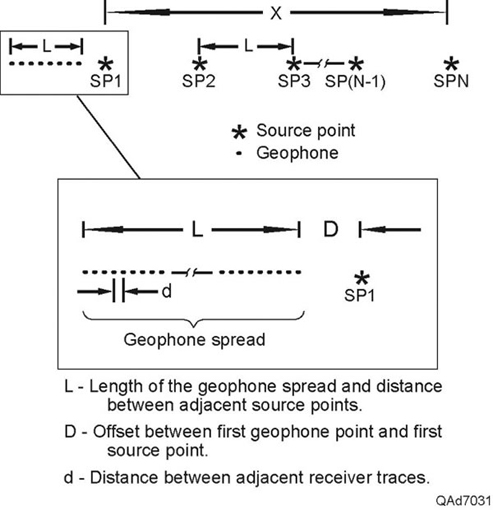
If a source station is inaccessible for any reason, that source point should be moved closer to the receiver spread to prevent gaps in the offset profile. Successive source stations should then be moved forward by the same distance to preserve a uniform spacing L between the remaining source-station positions.
Site selection is important when recording wave-test
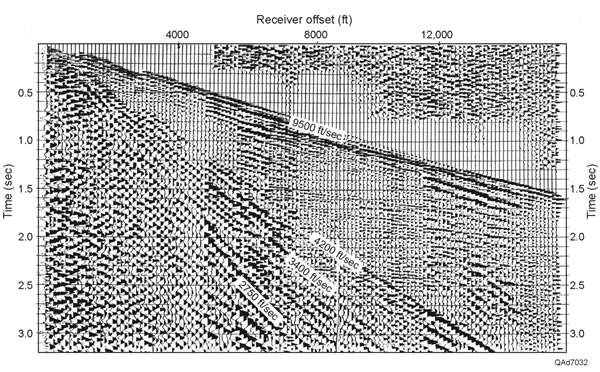
Wave-test
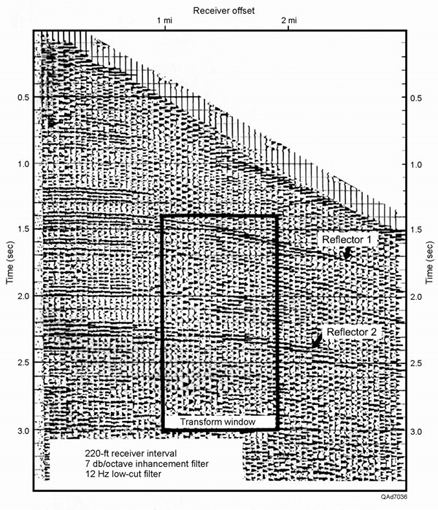
Several reflection events can be seen between 1.5 and 2.5 s at large offset distances beyond the surface-wave noise cone. Because wave-test
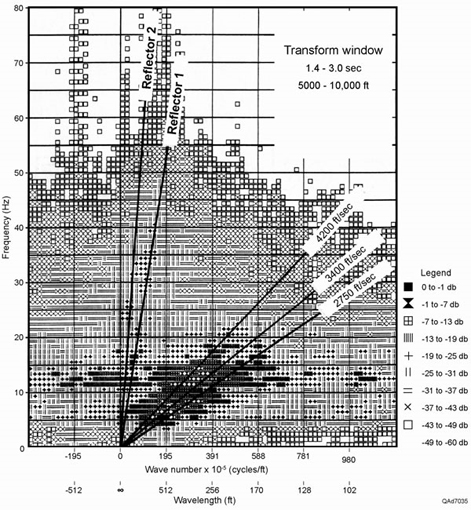
A 12-Hz low-cut filter has been applied to these
With this knowledge,
The concept described here should really be called horizontal wave testing, meaning geophones are deployed horizontally across the Earth surface when acquiring the test
Copyright © AAPG. Serial rights given by author. For all other rights contact author directly. |