Print this page
 Click to view article in PDF format.
PSPetroleum  Source
 Potential in the West Disko Area, Offshore West Greenland: Regional Evidence from Multiple Data Sets*
K. Eric Bogoslowski1 and Lyndon Miller1
Search and Discovery Article #10280 (2010)
Posted November 30, 2010
*Adapted from poster presentation at AAPG Convention, Calgary, Alberta, Canada, September 12-15, 2010
1Husky Energy, Calgary, Canada ([email protected])
Abstract
Offshore West Greenland has a history of hydrocarbon exploration that dates back to the 1970’s. Recent successful licensing rounds and subsequent multiple seismic acquisition programs indicate renewed interest in the area. While it is still early in the exploration cycle for this frontier area, it is important to demonstrate the potential for thermally mature petroleum source rocks, a critical component of the petroleum system. With limited well control, regional data were utilized to evaluate the likelihood that this condition exists in the West Disko License area
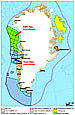
(Figure 1). Evidence of hydrocarbon charge includes nearby onshore oil seeps, offshore oil slicks interpreted from satellite images, direct hydrocarbon indicators on seismic, hydrocarbon fluid inclusions, and a gas kick/drilling show in an offshore well. In addition, source rocks outcropping in the nearby Nuussuaq Peninsula and penetrated by wells attest to sections with good hydrocarbon generating potential.
Numerous onshore oil seeps occur along the coasts of the Nuussuaq Peninsula and Disko Island. These seeps were verified by the Geological Survey of Denmark and Greenland (GEUS) (Bojesen-Koefoed, J.A., Christiansen, F.G., Nytoft, H.P., and Pedersen, A.K., 1999) as part of a systematic sampling effort conducted in the field over a number of years. Geochemical analysis of these oil samples by GEUS characterize the oils as belonging to 5 distinct families whose sources range in age from Cretaceous to Paleocene. Organic-rich, potential source rocks of these ages outcrop near the western Greenland and eastern Canadian Arctic coastlines (Figure 2). One of the most notable source rock intervals is the Cenomanian-Turonian section, interpreted to be the source for the ‘Itilli-type’ oil extracted from the seeps.
High resolution TerraSAR X satellite data was acquired during the summer of 2009 over the West Disko License Blocks. The imagery has revealed a number of low quality anomalies attributed to possible oil slicks. It is intriguing to note that similar anomalies have been observed in the same general area on earlier satellite images and that they also occur in close proximity to features mapped on seismic data.
To date, a total of six wells have been drilled offshore West Greenland; five of the six were drilled in the 1976 and 1977 seasons. Qulleq-1 was the last well drilled; it was plugged and abandoned October 3, 2000 after reaching a total depth of 2972 metres. Although there have been no discoveries, the Kangamiut-1 well reported taking a gas kick and yielded a wet gas show. Fluid inclusion stratigraphy (FIS) indicates dry and wet gas responses in four of the wells. Immature to marginally mature source rocks identified from drill cutting analysis can be correlated to deeper, more mature kitchen areas using seismic data. In the West Disko kitchen areas, 2D basin modeling indicates that Paleocene and Cretaceous source rock intervals should be either in the oil generating window today, or have passed through it during the Neogene.
This poster is a regional compilation of data from multiple sources which supports the existence of thermally mature source rocks capable of providing a hydrocarbon charge in the lightly explored, West Disko license area. Future work leading to drilling prospects will address issues of hydrocarbon migration and timing of charge relative to trap formation.
Selected Figures
|
Figure 1. Greenland location map showing
|
|
Figure 2. Occurrence of surface
|
|
Copyright © AAPG. Serial rights given by author. For all other rights contact author directly. |