Print this page
Click to view abstract and posters in PDF format.
PSThe Influence of Basement Structures from Devonian Black Shale Thicknesses in the Northern Appalachian Foreland Basin*
Gerald J. Smith1, Robert D. Jacobi1, Jodi L. Seever2, and Stu Loewenstein1
Search and Discovery Article #50203 (2009)
Posted Posted September 25, 2009
* Adapted from poster presentation at AAPG Annual Convention and Exhibition, Denver, Colorado, USA, June 7-10, 2009.
1Nornew, Inc., Amherst, NY. ([email protected])
2Department of Geology, University at Buffalo, Buffalo, NY.
Five thick black shales were deposited in western New York and northern Pennsylvania during the Middle and Late Devonian. Traditional models show the regional maximum black shale thickness successively steps farther west with the development of a gentle, structurally inactive clinoform. However, in the northern region of the Appalachian Foreland Basin, many of the areas of thickest black shale deposition coincide with areas of active faulting. From our outcrop studies in New York State and well-log analyses in New York and Pennsylvania we observed abrupt thickening of several of the black shales coincident with active faults that extend up from basement structures, primarily the Clarendon-Linden Fault System and Iapetan opening/Rome Trough structures. For example the regionally minor black shales the of Pipe Creek and the Hume formations are typically 1 meter or less thick and appear inconsequential as a reservoir/source rock. However, within the extent of the Clarendon-Linden Fault System, the Hume Formation averages 36m (120ft) thick, and the Pipe Creek Formation reaches 5.5m (18ft). More importantly for shale reservoirs, thick accumulations of the Geneseo (~45m/150ft) and Rhinestreet (91m/290 ft) formations coincide with basement structures of reactivated Clarendon-Linden, while greater thickness of the Marcellus (~56m/180ft) and Middlesex (~61m/200ft) correspond with the Iapetan-opening/Rome Trough structures.
We suggest that the combined stress of the Neo-Acadian collision and accompanying sediment loading reactivated the older basement structures, generating variable accommodation within the vicinity of the fault zones. In some cases, the thickening may result from thrusts that can be easily overlooked in the typical wireline logs if there are not distinctive marker units (as is typical in the black shales). However, such thrusts are recognizable in outcrop and FMI or similar logs. In addition to the increased localized accumulation of organic-rich shale, later fault reactivation would increase local fracturing, increasing the potential of these black shales as reservoirs and source rocks.
|
Recent influx of interest in black shales suggests a closer examination of the
Many of the major black shale plays occur along the orogenic front. (Figure 6) If basement structures were reactivated in the Appalachian Basin, then it seems likely that other foreland basins will have also experienced
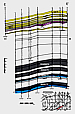
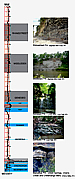
Deeper structures generally coincide with preservation of the Rushford Formation. The broad anticline in E-E’ occurs where a thicker, coarsening
upward sequence was deposited. (Figure 14) In F-F’, the thrust fault in the Tully coincides
with the disappearance of the Rushford Formation. (Figure 15) G-G' is a north-south Upper Devonian
Isopach
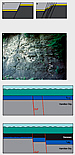
Syndepositional faulting or tectonic activity within foreland basins (Figure 24) has been shown to control/influence deposition and architecture in fluvial systems (Plint and Wadsworth, 2006), carbonate reefs (Dorobek, 1995), beaches (Hart and Plint, 1993; Smith and Jacobi, 2001) and offshore sand ridges (Nummedal and Riley, 1999). Just as relatively minor amounts of uplift (~1 m) may affect deposition and depositional pattern, so can minor amounts of subsidence (or relative subsidence) affect preservation through a localized increase in accommodation. (Martinsen, 2003) (Figure 25) Syndepositional faulting caused by the reactivation of basement structures would be expected within a foreland basin as forces from collisional tectonics, sediment load, development and migration of the peripheral bulge generate alternating periods of localized compression, extension and strike-slip stress. (Figure 26)
The effect of syndepositional faulting on black shale deposits is varied accumulation thicknesses following
Dorobek, S.L., 1995, Synorogenic carbonate platforms and reefs in foreland basins: controls on stratigraphic evolution and platform/reef morphology; in Dorobeck, S.L. and Ross, G.M. eds. Stratigraphic Evolution of Foreland Basins SEPM Special Publication 52, SEPM (Society of for Sedimentary Geology) Tulsa, p. 127 – 147.
Ettensohn, F.R., 1985a, The Catskill Delta Complex and the Acadian Orogeny: in Woodrow, D.L., and Sevon, W.D., eds., The Catskill Delta:GSA Special Paper 201, p. 39-49.
Harper, J.A., 1989, Effects of recurrent tectonic patterns on the occurrence and development of oil and gas resources in western Pennsylvania ; Northeastern Geology, v. 11, p. 225-245.
Hart, B.S., and Plint, A. G., 1993, Tectonic influence on deposition and erosion in a ramp setting: Upper Cretaceous Cardium Formation, Alberta Foreland Basin: American Association of Petroleum Geologists Bulletin, v. 77, p. 2092-2107.
Jacobi, R.D., 2002, Basement faults and seismicity in the Appalachian Basin of New York State: Tectonophysics, v. 353, p. 75-113.
Martinsen, R.S., 2003, Depositional Remnants, Part 1: Common components of the stratigraphic record with important implications for hydrocarbon exploration and production; American Association of Petroleum Geologists Bulletin, v. 87, p. 1869-1882.
Nummedal, D., and Riley, G.W., 1999, The origin of the Tocito Sandstone and its sequence stratigraphic lessons; in Bergman, K.M. and Snedden, J.W., eds., Isolated Shallow Marine Sand Bodies: Sequence Stratigraphic Analysis and Sedimentologic Interpretation, SEPM Special Publication No. 64, p. 227-254.
Rickard, L.V., 1975, Correlation of the Devonian rocks in New York: New York Museum and Science Service Map and Chart Series 24.
Schumaker, R.C.,1996,
Smith, G.J., and Jacobi, R.D., 2001, Tectonic and Eustatic Signals in the Sequence Stratigraphy of the Upper Devonian Canadaway Group, New York State; American Association of Petroleum Geologists Bulletin, v. 85, no. 2, p. 325-357.
|