Print this page
 Click to view article in PDF format.
GCSelected Low Frequencies Aid  Interpretation
 of Deep Faults*
Bob Hardage1
Search and Discovery Article #40454 (2009)
Posted September 30, 2009
*Adapted from the Geophysical Corner column, prepared by the authors, in AAPG Explorer, September, 2009, and entitled “Looking
Low Aids Data Interpretation”. Editor of Geophysical Corner is Bob A. Hardage ([email protected])
. Managing Editor of AAPG Explorer is Vern Stefanic; Larry Nation is Communications Director.
1Bureau of Economic Geology, The University of Texas at Austin ([email protected])
Numerous examples have circulated among the geophysical community that illustrate how some geologic
targets can be better seen by constraining the reflected seismic wavefield to a particular narrow range of frequencies. The exact frequency range
that produces an optimal image of a target varies, depending on target size, depth, thickness and impedance properties. The data discussed here document
an example where frequency-constrained seismic data provided improved images of deep fault systems.
|
These seismic
Across the study area, the deep reservoir interval was traversed by numerous faults, making accurate fault mapping one of the
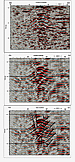
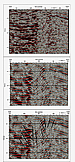
keys to exploiting the reservoir system. One example of a seismic profile crossing a key structural feature is shown as Figure
1
:
The display on panel (a) shows the image that was created by attempting to preserve the maximum frequency bandwidth
of the
In all profiles that traversed the study area, it was found that deep faults were consistently better defined by
What is the message? If you are confronted by the problem of interpreting faults in limited-quality seismic
|