Print this page
 Click to view article in PDF format.
Improved
Techniques for Acquiring  Pressure
 and Fluid Data in a Challenging Offshore
Carbonate Environment*
and Fluid Data in a Challenging Offshore
Carbonate Environment*
K.D. Contreiras1, F. Van-Dúnem1, P. Weinheber2, A. Gisolf2, and M. Rueda2
Search and Discovery Article #40433 (2009)
Posted August 10, 2009
*Adapted from expanded abstract prepared for AAPG International Conference and Exhibition, Cape Town, South Africa, October 26-29, 2008.
1Schlumberger ([email protected] )
2Total
3ENI
The combination of low permeability, oil base mud and near
saturated oils presents one of the most challenging environments for fluid
sampling with formation testers. Low permeability indicates that the drawdown
while sampling will be high but this is contra-indicated for oils that are
close to saturation pressure. A logical response is to therefore reduce the
flow rate but in wells drilled with OBM an unacceptably long clean-up time
would result.
The Pinda formation in Block 2 offshore Angola presents just such
a challenge. Formation mobilities are in the low double or single-digits,
saturation pressure is usually within a few hundred psi of formation pressure
and borehole stability indicates that the wells must be drilled with oil base
mud.
In the course of several penetrations of the Pinda formation a number of attempts were made to acquire representative formation samples but were stymied due to either excessive drawdowns that corrupted the fluid or by excessive contamination levels that rendered the samples unsuitable for laboratory analysis. Clearly a more flexible solution was required.
In this paper we review the results from previous attempts in the
Pinda. We show the pre-job modeling that was done to predict the required flow
rates and the anticipated drawdowns. Ultimately a two-step solution was used.
We first ran a high efficiency pretest-only WFT in order to quickly gather
formation pressure data and mobility data. This data was then used to design
the sampling string which was a combination of an inflatable dual packer with
focused probe. We discuss the decision process that governed the choice of
pump, displacement unit, probe and packer. We pay particular attention to the
unique pump configurations that were required to effectively manage the
drawdowns when using the probe and also to allow sufficient flow rate when
using the dual packer.
uExample 1 – Focused Probe Sampling uExample 2 – Dual Packer Sampling
uExample 1 – Focused Probe Sampling uExample 2 – Dual Packer Sampling
uExample 1 – Focused Probe Sampling uExample 2 – Dual Packer Sampling
uExample 1 – Focused Probe Sampling uExample 2 – Dual Packer Sampling
uExample 1 – Focused Probe Sampling uExample 2 – Dual Packer Sampling
uExample 1 – Focused Probe Sampling uExample 2 – Dual Packer Sampling
uExample 1 – Focused Probe Sampling uExample 2 – Dual Packer Sampling
uExample 1 – Focused Probe Sampling uExample 2 – Dual Packer Sampling
|
The Pinda was deposited in a shallow marine environment and is
rich in carbonates and is frequently highly dolomitized. In such complex
reservoirs the acquisition of quality formation tester samples is crucial to
the reservoir evaluation. In this paper we wish to discuss results from
previous attempts in the same area, the subsequent recommendations that were
made and their implementation. This discussion is informed by the fact that
these are low permeability rocks drilled with oil base mud, containing oils
that are very close to saturation
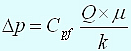
The interplay between formation characteristics and tool operation is described by the implementation of Darcy’s law (Moran and Finklea, 1962; Schlumberger, 2006) as seen in Equation 1.
As can be seen the drawdown at the sand face is a function of the mobility (k/μ), the flow rate and the probe size. Therefore in order to minimize the drawdown and stay above the bubble point it is required to either reduce the flow rate or increase the probe size. However neither of these options is without consequence. When the flow rate is reduced we will reduce the drawdown but the resulting very low flow rates imply it will take much longer to clean up the oil base mud filtrate. Similarly, a larger probe size permits a larger flow rate for a given drawdown but also allows for less sealing area for the packer as the flowing area is increased. The sealing success rate must be balanced against the requirements for drawdown and flow rate.
The question is then posed: how to design a sampling program that accounts for the bubble point and contamination conditions? Looking at Equation 1 we see that four variables affect the drawdown. The formation permeability, k, and the fluid viscosity, μ, are out of our control. We are left to manipulate the geometry of rp (probe radius) by how we interface with the formation, and flow rate, Q by our pump design. Table 1 is a summary of available probes and their geometry
The inflatable dual packer uses two inflatable rubber elements to isolate and communicate with the reservoir. The spacing between the packer elements is adjustable however the nominal spacing is about 1.0 metre. Whereas the probes discussed earlier have a flow area that ranges anywhere from 0.15 to about 2 square inches, the dual packer, when inflated in an 8.5 inch borehole will isolate a flow area of about 960 square inches. This obviously leads to a huge reduction in drawdown for a given flowrate and mobility. We can model the performance of the probes and packers. The results of this modeling are presented in Table 2 and assume a formation mobility of 50 mD/cp.
As can be seen the inflatable dual packer presents considerable advantage in terms of reduced drawdown, increased flow rate or both. However, the advantages of the dual packer do not come without consideration. The dual packer is typically longer on station. Inflate and deflate times are longer than the set and retract sequences for a single probe. Additionally, when considering clean-up time, it is now necessary to clean up a cylinder that is 1.0 metre in height as opposed to the cone of fluid associated with a probe type of tool. This can take quite a bit longer. Finally, extended on-station times and larger tool diameter often dictate the inflatable dual packer is run drill pipe conveyed instead of on wireline which greatly increases the costs associated with rig time.
As the above discussion shows, in lower permeability reservoirs
where there is a drawdown constraint due to saturation
Consider in Figure 1 a conventional (non-focused) probe. We show in this figure a packer set against the borehole wall (left hand side). We assume that the near wellbore fluid, in yellow-green, is invaded filtrate and that the far field virgin fluid, in blue, is the desired formation fluid. After the tool is set and the pretest is complete the pump is started to begin the evacuation of fluid from the formation and into the wellbore. In the case of a conventional sampling probe the flow regime that exists is similar to the one depicted in the right side of Figure 1. Essentially a cone of clean reservoir fluid is set up surrounded by a shell of filtrate. A number of observations can be made about this fluid flow regime. Firstly, some amount of pure reservoir fluid can be seen quickly, often within one or two strokes of the pump. However additional clean-up can take considerable time and pumped volumes (Hammond, 1991). Secondly, it is practicably impossible to achieve zero percent contamination. There will always be some amount of filtrate flowing around the outside of the cone. The lowest level of contamination that can be achieved is related to the ratio of vertical to horizontal permeability and to the viscosity contrast between the filtrate and the formation fluid. Extensive sampling experience with probe-type formation testers has shown that near-zero contamination results are only possible in the rare case of sampling very thin beds in high-mobility environments. A real time contamination prediction algorithm based on the optical densities of the sampled fluids has been in widespread use for several years and has proven to be an effective gauge of fluid quality (Smits et al, 1995; Mullins et al, 2000).
Now consider the schematic of the focused sampling probe shown
in Figure 2. Note that there have been two significant changes to the
focused probe versus the conventional probe. Firstly, the probe has been
separated into two distinct flow areas. There is a perimeter ring around the
outside which we shall call the guard ring or guard side. In the center
there is a flow area which we shall call the sample probe or the sample side.
Secondly, there are now two separate flowlines into the tool body. The tool
is equipped with a bypass valve that connects or isolates the guard side from
the sample side. When this valve is open or connecting we refer to the flow
as “commingled”. When the valve is closed or isolating we refer to the flow
as “split”. Additionally, the tool carries two
Example 1 – Focused Probe Sampling
We look first at the focused sampling station in Figure
3. Note at the beginning that hydrostatic
At point ‘B’ at about 2900 s the lower pumpout module is stopped
and the upper pumpout is started. The flow rate achieved is a very low 1.1
cc/s and the resultant drawdown is only 80 psi. Note that the inner bypass is
still open so guard and sample are still reading the same
Example 2 – Dual Packer Sampling
Multiple attempts to acquire a water sample in the lower part of
the reservoir with a probe only resulted in high drawdown low mobility
pretests. It was therefore decided to inflate the dual packer. Figure
4
shows the sequence. At point ‘A’ we see the lower pump being
used to inflate the packer. During all of time period ‘A’ we are in pump-in
mode to inflate the packers. At point ‘B’ we switch to pump-out mode and
begin the drawdown from the formation. After initially running the lower pump
at ~450 rpm the pump is slowed to 300 rpm and the flowing
Sampling near saturated oils from low permeability reservoirs in a well drilled with oil base mud can provide a significant challenge for a wireline formation tester. The conflicting requirements of drawdown and rate will pull tool string design in opposite directions. On the one hand we need to minimize flowrate to control the drawdown. On the other we need maximum flow rate to clean-up OBM contamination in a cost efficient manner. In this paper we have shown how to balance this. We implement the industry-unique focused probe toolstring and combine it with hardware options that result in the lowest practical WFT flow rates. Instead of just pumping large volumes to effect OBM clean-up we pump intelligently and focus the flow. So even though flow rates are less than 2 cc/s, the resultant samples are of a quality to perform accurate PVT characterization.
Of course it is acknowledged that there is a lower limit to permeabilities that may be sampled with the probe type tools. To that end an inflatable dual packer is also included in the tool string and successfully deployed to acquire a water sample and confirm the location of the transition zone. For further information see Contreiras et al, 2008.
Akurt R., et al; 2006, Focusing on Downhole Fluid Sampling and Analysis, Schlumberger Oilfield Review: Winter 2006, p. 4-19.
Beaiji, T, M. Zeybek, R. Crowell, R. Akkurt, S. Al-Dossari, A. Amin, and S. Crary; 2007, Advanced Formation Testing in OBM Using Focused Fluid Sampling for Producibility Evaluation in Mature Fields: SPE 110511 presented at the 2007 ATCE, Anaheim, California, USA, 11-14 November 2007.
Dong, C., C. Del Campo, R. Vasques, P. Hegeman, and N. Matsumoto, 2005, Formation Testing Innovations for Fluid Sampling: Seventeenth Annual Deep Offshore Technology Conference, Vitoria, Brazil, 8–10 November 2005.
Hammond, P.S., 1991, One- and Two-Phase Flow During Fluid Sampling by a Wireline Tool Transport in Porous Media: in Transport in Porous Media, Springer-Verlag, v. 6, p. 299-330.
Contreiras, K.K., F. Van-Dúnem, P. Weinheber, A. Gisolf, and M. Rueda;
2008, Improved Techniques for Acquiring
Moran, J.H., and E.E. Finklea, 1962, Theoretical Analysis of
O'Keefe, M., K.O. Eriksen, S. Williams, D. Stensland, and R. Vasques; 2006, Focused Sampling of Reservoir Fluids Achieves Undetectable Levels of Contamination: SPE paper 101084, SPE APOGC, Adelaide, Australia, 11–13 September 2006.
Schlumberger Educational Services Fundamentals of Formation Testing 2006.
Weinheber, P.J. and R. Vasques, 2006, New Formation Tester Probe Design for Low-Contamination Sampling: Paper RR presented SPWLA Annual Symposium, Veracruz, Mexico, June 4-7, 2006.
Weinheber, P.J., A. Gisolf, R.J. Jackson, and I. De Santo, 2008, Optimizing Hardware Options for Maximum Flexibility and Improved Success in Wireline Formation Testing, Sampling and Downhole Fluid Analysis Operations: SPE 19713 presented SPE 2008 NAICE, Abuja, Nigeria, 4-6 August 2008.
|