Print this page
  Click to view article in PDF
format
Click to view article in PDF
format
Maturity and Depth Occurrence of the Oil and Gas Sources in South Caspian Basin*
A.A. Feyzullayev 1
Search and Discovery Article #40413 (2009)
Posted May 1, 2009
*Adapted from oral presentation at AAPG International Conference and Exhibition, Cape Town, South Africa, October 26-29, 2008
1Geology Institute of the National Academy of Sciences, Baku, Azerbaijan
A number of
studies have attempted to estimate the degree of thermal transformation of organic
matter (ОM) in the sedimentary rocks of the South Caspian Basin (Wavrek
et al., 1996; Abrams and Narimanov, 1997). These studies include attempts of
direct estimation of maturity of OM transformation
products: oils (Wavrek
et al., 1996; Abrams and Narimanov, 1997; Inan
et al., 1998; Abdullaev et al., 1998; Guliyev et al., 2000; Кatz et al., 2000; Gurgey, 2003)
and HC gases (Кatz et al., 2000). Considering the
importance of estimation of maturity of oil and gas in understanding the
mechanism of formation of various pools, the goal of this presentation is the
generalization of all studies carried out to date for the South Caspian Basin
with the purpose of creation of a summary  model
model of vertical zonality of oil and
gas formation in this basin.
of vertical zonality of oil and
gas formation in this basin.
|
|
Figure CaptionsMethodsThe analysis of maturity of organic matter (OM) was based on the optical method (analysis of vitrinite reflectance R0). The methods of a direct estimation of maturity of oil and gas were carried out by using of appropriate isotope-geochemical parameters (Peters and Moldovan, 1993). Biomarker parameters such as the degree of C29 sterane izomerization and methyl - phenanthrene index (MPI-1) were used during the estimation of maturity of oil. The values of these parameters were recalculated in equivalent R0 values on the basis of experimental research results.
The estimation of maturity of gas is based on the experimentally revealed dependence between isotope composition of carbon (ICC) of HC gases and vitrinite reflectance (R0) (Faber, 1987). The forecast of depth of the HC gases source location is given on the basis of this dependence and regularities of change of R0 vs. depth in the South Caspian Basin. The estimations were carried out on ethane because the estimations on methane with relation to the influence of methane of a biochemical origin are less objective.
Results
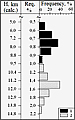
OM MaturityThe results of
the R0 measurements in the South Caspian Basin are partially
reflected in publications. However, the most important research was carried
out by the Geology Institute of Azerbaijan National Academy of Sciences in
cooperation with the foreign oil companies. The results of these studies for
Paleogene-Miocene rocks generalized in the form of a bar
According to
the bar
Oil MaturityAccording to Guliyev et al. (2000) about 50% of the oil samples studied have values of maturity at C29 sterane isomerization of 0.63-0.73% Req. Estimations based on the same parameter carried out by Abrams and Narimanov (1997) and Gurgey (2003) set Req values of 0.52-0.81 and 0.56-0.85 accordingly. Estimations at MPI carried out by Wavrek et al. (1996), Inan et al. (1998), Abdullaev et al. (1998), Кatz et al. (2000) and by the author of this presentation vary within the limits of 0.7-0.8%; 0.79-0.87%; 0.56-0.82%; 0.7-0.95% and 0.52-0.96% Req accordingly.
In spite of the fact that the above estimations based on the data of the oil analyses were carried out in various laboratories using various parameters, they, as a whole, coincide with each other, reflecting an initial stage and peak of oil generation.
Peak maturity of oils (on Req) and OM (on R0) as a whole coincide well with each other (see Figure 1 А, B1, B2), confirming objectivity of the calculated Req values.
It is interesting that the maturity of oil seepages related to mud volcanoes coincides with the maturity of Miocene-lower Pliocene reservoir oils. This leads to the conclusion that oils of the mud volcanoes are a product of destruction of oil accumulations in the noted reservoirs.
Maturity of Gases Calculated values of Req of HC gases (at ethane) of fields in the South Caspian Basin (with the reservoirs depth occurrence interval of 501-5778 m) carried out by Katz et al. (2000) varies within the limits of 0.85-1.70% Req. The estimations carried out by the author of this presentation, as a whole, coincide with the estimations of Katz et al. (2000) characterized by Req values of 0.98-1.91%, except in 3 cases (from 56 tested samples) with Req of > 2.2% (Neftchala, wells 867 and 889; Absheron kupesi, well 42).
The maturity of HC gases from mud volcanoes as a whole coincide with the maturity of HC gases of reservoirs varying within the limits of 1.3-2.07% Req (Figure 1 C1 and C2). According to four measurements of maturity of HC gases of hydrates formed in submarine mud volcano craters in a deep-water part of the Southern Caspian sea varies within the limits of 1.47-1.94 % Req (Figure 1 C3). Modal values of maturity of these gases, as well as gases of mud volcanoes and reservoirs, vary in the range of 1.5-2.0% Req. Conclusions
Using all results of
estimations of the oil and gas maturity and regularity of change of R0 values with depth revealed for the South Caspian Basin (Wavrek et al. 1996), the
summary
It is important to note that the vertical zonality of oil and gas formation do not reflect zonality of their accumulation in reservoirs, which is caused by the process of intensive subvertical migration of HC fluids, having presumably injection character (Feyzullayev and Aliyeva, 2003). The distance of subvertical migration of most volume of oils is, presumably, 4 km (Figure 3 B). It is well known that source rocks and main reservoirs in the South Caspian Basin are related to various stratigraphic complexes, which is once again confirmed by the absence of dependence between depths of generation and accumulation of oils (Figure 3 A).
Abdullaev, T., M. L. Falt,
A. Akhundov, W. G. van Grass, T. Kwamme, H. L. Flolo, K. Mehmendarov, A. A.
Narimanov, S. T. Olsen, G. Seljeskog, O. Skontorp, T. Sultanzade, N. Tank,
and E. Valieva, 1998, A reservoir
Abrams, M.A., A.A. Narimanov, 1997, Geochemical evaluation of hydrocarbons and their potential sources in the western South Caspian depression, Republic of Azerbaijan, Marine and Petroleum Geology, v. 14, p. 451-468.
Faber, E.Z., 1987, Isotopengeochemie gasformiger Kohlenwasserstoffe: Erdole, Erdgas and Kohle, v. 103, p. 210-218 (in German).
Feyzullayev, A., Aliyeva Es, 2003, Estimation of the various source rocks contribution in oil pools formation, EAGE 65 Conference and Exhibition, Stavanger, The Norway, 2-5 June, Extended Abstracts CD, P 026.
Feyzullayev, A., I. Guliyev, M. Tagiyev, 2001, Source potential of the Mesozoic-Cenozoic rocks in the South Caspian Basin and their role in forming the oil accumulations in the Lower Pliocene reservoirs, Petroleum Geoscience, v. 7, p. 409-417.
Guliev I., A. Feyzullayev,
D. Husseynov, 2000, Maturity degree of oils the different
Gurgey, K., 2003, Correlation, alteration, and origin of hydrocarbons in the GCA, Bahar, and Gum Adasi fields, western South Caspian Basin: geochemical and multivariate statistical assessments, Marine and Petroleum Geology, 21 p.
Inan, S., N.M. Yalcın, S. I. Guliev, K. Kuliev, and A.A. Feizullayev, 1998, Deep petroleum occurences in the Lower Kura depression, South Caspian Basin, Azerbaijan, An organic geochemical and basin modeling study, Marine and Petroleum Geology, v. 14, p. 731–762.
Katz, K.J., D. Richards, D. Long, and W. Lawrence, 2000, A new look at the components of the petroleum system of the South Caspian Basin, Journal of Petroleum Science and Engineering, v. 28, p. 161–182.
Peters, K.E., J.M. Moldovan, 1993, The biomarker guide: Interpreting molecular fossils in petroleum and ancient sediments, Prentice Hall, Englewood Cliffs, New Jersey, 363 p.
Wavrek, D., J. Collister, D. Curtiss, J. Quick , I. Guliyev, and A. Feyzullayev, 1996, Novel Application of Geochemical Inversion to Derive Generation/Expulsion Kinetic Parameters for the South Caspian Petroleum System (Azerbaijan), AAPG/ASPG Research Symposium, “Oil and gas petroleum systems in rapidly subsiding basins”, October 6-9, Baku, Azerbaijan.
|