Print this page
 Click to view article in PDF format.
PS3-D Exploration for Remaining Oil Using Historical Production Data
Yun Ling1, Xuri Huang2, Desheng Sun1, Jun Gao1, and Jixiang Lin1
Search and Discovery Article #40399 (2009)
Posted April 10, 2009
* Adapted from oral presentation at AAPG International Conference and Exhibition, Cape Town, South Africa, October 26-29, 2008.
1BGP, CNPC, Zhuozhou, China (mailto:[email protected])
2Golden Eagle Int'l, Inc., Beijing, China
3D and 4D (or time-lapse) seismics are techniques commonly used
for exploration and  reservoir
 exploitation. Increasingly, time-lapse seismic
is becoming a more popular tool for reservoir development and management.
However, its application is constrained by reservoir conditions, production
mechanisms and seismic data repeatability. The technique of 3D exploration
for remaining oil with historical production data (3.5D) uses high quality
3D seismic data, acquired after a certain period of reservoir production,
and integrates it with historical production data to provide information
for reservoir dynamics, such as the identification of additional resources
and the delineation of remaining oil. In integrating the 3D seismic with
historical production data, the 3D seismic data are time-stamped and then
related to the reservoir dynamics. This enables 3D seismic data to represent
reservoir dynamics in time. The method is applied to an onshore field
in Western China. The result shows that the 3.5D seismic approach can
identify reservoir potentials and remaining oil.
exploitation. Increasingly, time-lapse seismic
is becoming a more popular tool for reservoir development and management.
However, its application is constrained by reservoir conditions, production
mechanisms and seismic data repeatability. The technique of 3D exploration
for remaining oil with historical production data (3.5D) uses high quality
3D seismic data, acquired after a certain period of reservoir production,
and integrates it with historical production data to provide information
for reservoir dynamics, such as the identification of additional resources
and the delineation of remaining oil. In integrating the 3D seismic with
historical production data, the 3D seismic data are time-stamped and then
related to the reservoir dynamics. This enables 3D seismic data to represent
reservoir dynamics in time. The method is applied to an onshore field
in Western China. The result shows that the 3.5D seismic approach can
identify reservoir potentials and remaining oil.
|
Back
in the late 30s, 3D wave propagation was investigated based on
multiple 2D lines in different directions and wave propagation
geometries (Rock, 1938). After the 50s, 3D seismic reflection and
imaging were discussed based on physical 3D models. In the mid-70s,
the first 3D seismic survey was acquired in the Gulf of Mexico
(Dahm and Graebner, 1982). It was observed in the lab that a large
velocity change can occur in rocks with heavy oil if the oil is
replaced by steam (Nur et al., 1984). From the late 80s, the application
of time-lapse seismic was investigated (Robert and Terrance, 1987).
With hundreds of field applications in the last decade, time-lapse
seismic has become an industry-wide tool for
Background of Geology and Seismic
Geology
background: The
field is on a monoclinal structure that forms a lithological
trap for the
Seismic acquisition and processing: The 3D survey conducted in the field is located in the northwest margin of the Jungar basin. The surface is mainly covered with sand dunes of 3-20 m in height and some farmland on the eastern side. The main parameters of the survey geometry are as follows: Spread, 12 lines x 10 shots; Fold, 60; Bin size, 12.5 m x 12.5 m. The processing workflow includes amplitude preservation, source/receiver statistical deconvolution, velocity picking, statics, and NMO+DMO+poststack migration. Compared with the processing workflow of the conventional time-lapse seismic (Ross et al., 1996), this workflow does not need to focus on the elimination of non-repeatable noise from both acquisition and processing. This indicates that a 3.5D seismic application could be more practical compared to time-lapse seismics, possibly reducing the financial risk of the entire process.
Figure 1a
is a seismic
section across the
This leads to a paleotopography with a high in northwest, and a low in the southeast (see Figure 1b). Sedimentary deposition starts in the early Jurassic (J1b). This period has three sub-cycles of deposition as marked in Figure 1b by the deep to light yellowish colors for the three superimposed sedimentary units. The sediment source is from the northwest. After this period, the southeast continues to subside and leads to the formation of the mid-Jurassic deposition (J2x). J2x has two sub-cycles of deposition that form two superimposed sedimentary units, with the source in the northwest. In the late Jurassic (J3q) there are two sub-cycles of deposition (see Figure 1b marked with deep or light color) that are thicker in the southeast than in the northwest. In the seismic sections, a foreset reflection can be observed clearly in the northwest. This indicates that the sediments are from the northwest.
Figure 1c
shows the present
structure from the seismic data. From Figure
1c
and the above structural evolution discussion, we conclude,
that with a good cap rock, the
Based on the structural and depositional evolution study, the seismic waveform clustering attribute is generated as shown in Figure 2 . The mid-to-light blue colored region indicates a region of alluvial deposition. An uplift (the white line in Figure 2) separates it from the adjacent depositional region. These two zones form two major depositional regions. From the depositional analysis, the J3q formation mainly forms onlap traps. On the other hand, the J1b and J2x formations mainly form unconformity traps.
Historical Production Data Study
Obviously,
the preceding structural and depositional discussion, which is
based only on high quality 3D seismic data, cannot characterize
Interpretation of 3D with Historical Production Data
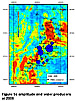
Based on the interpretation of 3D seismic data and of the dynamic data, Figure 5a shows the combined result of overlaying the dynamic data with 3D seismic amplitudes. As shown in Figure 5a , the low water producers are located in regions where the seismic amplitudes are high, and the high water producers are located in low amplitude regions in 2006. This indicates a high correlation between the water producers and seismic amplitudes. However, as shown in Figure 5b (3D seismic amplitude with cumulative oil before 2006), wells with high cumulative oil are not located at places of high 3D seismic amplitude. Wells with low cumulative oil do not always overlie regions of low seismic amplitude either. This suggests that the high-resolution 3D seismic data acquired in 2006 has been changed by fluid substitution. Thus, through this study, 3D seismic data have been characterized dynamically. To differentiate from time-lapse seismic, this can be called a 3.5D seismic approach. With the structural study of the 3D seismic data and further integration of historical production data, the aquifer invasion is mapped and the remaining potential areas are identified in Figure 6 . The water invaded from the southeast. In the north, two aquifers invaded along two paths in the J2x formation. The unexplainable Well A, as mentioned before, is located in a different sedimentary region than the field’s major producing region. The area of the remaining potential in the Well A region is estimated to be 1.5 km2. The questionable Well B is located in the same facies as that of the major production region, but it produces from a different sand body. The potential for this region has an area of 1.1 km2.
Based
on a case study, a technique of 3D exploration for remaining oil
using historical production data (3.5D) has been proposed and demonstrated.
Compared with the workflow of time-lapse seismics, whose success
depends on
Dahm, C.G. and R.J. Graebner, 1982,
Field development with three-dimensional seismic methods in the
Gulf of Thailand-A case history:
Lumley,
D.E., 2001, Time-lapse seismic
Nur, A, C. Tosaya, and D.V. Thanh, 1984, Seismic monitoring of thermal enhanced oil recovery processes: 54th Annual International Meeting Society Exploration Geophysists, Expanded Abstracts, Session RS.6.
Robert
J.G. and J.F. Terrance, 1987, Three-dimensional seismic monitoring
of an enhanced oil recovery process:
Rock,
S.M, 1938, Three dimensional reflection control:
Ross, C.P, G.B. Cunningham, and D.P. Weber, 1996, Inside the cross-equalization black box: The Leading Edge, v. 15, p. 1233-1240.
|