Print this page
 Click to view abstract and references in PDF format.
For faster opening of the posters, right click on the links below to download files to your computer
Poster 1 (86 mb)
Poster 2 (5 mb)
Poster 3 (97 mb)
PSApplication of Mechanical Stratigraphy to the Development of a  Fracture
 -Enhanced Reservoir Model, Polvo Field, Campos Basin, Brazil*
Michael Gross2, T.C. Lukas2, and Peter Schwans1
Search and Discovery Article #20080 (2009)
Posted October 15, 2009
*Adapted from poster presentation prepared for AAPG Annual Convention, Denver, Colorado, June 7-10, 2009. See companion article,
“Development Challenges in a Fracture-Enhanced Carbonate Grainstone Reservoir, Polvo Field, Brazil - from Reservoir Characterization to Dynamic Model”, Search and Discovery Article #20079 (2009).
Note: Numbers in parentheses after headings and figure captions represent numbered sections of poster presentation.
1 International Exploitation, Devon Energy, Houston, TX ([email protected]).
2 Consultant— Gross--Department of Earth Science, Florida International University, Miami, FL ([email protected]); Lukas, Houston, TX ([email protected])
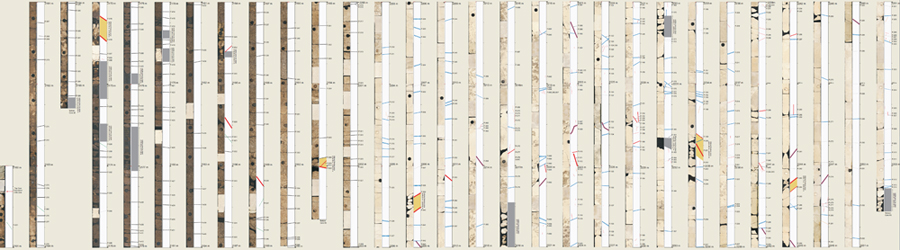
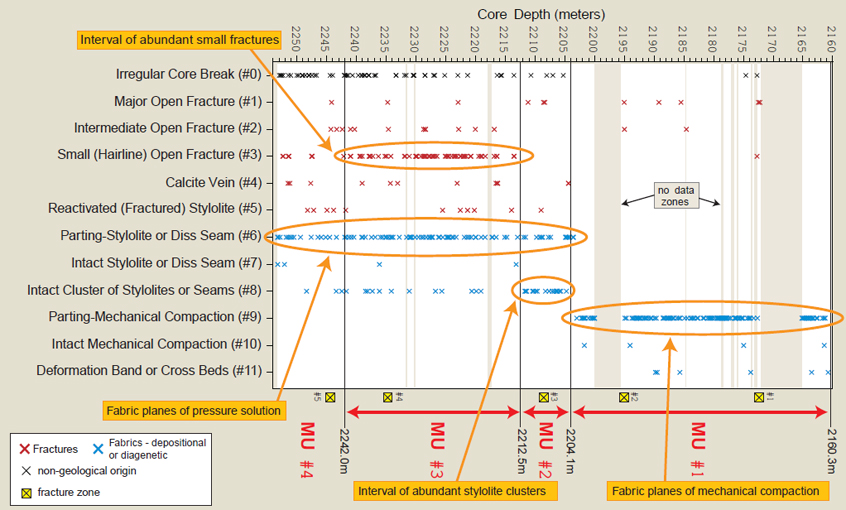
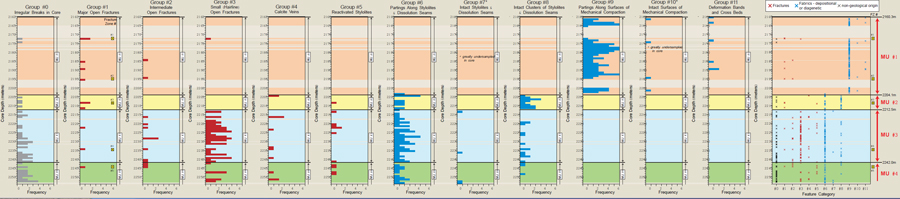
A fracture model was developed for a sequence of passive-margin carbonates in Polvo Field, Campos Basin, Brazil, by applying concepts of mechanical stratigraphy to datasets derived from core, image logs and 3D seismic surveys. Upper Cretaceous carbonate rocks of the Quissama Member of the Macaé Formation include a highly porous and permeable grainstone reservoir facies underlain by various combinations of wackestone, packstone and grainstone. Systematic description of ~100m of core from a vertical well reveals a complex relationship between brittle deformation and diagenetic processes related to burial and compaction. Fractures and fabrics were subdivided into twelve distinct categories, with identification of four major mechanical units based on their vertical distribution.
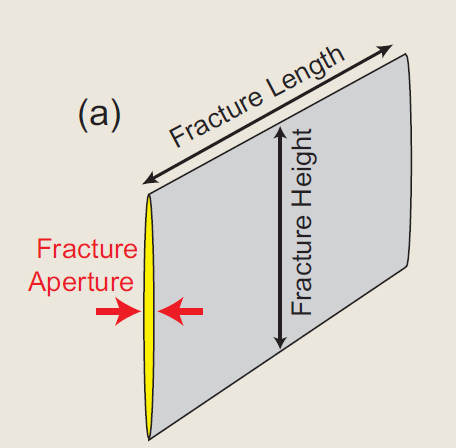
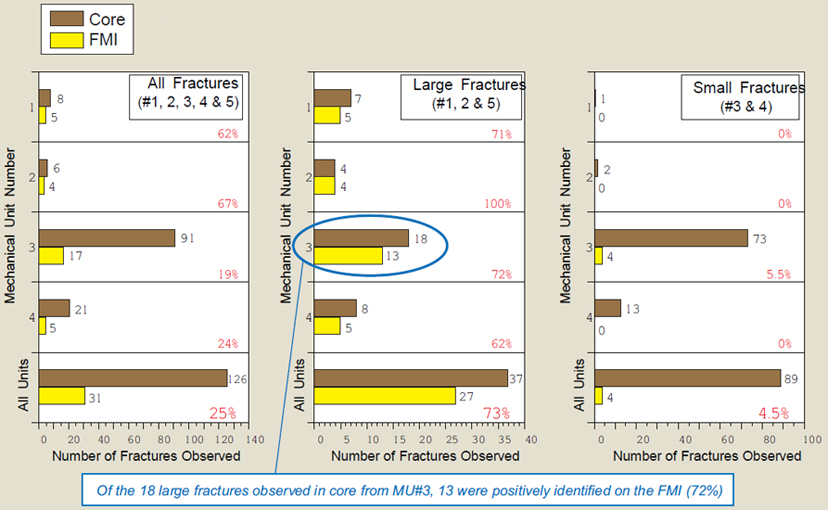
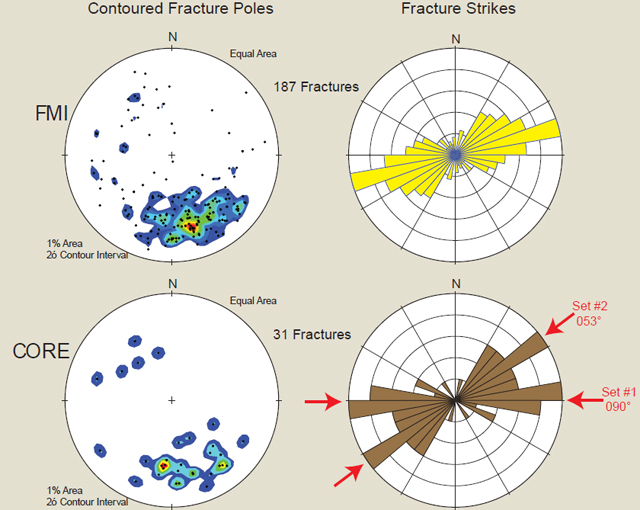
Thirty-one of 126 fractures measured in core can be precisely matched to features interpreted independently on the FMI log, allowing verification of the orientations of prominent fracture sets and establishing criteria to identify bed-confined and throughgoing fractures on image logs. The latter were used to map the occurrence of hierarchical fracture populations in FMI logs from two horizontal wells by distinguishing among bed-confined, incipient throughgoing, and mature throughgoing fractures. A conceptual model for the fractured reservoir was developed by incorporating attributes of ~ 3000 fractures identified on FMI logs, including computed apertures, into the mechanical stratigraphy established from core description, which was then correlated to seismically mapped facies. Ranges for spacing, height, length and aperture were estimated for each fracture set and mechanical unit based on scaling relations, bed thicknesses and relative strain magnitudes, providing important constraints on subsequent DFN
models and reservoir flow simulations
|
|
Figures 1-1, 1-2, 1-3, 1-4, 1-5, 2-1, and 2-2
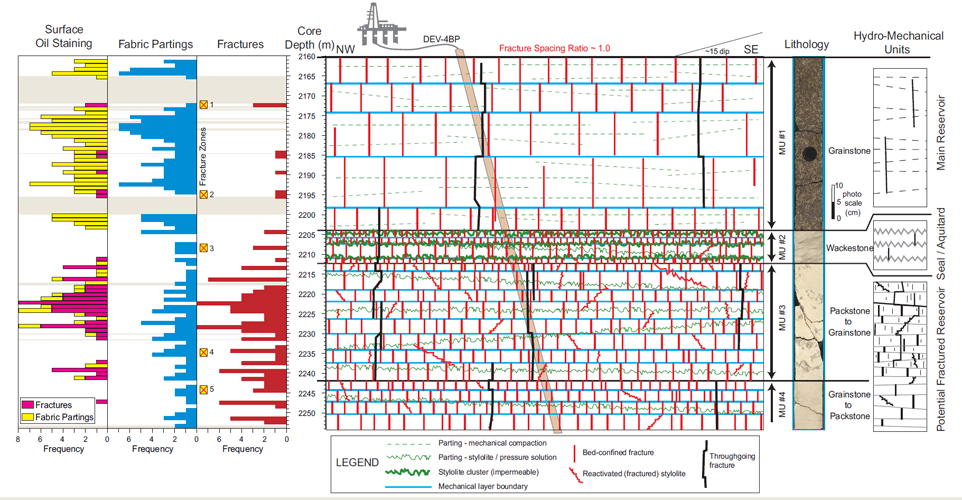
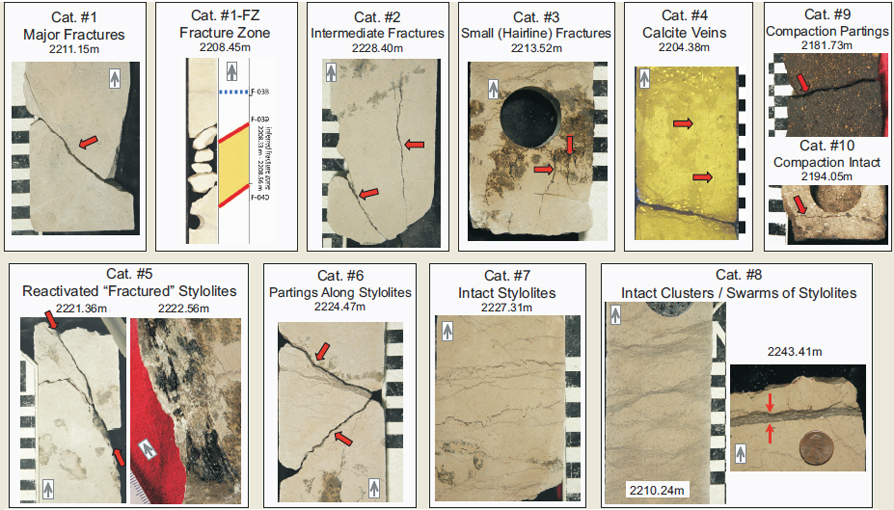
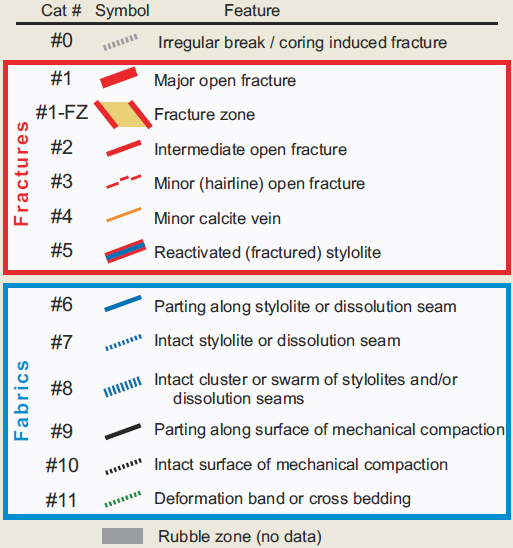
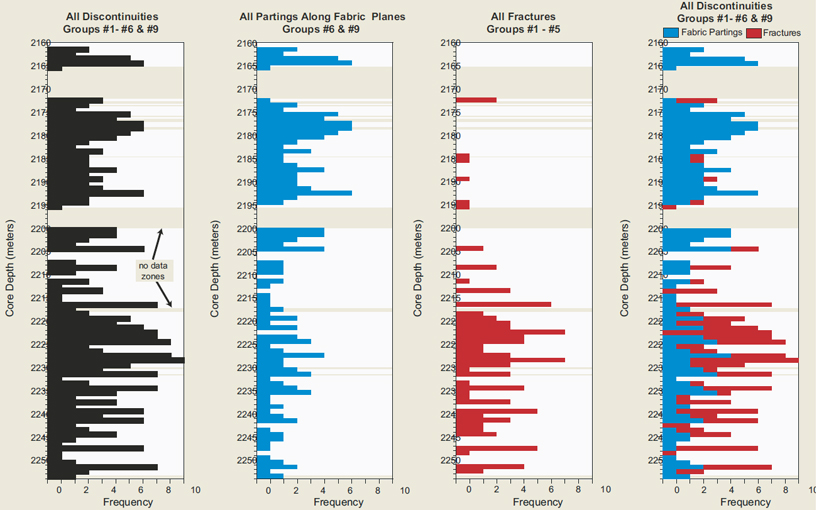
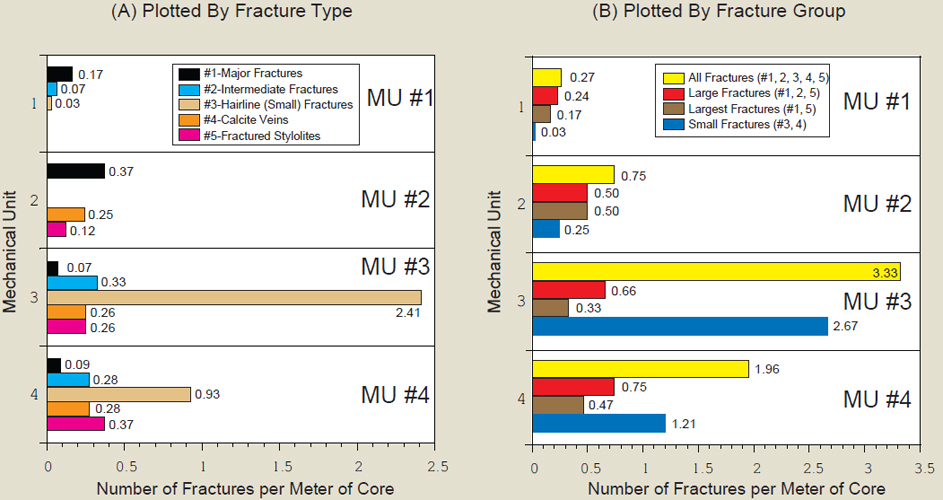
The Four Main Mechanical Units (9) Units #1 -#4 A mechanical stratigraphy was developed, based on the physical properties and vertical distribution of the 11 categories of fractures and fabrics observed in core. Mechanical Unit #1
Grainstone reservoir facies characterized by thick mechanical layers, low Mechanical Unit #2 Wackestone non-reservoir facies characterized by numerous clusters of stylolites and dissolution seams that dramatically reduce matrix permeability. Considered a leaky aquitard. Mechanical Unit #3
Packstone-to-grainstone lithology, with abundant small fractures and numerous oil-stained Mechanical Unit #4 Similar to overlying MU #3, except for a marked reduction in small fractures and only minor oil staining.
The lowest
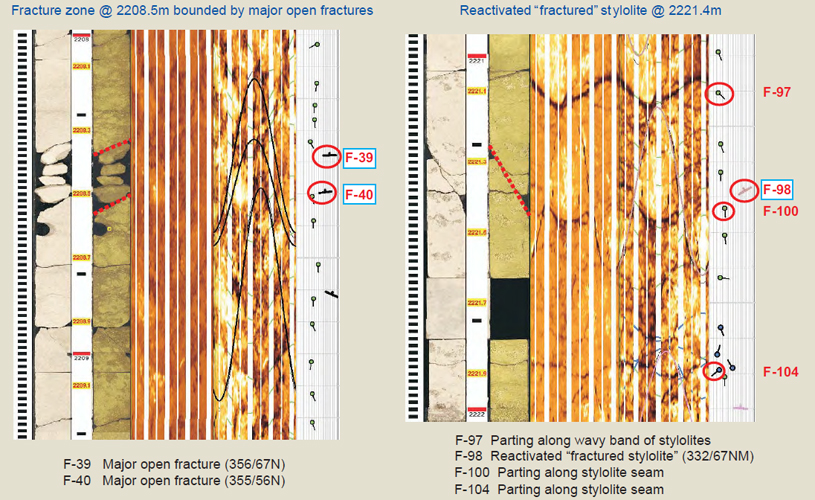
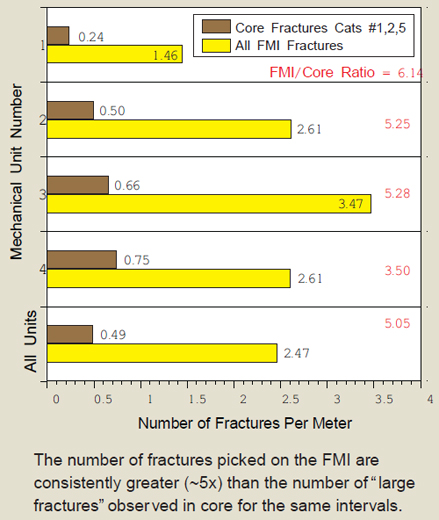
Fractures in Core and Features on FMI
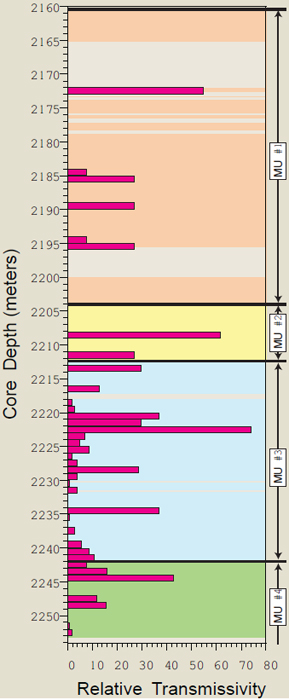
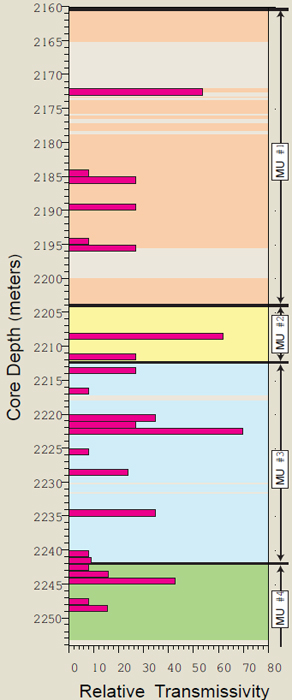
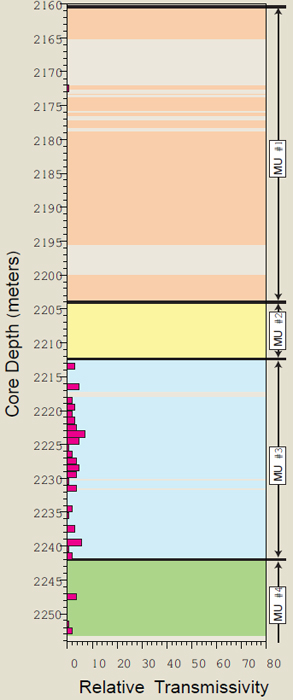
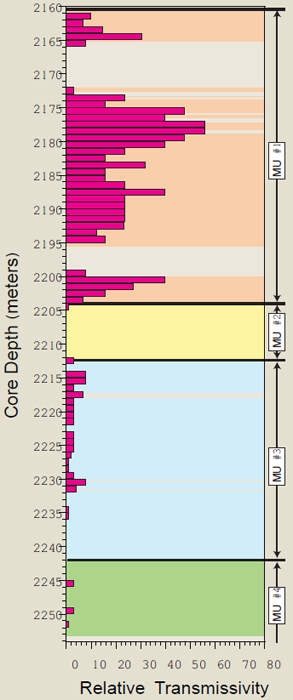
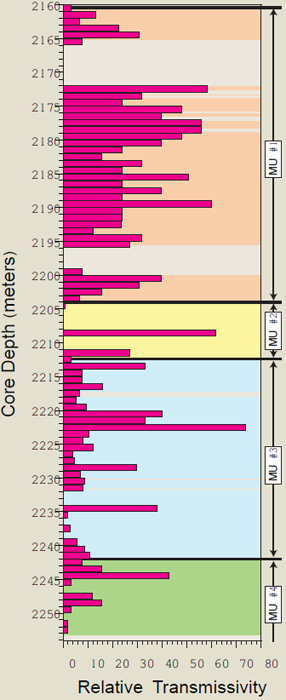
Hydrologic Properties Inferred from Core
Relative
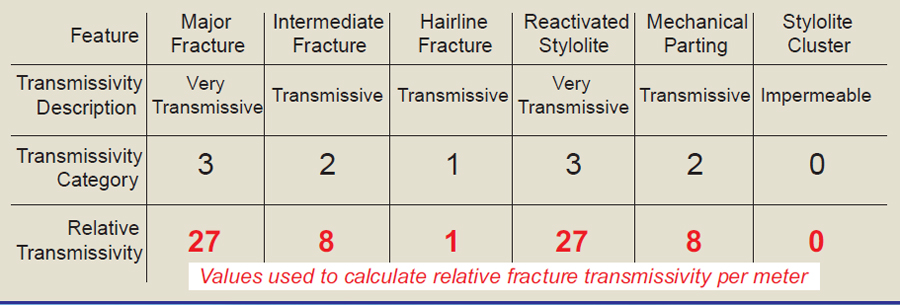
A transmissivity category was assigned to each discontinuous feature observed in core, whether a
Next a “relative
Q = WΔgb3/12 Q = volumetric flow rate Δ = fluid density g = acceleration of gravity
Δh/ΔL = hydraulic gradient
The relative transmissivity for an individual feature was calculated as the cube of the assigned transmissivity category. Thus, a
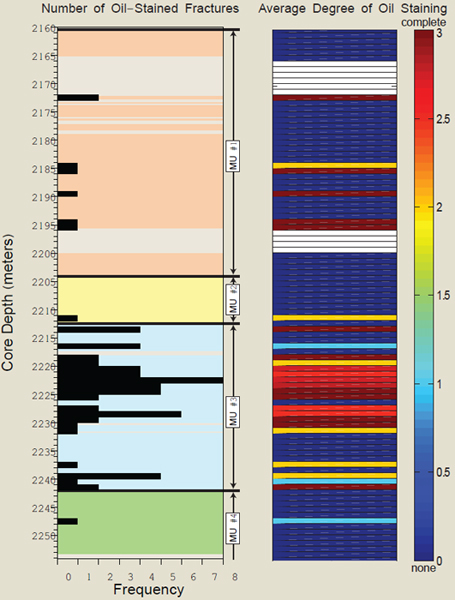
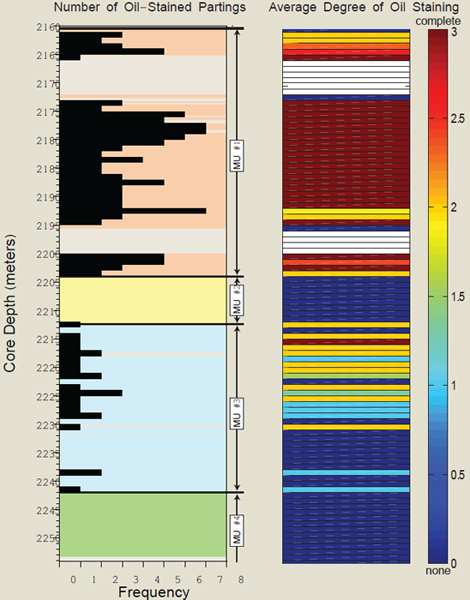
“ Oil Staining on Fractures and Partings (Figures 2-13 and 2-14)
An important indicator of a fractured reservoir is the occurrence and degree of oil staining on 0=no oil staining 1=minor (patch) oil staining 2=partial oil staining 3=complete oil staining The occurrence of oil staining is quantified in histograms as the number (frequency) of oil-stained fractures per meter of core depth. The degree of oil staining is quantified as the numeric staining average of all features (stained and unstained) per meter of core depth, and is presented on a color-coded scale bar.
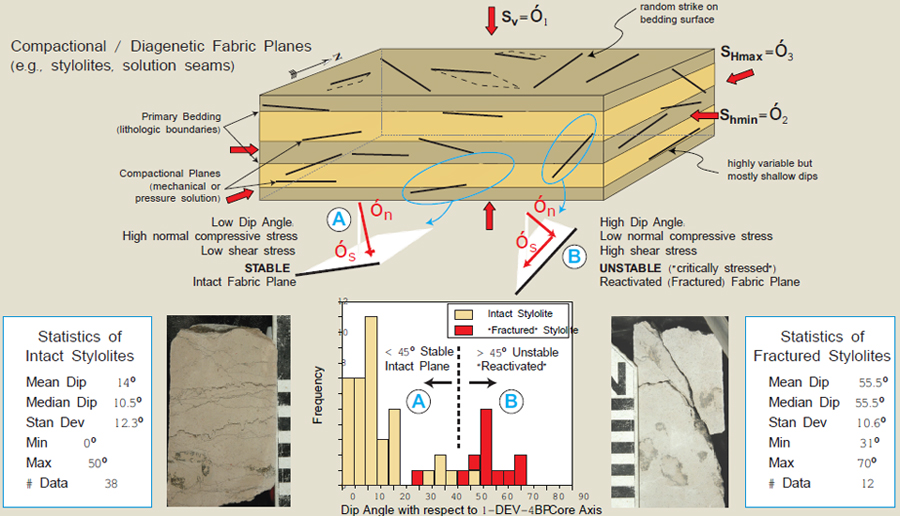
Note in MU#1 the abundant oil staining along numerous fabric partings with a high degree of staining. This may indicate potential to extend the reservoir below the surface of matrix saturation. Note the lack of oil staining in MU#2, consistent with behavior as an impermeable barrier or seal. In MU#3 there is abundant evidence for oil-stained fractures as well as oil staining along fabric partings. This suggests an active Reactivated “Fractured” Stylolites (16) (Figure 2-15)
Fractures in Horizontal Wells
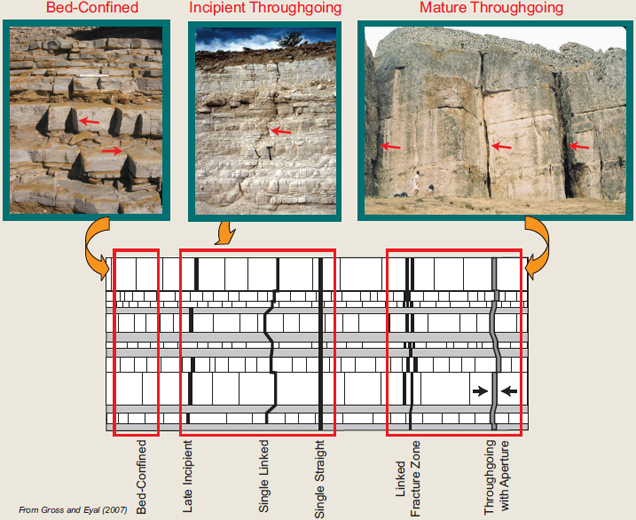
Classification and Outcrop Analogs (17) (Figure 3-1)
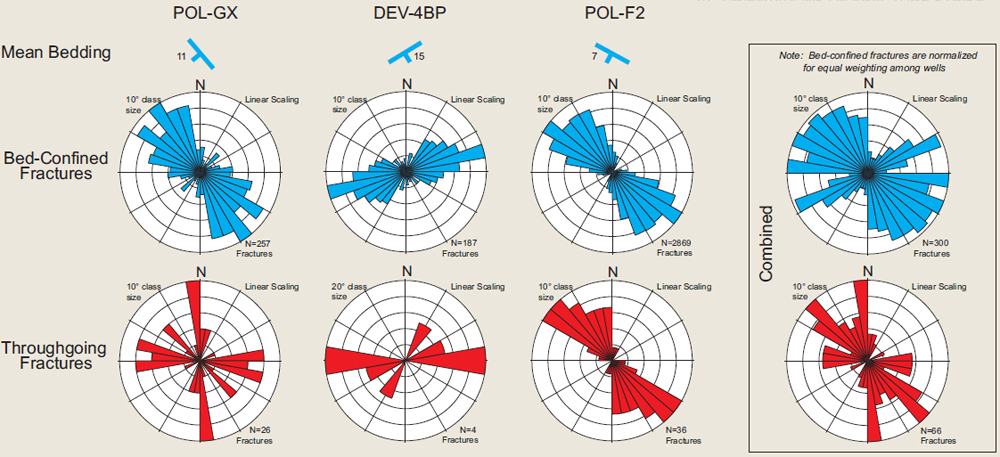
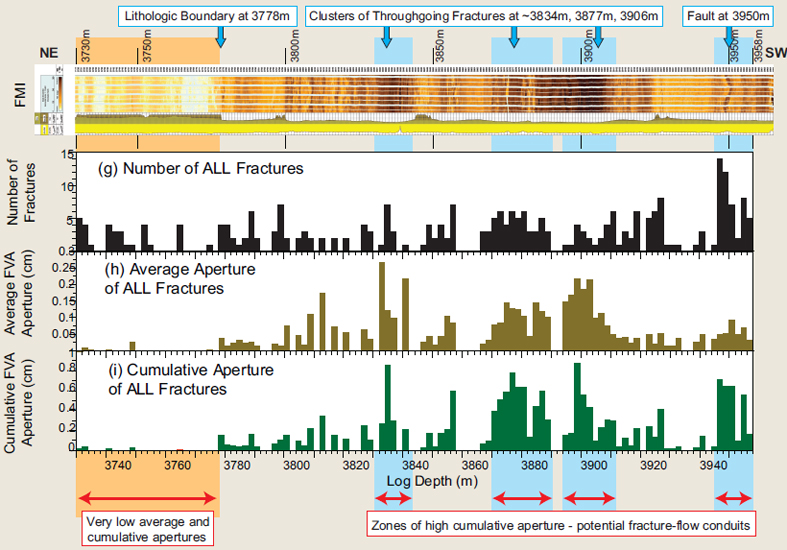
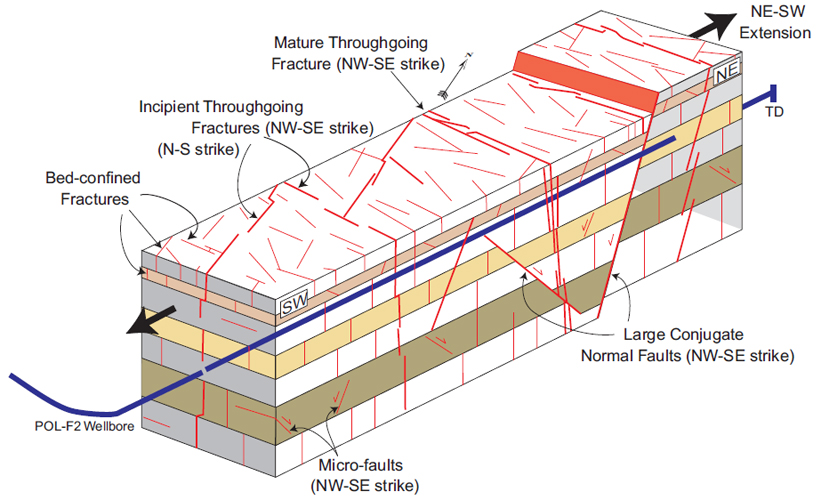
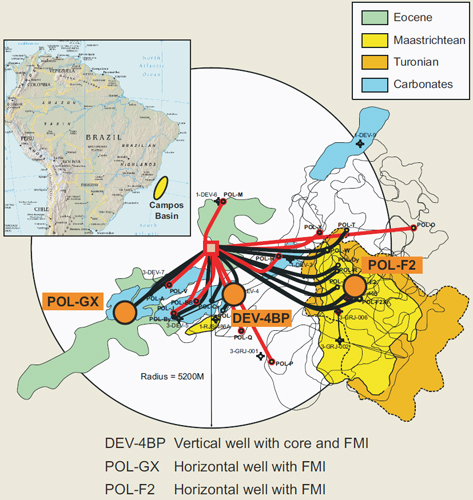
The POL-GX and POL-F2 horizontal wells are optimally oriented to intersect vertical fractures, which constitute the overwhelming majority of fractures encountered in the shallow-dipping strata of Polvo field. Similar to outcrop analogs, a clear scale-dependent hierarchy is observed in the
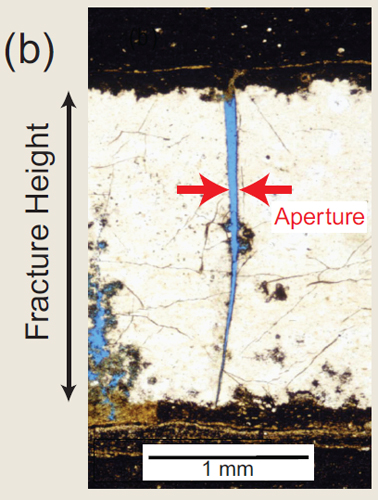
In outcrop analogs, the bed-confined fractures are contained within individual layers. Fractures terminate at bed boundaries, thus
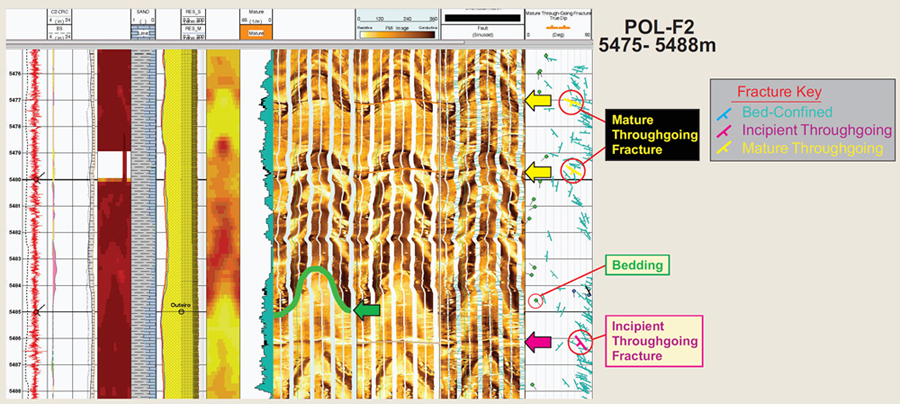
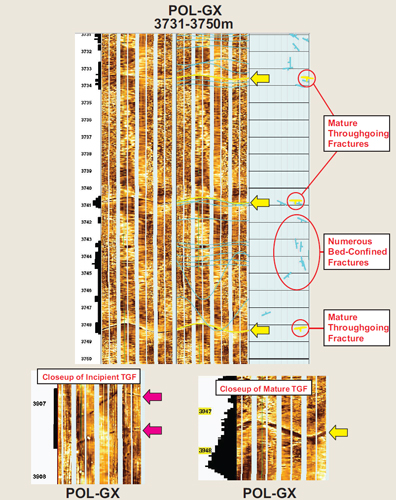
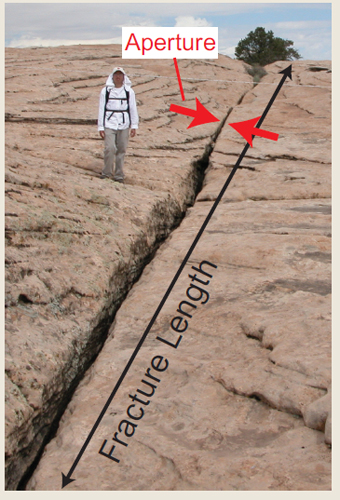
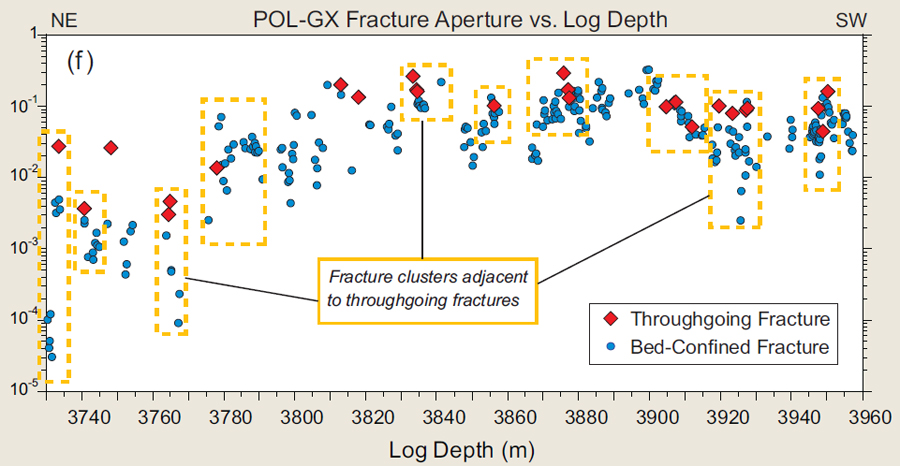
Throughgoing fractures are large, multilayer structures that often represent the backbone of the Identification on Image Logs (18) (Figures 3-2 and 3-3) The three main types of fractures observed in outcrop analogs can be identified on image logs from horizontal wells. (1) Bed-confined fractures appear as discontinuous features with narrow widths, and thus are considerably less prominent than throughgoing fractures. Their terminations at stratigraphic boundaries are often observed on the image log. In many cases, numerous bed-confined fractures cluster around mature throughgoing fractures. (2) Incipient throughgoing fractures are continuous across the image log but not as prominent as the mature throughgoing fractures, and often lack a consistent width. However, their widths and continuity are much greater than for the smaller bed-confined fractures, and they do not terminate at bed boundaries. (3) Mature throughgoing fractures are distinguished by a continuous, thick band of low resistivity, indicating a consistently wide aperture relative to incipient throughgoing fractures and bed-confined fractures.
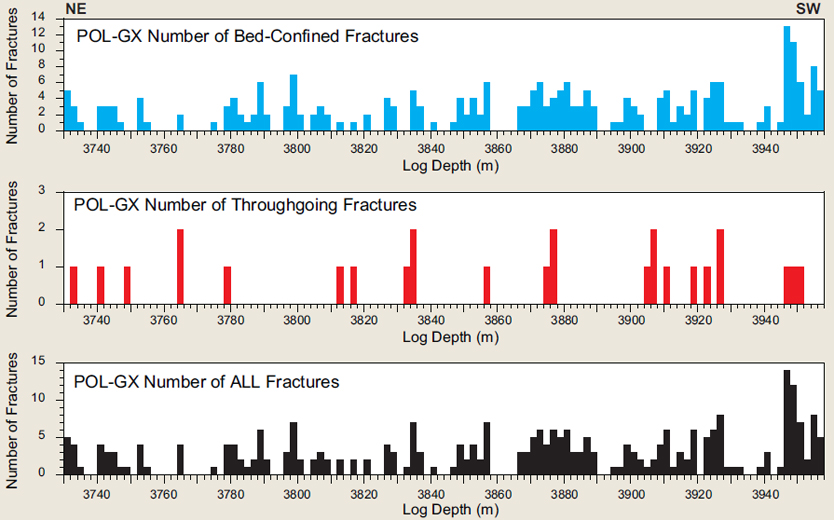
Orientations of Spatial Distribution of Fractures in Horizontal POL-GX Well (20) (Figures 3-5 and 3-6)
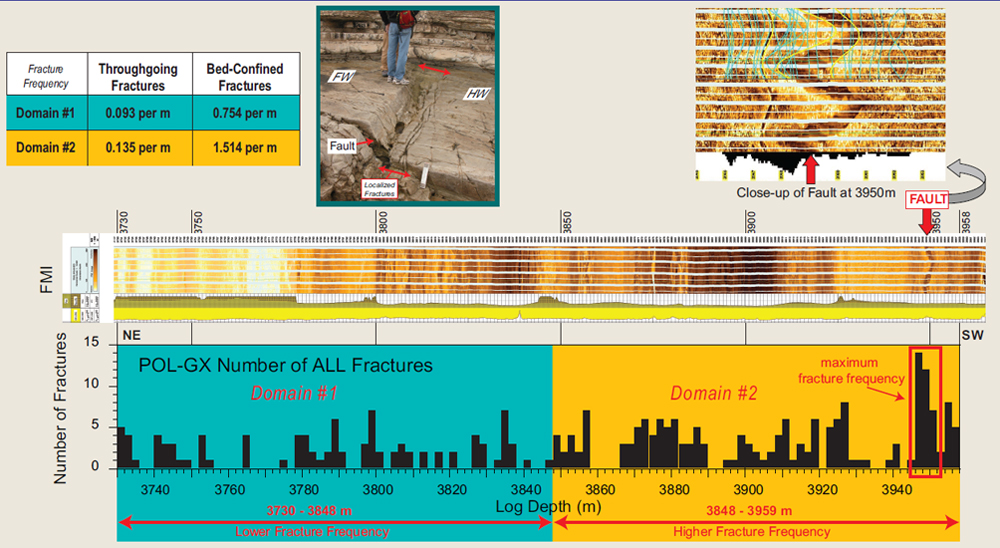
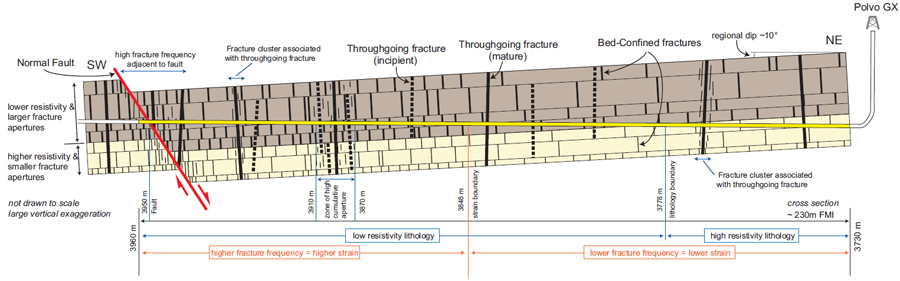
There appears to be an increase in the frequency of bed-confined fractures with depth. In general, the interval can be divided into two domains: a domain of lower
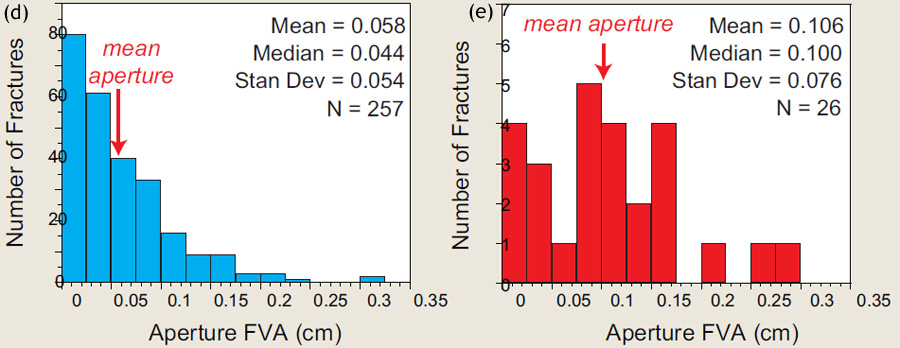
Estimates of
Models and Cross Section (Figures 3-8, 3-9, and 3-10)
Gross, M.R., and Y. Eyal, 2007, Throughgoing fractures in layered carbonate rocks; GSA Bulletin, v. 119, p. 1387-1404.
Luthi, S.M., and P. Souhaite, 1990.
Copyright © AAPG. Serial rights given by author. For all other rights contact author directly. |
 x Δh/ΔL