Print this page
 Click to view article in PDF
format.
Click to view article in PDF
format.
PSIntegrated Seismic Structure, Stratigraphy and
 Magnetic
 Basement Interpretation: Offshore Louisiana Shelf*
Michael Alexander1
Search and Discovery Article #10200 (2009)
Posted August 6, 2009
*Adapted from poster presentation at AAPG International Conference and Exhibition, Cape Town, South Africa, October 26-29, 2008
1Integrated Geophysical Corporation, Houston, TX ([email protected])
This
paper presents a rationale for using an integrated interpretation of seismic
and magnetic data to reduce risk for a deep play. The methodology has
application not only in the Gulf of Mexico (GOM) but also in similar geologic
settings.
Basement,
defined here as the magnetic top of crystalline crust, may not correspond
locally to “acoustic” basement identified in some GOM literature as a
mid-Jurassic sequence boundary (MJS). Depth differences between basement and
MJS, ranging up to thousands of feet, are significant because they infer the
existence of local pre-MJS troughs with large volumes of nonmagnetic formations
and deep hydrocarbon-generating “kitchens”.
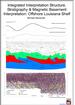
An example of integrated data is illustrated on a north-south seismic section from the Louisiana Shelf. It demonstrates a relationship between potential reservoirs, faults for trapping and/or migration pathways, potential “kitchens”, and basement structure. The posted basement and MJS profiles cross a set of basement ridges, troughs, and faults. A strong reflector, generally coincident with the MJS depths, is conformable with the basement surface except over the basement trough. Here the reflector shows north dip and supports interpretation of an anomalously thick pre-MJS section.
Reflections marking the top of Cretaceous-Jurassic (K-J) section are conformable with dips of the underlying basement. Two complex K-J features overlying a basement trough, adjacent basement ridges, and a north-verging basement thrust are deemed attractive targets given their positive structure, proximity to potential deep pre-MJS hydrocarbon “kitchens”, and adjacent faults to provide “plumbing” for favorable hydrocarbon migration. In contrast, both basement and seismic structure to the south show a regional deep from which early-stage hydrocarbons would have migrated laterally away to more favorable locations.
|
An Integrated Approach
A north-south cross-section
traversing part of the offshore Louisiana Shelf has been used to study a
prospective hydrocarbon environment. This example provides a rationale for
using an integrated approach to seismic structure/stratigraphy interpretation
and
An important end-result of
this model that fits all data sets is the visual demonstration of
relationships between 1) potential reservoirs in seismically-mapped
sedimentary structures, 2) their gross stratigraphy, 3) the faults required
for trapping and/or providing migration pathways, 4) a potential hydrocarbon
“kitchen”, and 5) the
The basement profile for
this 2D model was extracted from a proprietary regional basement surface
interpretation that was based on discrete quantitative
In addition to the depth
estimates from
A prominent set of high-amplitude reflections (yellow) ranging between 4.0 and 8.0 seconds on the seismic section can be locally correlated with a horizon variously described as the MCU, K-T boundary, or top of Cretaceous-Jurassic (K-J) sediments. The MJS, as estimated from published maps, correlates with a deeper set of high-amplitude reflectors (green) between 6.0 and 9.0 seconds.
The K-T horizon is
generally conformable with dips of the underlying
In the north half of the profile (Thrust Zone Area), lateral seismic character changes and structurally complex features in the post K-T section overlie a zone of major basement faulting and structuring. Local sedimentary features are associated with a deep basement trough, its adjacent basement ridges, and with the northwest-verging thrusts. A strong energy band (green) generally coincident with time-converted depths extracted from the MJS surface is conformable with the basement surface except over the trough. Here the reflector shows some north dip, thus supporting the concept of an anomalously thick pre-MJS section which could form a deep hydrocarbon “kitchen” with adjacent faults to provide “plumbing” for early-stage migration.
To the south (Transfer Zone), an abrupt southward thinning of the pre-MJS section and dramatic expansion of the post K-T/Cenozoic section occurs over an interpreted regional left-lateral basement transform fault zone intersected by the profile. There is an evident north-to-south change in seismic character in the deep Cenozoic. Both the basement structure and seismic structure show the area to be a regional deep from which early-stage hydrocarbons would have migrated laterally to more favorable locations. As such, this would be an area of high-risk exploration.
The post-K-T boundary
portion of the model has not been interpreted in detail, other than to post
depth-converted reflector horizons and fault traces. The model’s MCU/K-T
horizon (yellow band) is shown as broken by significant faults to the north,
but is relatively continuous to the south. Its depth at the north end was
established by ties to other studies and at the south end by a tie to a
refraction depth (red triangle). Both the northern and southern portions
correlate with
One of the more important
features of the model is the pre-MJS section overlying
The coincidence of
supra-basement
The interpreted
non-
A configuration of the
In summary, integration of
seismic and
The seismic section
displayed is part of a non-exclusive 3D seismic survey provided courtesy of
Fairfield Industries, Houston, Texas; its interpretation was made by
Integrated Geophysics Corporation. The
Bradshaw, E.B. and J.S. Watkins, 1995, Mesozoic and Cenozoic salt migration pathways in offshore Texas, northwestern Gulf of Mexico, GCSSEPM Foundation, Annual Research Conference, Dec. 3-6, 1995.
Culotta, R., et al, 1992, Deep structure of the Texas Gulf passive margin and its Ouachita-Precambrian basement: results of the COCORP San Marcos Arch survey: AAPG Bulletin v. 76, p. 270-283.
Rosenthal, D.B., and R.T. Buffler, 1987, Depth to basement, Gulf of Mexico region: UTIG Technical Report 71, University of Texas Austin, Austin, Texas.
|