Print this page
 Click to view article in PDF format.
GC Frequency in Defining Trend of Productive Thin-bedded Sandstone*
By
Bob Hardage1
Search and Discovery Article #40284 (2008)
Posted March 31, 2008
*Adapted from the Geophysical Corner column, prepared by the author, in AAPG Explorer, March, 2008, and entitled “ ‘Instantaneous’ an Ideal Indicator.” Editor of Geophysical Corner is Bob A. Hardage. Managing Editor of AAPG Explorer is Vern Stefanic; Larry Nation is Communications Director.
1 Bureau of Economic Geology, The University of Texas at Austin ([email protected])
The numerous  seismic
 attributes that can be calculated with various interpretation software packages are based on three fundamental wiggle-trace attributes: amplitude, phase, and frequency. Because these attributes are calculated at every time-sample of a seismic trace, they are referred to as “instantaneous” attributes.
Constructing attributes as instantaneous functions is important because interpreters then have more flexibility in how they use the attributes. For example, a time-based attribute can be analyzed along an interpreted horizon (only one data point thick); within a thin data window (three or four data points thick) that conforms to a reference surface; or averaged throughout an extensive data window (several tens of data points thick) that spans some portion of seismic image space.
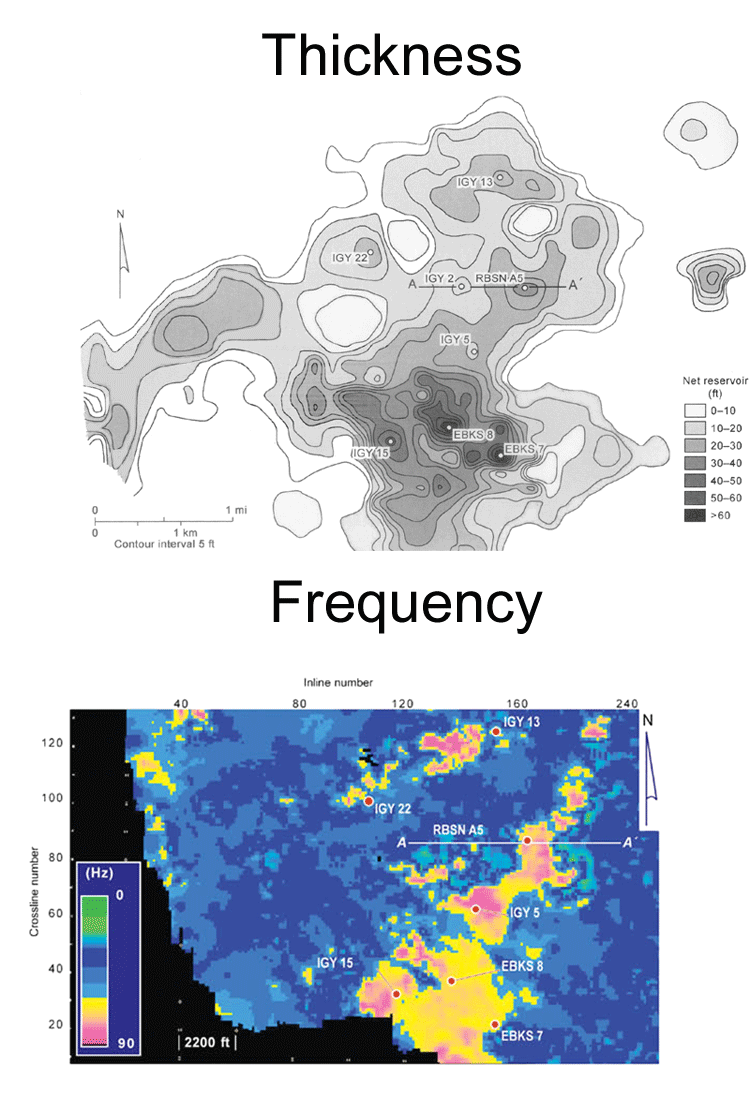
Most seismic interpreters, including the author, tend to focus on amplitude-based attributes as they search a 3-D seismic volume for geologic information. However, phase-based and frequency-based attributes are valuable for depicting subtle targets in many instances. This article illustrates an application in which instantaneous frequency was used to define a stratigraphic trend of a productive thin-bedded sandstone.
|
|
The net-sand-thickness
A vertical
Several
Selection of the color bar used to display a
The fundamental message from this example is that frequency-based attributes at times can be ideal indicators of stratigraphic-trap conditions.
|