Print this page
 Click to view article in PDF format.
GC Frequency in Defining Trend of Productive Thin-bedded Sandstone*
By
Bob Hardage1
Search and Discovery Article #40284 (2008)
Posted March 31, 2008
*Adapted from the Geophysical Corner column, prepared by the author, in AAPG Explorer, March, 2008, and entitled “ ‘ Instantaneous
 ’ an Ideal Indicator.” Editor of Geophysical Corner is Bob A. Hardage. Managing Editor of AAPG Explorer is Vern Stefanic; Larry Nation is Communications Director.
1 Bureau of Economic Geology, The University of Texas at Austin ([email protected])
The numerous seismic attributes that can be calculated with various interpretation software packages are based on three fundamental wiggle-trace attributes: amplitude, phase, and frequency. Because these attributes are calculated at every time-sample of a seismic trace, they are referred to as “instantaneous” attributes.
Constructing attributes as instantaneous functions is important because interpreters then have more flexibility in how they use the attributes. For example, a time-based attribute can be analyzed along an interpreted horizon (only one data point thick); within a thin data window (three or four data points thick) that conforms to a reference surface; or averaged throughout an extensive data window (several tens of data points thick) that spans some portion of seismic image space.
Most seismic interpreters, including the author, tend to focus on amplitude-based attributes as they search a 3-D seismic volume for geologic information. However, phase-based and frequency-based attributes are valuable for depicting subtle targets in many instances. This article illustrates an application in which instantaneous frequency was used to define a stratigraphic trend of a productive thin-bedded sandstone.
|
|
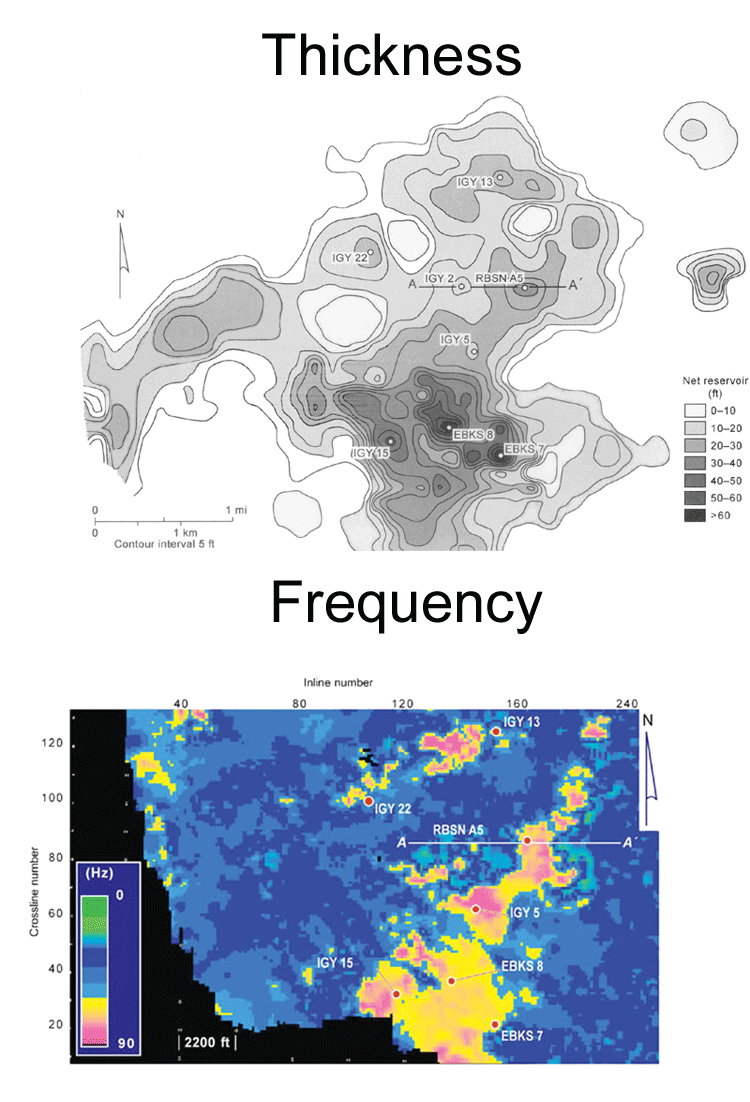
The net-sand-thickness map in Figure 1 illustrates the distribution of a productive Caddo sandstone in the Bend Conglomerate interval of the Fort Worth Basin. Considerable contour detail is shown on the map because reservoir thickness was defined from logs acquired in about 30 wells across the mapped area. Only a few of these well locations are labeled in Figure 1. A vertical seismic section along profile AA’ is shown in Figure 2. The labeled feature shows the reflection character across the thin-bedded sandstone and illustrates that the sandstone target is stratigraphically trapped and is not a structural feature.
Several seismic
Selection of the color bar used to display a seismic attribute is often the key to attribute interpretation. The correspondence between a seismic attribute value and a targeted geologic condition can be enhanced by the proper choice of color bar that displays the attribute – and, unfortunately, attribute-to-geology relationships can be obliterated by a poor choice of color bar. Some interpreters justifiably take as much time creating an appropriate color bar for attribute maps as they do creating the attribute that is being mapped.
The fundamental message from this example is that frequency-based
|