Print this page
 Click to
view article in PDF format.
Click to
view article in PDF format.
PSThe
Significance of Temperate-Type (Foramol)  Carbonate
 Systems as Indices of
Depositional Dynamics*
Systems as Indices of
Depositional Dynamics*
By
Fotini Pomoni-Papaioannou1
Search and Discovery Article #50062 (2008)
Posted February 26, 2008
*Adapted from poster presentation at AAPG and AAPG European Region Energy Conference, Athens, Greece, November 18-21, 2007
Editor’s note: Appreciation is expressed to Anne Pinkey for format conversion of the original document.
1Department of Geology and Geoenvironment, Section of Historical Geology & Paleontology, University of Athens, Panepistimiopolls157 84, Athens, Greece
Acceptance of a
spectrum of warm- through cold-water shallow-marine carbonate facies remains an
important challenge in interpreting the origin and significance of platform
carbonates.
In the western
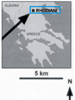
Pelagonian domain, Rhodiani area (Northern Greece, Internal Hellenides) (Figure
1), the
passage from a Late Jurassic – Early Cretaceous "Bahamian-type" platform, which
was frequently exposed under subaerial conditions, to a Late Cretaceous open
shelf environment, of ramp-like morphology, resulted in significant carbonate
diversification concerning the biota assemblage, mineralogy, microfacies types,
and early diagenetic patterns.
The Upper
Cretaceous is characterized by calcite-dominated, "foramol" type,
grain-supported, rudist-bearing limestones, whose biota assemblage recalls a
temperate-type sedimentary setting. Due to intensive bioerosion of rudists and
lack of early cementation, a significant amount of bioclasts, transported
off-shelf by storm-related sand flows, accumulated in a pelagic realm. An
overall destructive early diagenetic regime characterizes the Upper Cretaceous
platform carbonates, and major porosity destruction and lithification occurred
mainly in response to chemical compaction of calcitic skeletons during moderate
to deep burial.
Paleoenvironmental conditions during Early Cretaceous suggest an open shelf
domain, with gentle slope margins (ramps), recording a tendency of drowning, due
to relative sea level rise coupled with low potential for growth typical of
foramol carbonate factories. Complex arrangements of winnowed, remobilized
and/or resedimented lithofacies took place during terminal highstands and/or
regressive phases of sea level.
Temperate-type carbonate facies also accumulated in the central-west part of
Crete (Figure 2), in the Apostoli Basin during the Neogene. The depositional environment
corresponds to a shallow ramp; the sediments were deposited in a nearshore
environment and under conditions analogous to those prevailing in the
circa-littoral bottoms of the Recent counterparts of the Mediterranean Sea.
|
|
Rhodiani Area, West Macedonia, Greece
In
the Rhodiani area (Figure 3), Upper
Cretaceous diverse
In the Upper Cretaceous interval, fine bioclastic limestones are interbedded with coarse-grained, bioclastic limestones. Sediments are represented by mollusks (rudists)-rich limestones and large benthic foraminifera (Foramol Association). Corals, green algae, and non-skeletal grains are absent. Limestones are rudstones and floatstones, in a matrix consisting of poorly sorted, bioeroded skeletal fragments. The biota were calcite-dominated.
Rapid evolution to open shelf domain, with gentle slope margins
(ramps); shallow-water foramol skeletal debris, resulting from
bioerosion of a mesotrophic/tendentiously eutrophic association,
periodically contributed to hemipelagic deposition (temperate-type
setting or tropical areas where water conditions (e.g., cold
nutrient-rich upwelled currents) precluded the development of
chlorozoan associations. Bioclastic sands, intercalated with the
hemipelagic sediments are considered to have been transported
periodically off-shelf by means of gravity flows, within a deepening
trend (transgressive and highstands of sea level), giving rise to
important phenomena of re-sedimentation. Relatively minor
aggradation occurred along with a strong tendency toward
progradation, with significant migration of the main depocenters.
The resulting progradational wedges are composed of uncemented
skeletal grainstone sheets and/or channels. This sedimentary setting
differs substantially from the tropical
Evidence of
Uppermost Jurassic – Lower Cretaceous
These limestones are succeeded by calcareous breccias, whose clasts,
derived from the underlying succession, are embedded in a lateritic
matrix. Latest Jurassic -
The
base of the studied
Shallow-water
Rethymnon Region, Eastern Crete, Greece
Two Neogene basins occur in the Rethymnon region (Figure 5): (1) Rethymnon Basin to the north and (2) Apostoli Basin to the south. Elevated pre-Neogene terrane separates these basins.
Most of the Neogene sediments filling the Apostoli Basin, in the
central-west part of Crete, were deposited in terrestrial to shallow
marine environments. Rethymnon Formation consists of alternating
bioclastic limestones with marls. Rethymnon limestones correspond to
a typical non-tropical
The Apostoli Basin consists of three principal formations:
The Miocene Rethymnon bioclastic carbonates formed on a gentle shallow ramp; they possess many similarities with the recent bioclastic sediments of the circa-littoral bottoms of the Mediterranean Sea.
|