Print this page
 Click to
view article in PDF format.
Click to
view article in PDF format.
Hydrocarbon Prospects in Sub-Trappean Mesozoic Deccan Syneclise, India: Evidence from Surface Geochemical Prospecting
By
C. Vishnu Vardhan1*, B. Kumar1, C.J. Kumanan2, Devleena Mani1, and D. J. Patil1
Search and Discovery Article #10143 (2008)
Posted February 10, 2008
1National Geophysical Research Institute, Hyderabad ( [email protected] )
2Center for Remote Sensing, Bharathidasan Universtiy, Tiruchirappalli
*Presently with Hardy Exploration and Production (India) Inc. Chennai ( [email protected] )
The
Mesozoic sediments contribute around 54% of the oil and 44% of the gas reserves
of the world (Bois et al. 1982). Indian Mesozoic basins occupy an area of about
400 x 103 sq. km and are characterized as frontier basins under
category II - IV. These basins are mostly overlain by the Deccan Traps of Late
Cretaceous age and are least explored. Deccan Syneclise is one of the largest
Mesozoic basins in India, covering an area of ~ 273 x 103 sq. km.
Geophysical studies have inferred hidden sub-trappean Mesozoic sediments with
thickness up to 2.5 km. It is considered that requisite heat generation due to
Deccan Trap volcanism soon after the Cretaceous sedimentation may have acted as
a catalyst in hydrocarbon generation. Surface geochemical prospecting surveys
along with carbon isotopic studies have been used to assess hydrocarbon
generation potential of this part of the basin.
The area adjoining Nandurbar beneath
Narmada-Tapti region of Deccan Syneclise was selected for geochemical studies
where geophysical studies have shown considerable sediment thickness.
Surface
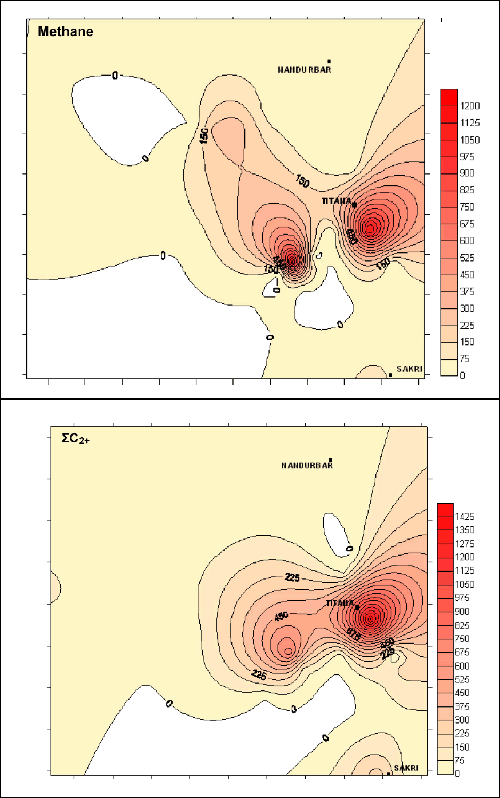
geochemical studies indicate the generation of light gaseous hydrocarbons, C1
and ΣC2+ in the range of 3 to 1187 ppb and 1 to 1449 ppb,
respectively. The carbon isotopic signatures of selected  soil
soil gas samples (δC13
CH4 in the range of –24 to –39.4‰ PDB) suggest thermogenic origin.
gas samples (δC13
CH4 in the range of –24 to –39.4‰ PDB) suggest thermogenic origin.
|
|
The large tract beneath the Upper Cretaceous-Paleocene Deccan Trap in western India is called Deccan Syneclise (Figure 1). It is one amongst the 26 sedimentary basins of India and is grouped under category IV: i.e., potentially prospective basin. Geophysical studies have revealed hidden Mesozoic sedimentary basins under the Deccan Traps. Surface Geochemical Surveys have been carried out in one of the prospective zones to assess the hydrocarbon prospectivity of the basin. Geochemical prospecting of hydrocarbons identifies the surface or near-surface occurrences of hydrocarbons or their alteration products, which are due to macro/micro seepage of the subsurface hydrocarbon occurrences. The micro/macro seepage is an established phenomenon, and these occur because processes and mechanisms such as diffusion, effusion, and buoyancy allow hydrocarbons to escape from reservoirs and migrate to the surface where they may be retained in the sediments and soils or diffuse into atmosphere or water columns. Microseepage of hydrocarbons has led to the discovery of many important petroleum producing areas in the world.
Deccan Syneclise is an intracratonic sedimentary basin covering an area of ~273 x 103 sq. km. The basin is mostly covered by Deccan Traps, with the exposure of Bagh and Lameta beds in the adjoining areas. The Deccan trap thickness varies largely and is about 100 m in the northeastern part and >1500 m towards the west coast of India. Below the Deccan Traps in the Narmada-Tapti region a hidden Mesozoic basin has been mapped in the form of two grabens separated by a small horst. In the southern part a larger Tapti graben with sediment thickness of about 2000 m is revealed, whereas in the northern part there is a smaller Narmada graben with sediment thickness of about 1000 m (Kaila, 1989). Integrated geophysical studies carried out by National Geophysical Research Institute (NGRI), Hyderabad and Directorate General of Hydrocarbons (DGH), New Delhi, have revealed the presence of Mesozoic sediments with thickness of about 1000m to 2500 m in the central part of Narmada-Tapti region (DGH, Annual Report 2003-04). The sediments of this Mesozoic basin were deposited in a larger Mesozoic sea, which extended from Narmada- Tapti region through Saurashtra, Kutch, up to Sind and Salt Range in the form of horseshoe. The Moho configuration under the Deccan-Trap-covered area reveals the depression in the central part extending in an ENE-WSW direction, which almost coincides with the region of hidden Mesozoic basin (Kaila, 1989). The marine transgressions and regressions that occurred in west-central India before the Deccan volcanicity might have favored the deposition of organic-rich source rocks. Further, the Deccan Trap volcanism during Late Cretaceous might have generated the requisite thermal conditions and acted as a catalyst in a Mesozoic hydrocarbon-generation process (Biswas and Deshpande, 1983). The generalized stratigraphy of Deccan Syneclise is given in Table 1.
A
total of 50 One
gram of
The
light gaseous hydrocarbon concentrations (CH4, C2H6,
C3H8, i-C4H10, n- C4H10,
i-C5H12 and n-C5H12) in
Analyses of the gas samples for the measurement of δC13 in methane were carried out using Thermo Finnigan Delta Plus XP Isotope Ratio Mass Spectrometer. The δC13 values are reported as parts per thousand (‰) relative to the Peedee belemnite (PDB) standard (precision is ±0.3%). δC13 in methane lies in the range of –24 to –39.4‰ PDB suggesting a thermogenic origin. The
presence of C1-C5 hydrocarbons in the adsorbed
Evidence of generation of hydrocarbons derived from possible thermogenic source beneath the Deccan Traps may open new vistas for commercial discovery of oil/gas in the Mesozoic of India.
The authors thank the Director, National Geophysical Research Institute, India, for granting permission to publish this work. The first author gratefully acknowledges Council of Scientific and Industrial Research, India, for the award of Senior Research Fellowship and Hardy Exploration and Production (India) Inc. for constant encouragement.
Biswas, S.K., and Deshpande, S.V., 1983, Geology and hydrocarbon prospects of Kutch, Saurashtra and Narmada basins, in Bhandari, L.L., et al. (eds.), Petroliferous Basins of India, p. 111-126. Bois, C., Bouche, P., and Pelet, R. 1982, Global geologic history and distribution of hydrocarbon reserves: AAPG Bulletin, v. 66, p. 1248-1270. Gombos, Andrew M., Jr., Powell, William G., and Norton, Ian O., 1995, The tectonic evolution of western India and its impact on hydrocarbon occurrences: an overview, Sedimentary Geology, v. 96, p. 119-129. Kaila, K.L., 1989, Mapping the thickness of Deccan Trap flows in India from DSS studies and inferences about a hidden Mesozoic Basin in the Narmada – Tapti region, in Subbarao, K.V. (ed.) Deccan Flood Basalts: Geological Society of India Memoir 10.
Klusman, R.W., 1993, Kumar, B., Patil, D.J., Kalpana, G., and Vishnu Vardhan, C. 2004, Geochemical prospecting of hydrocarbons in frontier basins of India: Search and Discovery Article #10073 (2004): Adapted from extended abstract prepared for presentation at AAPG Annual Convention, Dallas, Texas, April 18-21, 2004. Oil Infraline- Oil and Gas Exploration and Production in India, A reference book, 2006, 503 p. Schumacher, D., and Abrams, M.A., (eds.), 1996, Hydrocarbon migration and its near surface expression: AAPG Memoir 66, 446 p.
|