Print this page
 Click to
view article in PDF format (~5.3 mb).
Click to
view article in PDF format (~5.3 mb).
Seismic Stratigraphy-A Primer on Methodology
By
John W. Snedden1, and J. F. (Rick) Sarg2
Search and Discovey Article #40270 (2008)
Posted January 19, 2008
1ExxonMobil Upstream Research Company, Houston, Texas ([email protected])
2Colorado Energy Research Institute, Colorado School of Mines, Golden, Colorado ([email protected])
Seismic stratigraphic methods allow one to interpret and map reservoir, source, and seal facies from reflection seismic data. Seismic stratigraphic methods have evolved since the first publications in the late 1970’s. This document attempts to provide an update of these elementary principles, written as a “how-to” series of steps.
|
|
Seismic stratigraphic techniques have evolved considerably since the
underlying principals were first discussed over twenty years ago
(e.g. Vail et al., 1977). Seismic stratigraphy methodology has
proven quite successful in identifying
In this document, we discuss some guidelines for conducting a
seismic stratigraphic investigation and include guidelines for data
preparation. This type of work should lay the foundation for later
However, these recommendations are meant to form a working approach rather than a series of subjective directions. Methodologies must always be adjusted to fit the data from a given area. Further reading is listed to support the information provided here.
As regional seismic stratigraphic
1. Plot regional base maps showing shot points and posted wells. These should be at an appropriate scale and size for later use in mapping. Bathymetry is also useful to have in offshore datasets. Base maps serve several functions, including places to mark seismic facies notations, areas of interest, anomalies to further investigate, checking line ties, etc. 2. From the base map, select key 2D or 3D seismic lines, emphasizing regional or sub-regional dip lines with important well-ties. Avoid, if possible, areas where wells must be extrapolated considerable distances (> 1 km) along strike or down structural dip to tie seismic lines. Select lines to allow loop ties in a progressively widening grid, avoiding severe tectonic deformation zones, if possible. Identify possible "hero" lines, often dip lines, which tie key wells and show clear stratigraphic trends and are good "show lines". Sometimes the best choices for hero lines emerge later on, following initial interpretation. 3. Plot paper copies of selected regional seismic lines at a reduced scale. We highly recommend using wiggle trace paper sections at the first stages of an investigation as this is usually the best way to see complex stratal relationships and terminations over long distances (Table 1). On the seismic workstation, such stratal observations are often obscured or masked by a high degree of vertical exaggeration. Long regional lines often require panning large back and forth on a workstation, whereas paper sections allow uninterrupted visual scanning for key terminations. In addition, wiggle trace sections, which allow for marking of often subtle stratal terminations, do not display well on the workstation screen. Figures 1 and 2 illustrate the results of plotting a small portion of a seismic workstation view with wiggle trace and variable density displays at regional scales (1:50,000). Notice how onlap of the seismic reflections is more clearly displayed on the wiggle trace section (Figure 1) than the variable density plot (Figure 2). This also holds true for the prospect or field scale at 1:25,000 (Figures 3 and 4). Variable density sections (as on seismic workstations) are more difficult to interpret stratigraphically than wiggle trace (variable area) sections because stratal terminations tend to be “smoothed out” by this type of display. In addition, the subtle brightening of adjacent reflections at a stratal termination, due in part to tuning effects, is often masked. If there is a desire to make the troughs stand out more, one can color these with a light shade of gray for greater contrast. 4. Avoid data which has trace-mixing that obscures stratal terminations. Avoid narrow AGC (automatic gain control) windows which tend to reduce differences in relative amplitude between stratigraphic units. Use migrated sections where possible, but this is not a requirement (sometimes non-migrated data is better for seismic stratigraphic interpretation). 5. Prepare well data for seismic ties. We recommend that well ties be made paper to paper in the early phase of a seismic stratigraphy study. One reason is that it is normal practice to tie synthetics to wiggle trace sections. Wiggle trace sections are preferred over variable density for other reasons as discussed above. Be sure to include the gamma ray or other critical logs. Time-based logs should be at the same scale as the seismic section (10 or 20 cm/sec). Time-based logs can also be used in various log correlation program cross-sections, for example. Seismic displays at 10 cm/sec offer an obvious advantage over 5 cm/sec while 20 cm/sec are good for detailed, prospect or field scale. Biostratigraphic and lithostratigraphic tops should be input into the synthetic seismogram program; this saves time by not having to do it by hand later. Check-shot surveys or VSP's (vertical seismic profiles), when available, should be used in generation of the synthetic. If these are not available, two other options can be employed: 1) Identifying a key reflection (typically a limestone/shale contact) with high acoustic impedance contrast and hanging the synthetic on it. 2) In some cases with limited or older velocity data, there is some utility in constructing a time-depth (T-Z) curve for the region using other checkshot surveyed wells. This empirical approach often yields a polynomial equation to predict depths from seismic TW time. Most check-shot data can be fit with a second-order polynomial (y = 2x +b) where y is depth and x is TW time. Be careful of areas where overpressuring causes variations in T/Z plots. Keep in mind that some bulk time-shifting can still be required to match the seismic (generally less than 100 ms). 6. We highly recommend construction of a well-tie template for illustrating the relationship between seismically-defined surfaces, time-based well log, biostratigraphic calibration, and global chronostratigraphy. This template can be prepared once horizons have been identified and well-ties are made with general agreement among interpreters. It also useful for project presentations as it provides a clear documentation of the stratigraphic age model used.
Seismic Stratigraphy Interpretation Once data has been properly prepared, seismic stratigraphic interpretation begins, typically using colored pencils for different horizons. While the speed and ease of work-station correlation is far greater than hand interpretation, there always is a basic need to develop regional ‘hero lines” to illustrate key stratigraphic relationships. Having a hero line or series of hero lines is a useful way of reducing variations among interpreters, as these become the starting point for any new seismic workstation project. Pencil-interpreted paper sections allow for some changes in correlation, especially when looping across other sections occurs. However, at some point the lead interpreter declares that the key horizons are “looped” and only limited significant subsequent alterations are allowed.
Interpretation Steps 1. Identify areas of major structural deformation and data artifacts (sideswipe and diffraction) on the seismic sections. One should have a sense of the general tectonic style, presence of structural decollements, or key deformational events from previous reports or the literature. Do not blindly adhere to conventional wisdom if seismic data dictates otherwise.
2. In structurally complex terrains,
it may be useful to do an initial correlation of a few surfaces and
then cut, flatten, and tape together sections to see key tectonic
relationships. A few half-scale seismic displays at or near 1:1
vertical exaggeration may also be helpful if structure is not
clear-cut. Interpret faults (with normal pencil) where obvious
offsets can be identified. Be sure to differentiate between migrated
and unmigrated seismic sections where identifying faults. Also be
careful of pitfalls due to over- or undermigration of seismic data.
In some cases, complete restoration of a series of seismic sections
is necessary to fully understand the original 3. Review key lines (especially dip lines) to identify major (second-order) shelf margins, if present in the region. Indicate by triangle or circular symbol. Get a feel for the scale of the seismic sequences (2nd order, 3rd order, etc.), and pre-, syn-, and post-orogenic sequences. Identify major angular truncations by bold top truncation arrows (in red). 4. Begin to identify major lapouts with red pencil marks. Do this BEFORE making seismic correlations. Stratal terminations are listed in order of importance and illustrated in Figure 5: -angular truncation obvious erosional termination of dipping reflections up against a reflection of lesser dip) -onlap (stratal termination up against a reflection of greater dip) -downlap (stratal termination down against a reflection of lesser dip) -toplap (termination of successively younger reflections against a reflection, passing downdip to prograding clinoforms (in some cases))
5. Connect onlap and angular
truncation terminations as a candidate
6. Keep in mind that the most
important seismic stratigraphic surface is the
7. Look in basinal positions for
double downlap as an indicator of LST-basin-floor thick or (in
slope) slope thicks or channels. The
8. Look in shelf-margin position for LSW’s, which will often be
indicated by detached, shingled toplap-downlap couplets. These
should be colored separately from other systems tracts. The LSWpc (lowstand
wedge prograding complex) is often identified where smaller
clinoforms downlap the
9. Carry through the correlations
made by connecting stratal terminations marks. Loop-tie the 10. A good practice in seismic stratigraphic correlation is to drag your pencil on the black peak or at the zero crossing just above the peak. One reason for this is the ease in erasing the pencil line should a miss-tie occur. However, if the impedance characteristics of sand and shale are well established and the surface type and position are known, it is more important to correlate the surface in the appropriate peak or trough. Knowing whether seismic data is quadrature or zero phase is also important, as these will control surface position to some degree.
11. A general rule of thumb when
correlating, either with pencil or with workstation cursor, is to
stay low as possible without crossing reflections when correlating a
SB in the basin. Conversely, it is wise to stay high when
correlating on the shelf, without crossing reflections. A MFS
surface may rise in the basin (due to sedimentation prior to downlap).
As mentioned, low toplap is common and can be confused with a
Integration with Other Data Types After key stratigraphic surfaces have been identified and correlated, the next set of steps are undertaken to integrate any available well data. 1. Integrate with logs, cores, and biostratigraphic information.
--Biostratigraphic data: It
is important when using biostratigraphic data to look for
concentration/dilution cycles. In general terms, concentration
cycles, zones where large numbers of microfauna and flora are
condensed over short intervals, are often associated with maximum
flooding surfaces (MFS). By contrast, dilution cycles are often
associated with
--Logs:
Stacking patterns, log motifs, and lithology are keys to the
intermediate scale of correlation which should support the seismic
correlations. In fact, the best log correlations are
established when the seismic data is used as a guide to extending
stratigraphic surfaces from well to well. While seismic data
does not often capture the high-resolution stratigraphic
correlations possible in a log cross-section, it usually displays
gross geometries (e.g., dipping clinoforms) which should be followed
in log correlation. For example, experience has shown that
clinoforming parasequences or stacked Stacking patterns seen on logs (and outcrops sections) are often indicative of key stratigraphic surfaces. For example, the change from retrogradational to progradational stacking often is associated with a maximum flooding surface, which can be checked against both seismic and biostratigraphic data. Log motif interpretation of systems tracts is particularly well defined (e.g., Mitchum et al., 1994). Stacking patterns, log curve shape, vertical trends in sand content, and relationship to over- and underlying surfaces are keys to identifying the systems tracts. However, integration with seismic and other data is critical to validating these interpretations. --Lithologic relationships can help identify systems tracts: 1) in mixed siliciclastic/carbonate systems, HST's are often dominated by carbonate rocks while sandstones are often found in the LSW’s and TST (e.g., Guadalupian strata of the Permian Basin; Sarg and Lehman, 1986). 2) In some LST’s, the carbonates can dominate the LSWpc, but sandstones onlap as basin-floor thicks. In-situ coals often reside in the HST’s and/or TST’s while transported terrestrial organic matter and coal spar (clasts) occur in the LST’s (e.g., North Sea Tertiary; Armentrout et al., 1993). Juxtaposition of contrasting lithologies and unlike facies types often signals a major basinward facies shifts (SB) or major transgressive event (parasequence set boundary (PSSB)).
--Cores:
The best evidence for identification and validation of important
stratigraphic surfaces often comes from cores.
At this point, it is often helpful
to take some of the Once surfaces are established, it is relatively easy to compute statistics like net/gross, etc., used in map overlays described below. Multiple datums may be necessary, particularly with long regional cross-sections, but many computer cross-section programs have some difficulty with this. 2. Color systems tracts: green = TST, Blue=HST, terra cotta (brown) = LST. Coloring lightly with pencil is particularly good for seismic sections which become the hero line and are used in the workroom as a “rosetta” stone for the group.
3. Use biostratigraphic information
to date the 4. Compare to global chronostratigraphy: a) assign age and b) appropriate surface nomenclature. We recommend use of terminology following the European Basins Cenozoic and Mesozoic Chronostratigraphy (de Graciansky et al., 1998). This system and associated charts are gaining industry acceptance as a global reference standard. The surface is named using the European Basins nomenclature; e.g.:
Tor1_sb Tortonian-1 Tor1_200fs Tortonian-1 200 flooding surface (4th order) MioX1_100mfs Miocene 4th order surface, unknown stage
Seismic
Mapping Based Upon
Once a preliminary stratigraphic
framework has been established, mapping based upon
Seismic Facies Mapping
Seismic facies mapping involves
qualitative to quantitative
Workstation- and some PC-based
seismic
External Form and Internal Geometry-A-B-C Mapping Seismic facies mapping was definitively explained in Ramsayer’s (1979), based upon 2D seismic sections interpreted prior to the advent of seismic workstations. This is referred to as the “A-B-C” mapping approach, as observations are made upon the upper boundary (A), the lower boundary (B), and internal reflection character (C). For example, a prograding seismic package with oblique clinoforms, toplap at its upper surface and downlap at its base would be noted as Top-Dwn/Ob (Figure 7). The three categories (A-B-C) of Ramsayer's (1979) seismic facies codes each include five types, thus providing 15 different variations for a given seismic interval of interest (Table 3). Although the technique was developed largely from 2D seismic data, it can be used on modern 2D and 3D sections displayed on conventional industry workstations.
Figures 8 and 9
illustrate use of the Ramsayer (1979) A-B-C seismic facies mapping
approach on a series of 2D sections interpreted using a workstation.
In the Paleogene section of the North Sea, five or six
Four seismic facies were identified in
When placed in a map view, the interpreter infers patterns of
similar seismic character as well as trends going from
up-
In addition to A-B-C seismic facies maps, other observations include
marking stratal terminations (e.g., arrows indicating downlap and
toplap), isochron thickness, or
Rather than mapping the entire Comparing these maps, one can see the variations in map pattern through one eustatic sea level cycle (Figure 8). Stacking all the systems tracts for one cycle, by contrast, leaves a very complicated map (Figure 10, inset).
Seismic facies mapping on the workstation can be done with both 3D
and 2D seismic, although the latter case involves some
interpretative interpolation between 2D lines (Figure
11, A). Using the map geometries and seismic facies
characteristics tied to well control, interpretation of the
Seismic Facies with Emphasis on Amplitude Characteristics
Since Ramsayer’s seminal paper in 1979, seismic facies techniques
have evolved to include additional information on internal amplitude
characteristics. Robust seismic facies information related to
amplitude strength (high or low), continuity, and reflection
frequency (Figure 12) can be described
in qualitative terms or quantified using various software products
and
Seismic Facies by Trace Classification
Recent innovations in seismic facies involve use of programs that
discriminate and classify seismic wavelet trace shape. The approach
is used within a
Combining Seismic Facies Maps with other Maps Confidence in seismic facies mapping can be gained by combining seismic facies maps with other types of displays such as isochron/isochore, etc., as explained below.
Isochron/Isochore Maps:
These maps provide more quantitative information on the gross
thickness of sequences or systems tracts and are particularly
powerful when combined with overlays showing net sand, net/gross
reservoir, etc. (e.g., Snedden et al., 1996). Conventional methods
for isochron (seismic time) or isochore (depth-converted thickness)
are employed. These thickness variations can indicate areal
differences in accommodation, particularly related to differential
subsidence. However, without some measure of net/sand or seismic
facies, it is difficult to ascertain whether the "thicks" contain
any reservoir rock. Overlays providing reservoir statistics or
trends in nearby drilled areas allow inferences to be made about the
Paleogeographic Maps:
Traditionally, paleogeographic maps have been based on
paleoenvironmental trends inferred from Paleogeographic maps are particularly useful when they represent the sum of other seismic maps. Combining seismic facies, isochron or isochore maps, and stratal observations (lapout maps) onto one map, if not too busy, provides an integrated basis for intepretation.
Application to Petroleum Exploration and Exploitation
The major reason for developing seismic stratigraphic maps is to
reduce critical risk in exploration and to extract benefit from
hydrocarbon discoveries. Sequences and
Highstand Systems Tract (HST)
In many hydrocarbon exploration
Transgressive Systems Tract (TST)
Transgressive systems tract (TST)
and in high accommodation settings, the transgressive
Lowstand Systems Tract (LST)
The lowstand systems tract (LST;
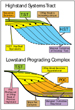
Figure 15) and lowstand The presence of a significant relative sealevel fall causes a major basinward shift in onlap, particularly when shifted seaward of the offlap break. Mid-shelf LST's can also occur (incised valley-fill of Van Wagoner et al., 1990). A common motif on seismic is often toplap/downlap couplets, with toe of clinoform debris wedges or sandstones. These are typically sand rich, although carbonates can also form (the downdip oolite play of the Permian basin). The vertical succession in a LST prograding complex is (bottom to top): downlap, progradation, toplap, aggradation, and floodback (Figure 17). Earlier models for deepwater settings suggested that there may be three parts to the LST: the basin-floor systems (distributary channel and sheet), slope channel systems (confined to weakly confined), and the prograding complex (LSWpc; Mitchum et al., 1994). Basin-floor systems sometimes show double downlap while the prograding complex shows toplap/downlap lapouts. Slope systems exhibit incision, lateral truncation of reflections, and complex filling geometries. These can greatly impact the internal fluid connectivity of a deepwater reservoir within the LST. More recent work suggests that deepwater systems are very complex arrangements reflecting shelf margin evolution, sediment load, climate, eustacy, and other factors. The methodologies for stratigraphic correlation, interpretation, and mapping in these complex, hierarchical deepwater channel systems are well defined and described in documents at these chapters. The lowstand systems tract prograding complex (LSWpc) can be confused with the highstand systems tract, as both are progradational. However, there are ways to differentiate the two systems, which have important implications for hydrocarbon entrapment (Figure 17). The LSWpc typically is dip-restricted, with strata not continuing updip vs. the more continuous HST. As a result, all other factors being equal, the HST’s tend to have less potential for lateral sealing than the LSWpc. Stratal terminations at the top of a HST tend to be tangential to non-terminated, versus toplap patterns in LSWpc's. The stacking patterns also differ, as LSWpc show early progradational and late aggradational patterns on logs, versus HST's with early aggradation and late progradational motifs
One measure of the value of a seismic stratigraphic mapping effort is seen in the ability to address and answer the following key questions: a) Is the petroleum system complete? Is there a critical missing element which will fatally flaw the petroleum system and prevent discoveries in un- or under-explored basin? It is recommended to use the resulting products (cross-sections and maps) to identify source and seals, not just reservoir rocks. For marine source rock mapping, recognition of the large scale, major downlaps (maximum flood) of major continental encroachment cycles is a good starting place (for more detail, see Duval et al., 1998). It is also useful to relate to worldwide eustatic charts and known source bed events. For example, Klemme and Ulmishek (1991) determined that six stratigraphic intervals have provided 90% of the world's discovered original reserves of oil and gas (Silurian-9%, U. Devonian-Tournasian-8%, Pennsylvanian/Lower Permian-8%, Upper Jurassic (25%), Mid-Cretaceous-29%, Oligo-Miocene (12.5%)).
b) Are certain systems tracts
under- or unexplored? In a recent survey of Texas onland
c) Can the d) If the lowstand system tract play corridor can be identified, are downdip prospects located in the major deltaic fairway or marginal to it? Even the world's greatest basinward shift will fail to send sand into a basinal area of interest if no updip deltaic source is present or an appropriate conduit for sand delivery is not in proximity. It is critical to be in the sand "fairway"!! e) Finally, identify possible play types for prospectors: e.g., pre-orogenic HST, if sealed by syn-orogenic shales; LST, if detached and sealed. TST, if sealed by MFS and sourced by 2nd-order TST shales. Summary and Conclusions
This document is meant to be used as
a working guide to seismic stratigraphic interpretation and not to
be used as a strict set of best practices or conceptual basis for
Much of the methodology described here and in this volume involves interpretation on paper sections and handmade well-ties (paper to paper). Much of any company’s seismic interpretation today is done on a seismic workstation. The use of paper sections is most useful at the early stages of a project, as geoscientists seek to make correlations and establish criteria for identifying horizons. Once a seismic stratigraphic framework is established on some paper sections (hero lines), the geoscientists can make better interpretations and often faster ones, as no delays occur when multiple interpreters cannot agree on correlations, terminology, or ages. Interpretation is then taken to the workstation for efficient and optimized mapping.
AcknowledgementsThe authors appreciate the assistance of Kurt Johnston (EMEC) in preparing seismic examples for this document. ExxonMobil is thanked for permission to publish this document. John Armentrout provided many insights on scale, hierarchy, and source rocks.
References and Further Reading Abreu, V., M. Sullivan, C. Pirmez, and D. Mohrig, 2003, Lateral accretion packages (LAPs): an important reservoir element in deep water sinuous channels: Marine and Petroleum Geology, v. 20, p. 631-648. Abreu, V., P. Teas, Thomas De Brock, Kendall Meyers, Williams Spears, Steve Pierce, and Dag Nummedal, 2002, Reservoir characterization of the South Timbalier 26 Field: The importance of shelf margin deltas as reservoirs in the Gulf of Mexico: AAPG Bulletin, v. 86, p. 212.
Armentrout, J. M., 1991,
Paleontologic constraints on
Armentrout, J.M., S.J. Malecek,
L.B. Fearn, C.E. Sheppard, P.H. Naylor, A.W. Miles, R.J. Demarais,
and R. E. Dunay, 1993, Log motif Armentrout, J.M., S.J. Malecek, V.R. Mathur, G.L. Neuder, and G.M. Ragan, 1996, Intraslope basin reservoirs deposited by gravity-driven processes: Ship Shoal and Ewing Banks areas, Offshore Louisiana: GCAGS Transactions, v. 46, p. 443-448. Bally, A.W., 1982, Atlas of Seismic Stratigraphy, AAPG Studies in Geology no. 27, 300 p.
Brami, T. R., C. Pirmez, C.
Archie, S. Heeralal, and K.L. Holman, 2000, Late Pleistocene
deep-water stratigraphy and
de Graciansky, P. et al.,
1998, Mesozoic and Cenozoic Duval, B.C., C. de Janvry, and B. Loiret, 1992, Detailed geoscience reinterpretation of Indonesia's Mahakam delta scores: Oil and Gas Journal, p. 67-72.
Duval, B.C., C. Cramez, and
P.R. Vail, 1998, Stratigraphic cycles and major marine source rocks,
in P. de Graciansky et al., eds., Mesozoic and Cenozoic
Fulthorpe, C. S., 1991,
Geological controls upon seismic Garfield T R., 2000, New insight into the three-dimensional architecture of deep-water facies; the product of a multidisciplinary approach. Anonymous, in Brazil 2000; 31st international geological congress; abstract volume. International Geological Congress Abstracts = Congres Geologique International, Resumes. 31; unpag.
Greenlee, S.P., 1992,
Integrated Haq, B.U., J. Hardenbol, and P.R. Vail, 1987, Chronology of fluctuating sea levels since the Triassic: Science, v. 235, p. 1156.
Klemme H.D., and G.F. Ulmishek,
1991, Effective petroleum source rocks of the world; Stratigraphic
distribution and controlling Kolla, V., Ph. Bourges, J-M. Urruty, and P. Safa, 2001, Tertiary sinuous channels, offshore Angola, (West Africa) and implications for reservoir architecture: AAPG Bulletin, v. 85, no. 8, p. 1373-1405.
Mansor, Y., J.W. Snedden, J.F.
Sarg, B.S. Smith, T.H. Kolich, and M.H. Carter, 1999, Pre-drill
predictions versus post-drill results: Use of
McGilvery, T.A., and D.L.
Cook, 2003, The influence of local gradients on accommodation space
and linked
Mitchum, R.M., Jr. and J.C.
Van Wagoner, 1991, High-frequency sequences and their
stacking patterns: Mitchum, R.M., Jr., J.B. Sangree, P.R. Vail, and W.W. Wornardt, W. W., 1994, Recognizing sequences and systems tracts from well logs, seismic data, and biostratigraphy: Examples from the Late Cenozoic of the Gulf of Mexico, in P. Weimer and H. W. Postamentier, eds, AAPG Memoir 58, p. 163-197.
Posamentier, H.W., G.P. Allen,
D.P. James, and M. Tesson, 1992, Forced regressions in a
Posamentier, H.A., 2002a,
Posamentier, H.W., 2002b, Ancient shelf ridges-a potentially significant component of the transgressive systems tract: Case study from offshore northwest Java: AAPG Bulletin, v. 86, p. 75-106. Ramsayer, G.R., 1979, Seismic stratigraphy, a fundamental exploration tool: 11th Annual Offshore Technology Conference Proceedings, p. 101-109. Sarg J.F.; and P.J. Lehmann., 1986, Lower-middle Guadalupian facies and stratigraphy, San Andres / Grayburg formations, Permian Basin, Guadalupe Mountains, New Mexico, in George E. Moore and Garner L. Wilde eds., J.F.Sarg, leader, Lower and Middle Guadalupian Facies, Stratigraphy, and Reservoir Geometries; San Andres / Grayburg Formations, Guadalupe Mountains, New Mexico and Texas: Permian basin Section – SEPM Symposium and Guidebook 86-25, p. 1-8.
Snedden, J.W., J.F. Sarg, M.J.
Clutson, M. Maas, T.E. Okon, M.H. Carter, B.S. Smith, T.H. Kolich,
and Md. Y. Mansor, 1996, Using
Snedden, J.W., J.F. Sarg, and Xudong Ying, 2002,
Exploration play
Thompson, L.B., and J.W.
Snedden, 1996, Geology and reservoir description of 1Y1 reservoir,
Oso Field, Nigeria, using FMS and dipmeter, in J.A. Pacht, and R.E.
Sheriff, eds., Stratigraphic
Van Wagoner, J.C., et al.,
1988, An overview of the fundamentals of
Van Wagoner, J.C., et al.,
1990, Siliciclastic Vail, P.R., R.M. Mitchum, Jr., and R.G. Todd, 1977, Seismic stratigraphy and global changes of sealevel, in Seismic Stratigraphy--Applications to Hydrocarbon Exploration: AAPG Memoir 26, p. 49-212.
Vail P R.,
1987, Seismic stratigraphy interpretation using |