Print this page
 Click to
view posters in PDF format.
Click to
view posters in PDF format.
PSThe
 Porosity
 Evolution of Eocene Limestones in the Preapulian Zone, Zakynthos
Island, Western Greece*
Evolution of Eocene Limestones in the Preapulian Zone, Zakynthos
Island, Western Greece*
By
Marianna Kati1 and Peter A. Scholle2
Search and Discovery Article #50060 (2007)
Posted January 8, 2008
*Adapted from poster presentation, AAPG European Regional Conference, Athens, Greece, November 18-21, 2007
1Department of Geology and Geoenvironment, University of Athens, Greece ([email protected])
2New Mexico Bureau of Geology and Mineral Resources, Socorro, NM ([email protected])
The Eocene pelagic and redeposited carbonate sediments on Zakynthos Island were
deposited on the base-of-slope connecting the Preapulian platform with the
Ionian basin. The resedimented facies primarily are represented by very
coarse-grained reefal debris flow deposits as well as bioclastic turbidites,
mostly of low- and minor of high-density. Detailed facies analysis and
associated porosity and permeability measurements in many of the selected
samples, lead us to define two main paths of porosity modification. First, the
primary porosity of reefal debris flows was mainly destroyed by synsedimentary
cements, but the dissolution of their originally metastable constituents soon
gave rise to remarkable moldic and small amounts of vuggy porosity. However,
most of this secondary porosity was occluded with sparry blocky/equant cements,
and in a later diagenetic stage, some leaching increased the size of vugs and
preserved some intergranular pore spaces. Second, the reduction of porosity of
turbiditic and pelagic facies was achieved mainly through compaction and the
precipitation of equant/blocky and syntaxial overgrowth cements, which in
association with recrystallization occluded almost completely their primary
porosity. Nevertheless, some intergranular porosity developed from later
dissolution, specifically in the coarser-grained, high-density turbidites.
Petrophysical data, as a whole, point out that Eocene limestones have small
values of porosity (total mean porosity= 10.87%), as well as very low
permeabilities (generally <1mD), with the exception the high-density turbidites
that locally have 27% porosity and mean permeability 22.79mD. The latter clearly
indicates an "effective porosity" and good reservoir characteristics, especially
if it is combined with the fine-grained, low-density turbidites and/or pelagic
sediments that always encompass this facies.
|
|
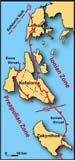
The Preapulian Zone crops out in the Ionian Islands, western Greece. The paleogeographic connection of the Preapulian Zone to the Italian Apulian platform is considered the “autochthonous” margin of the Apulian microplate in the Hellenides (Figure 1). Recent lithostratigraphic and sedimentological studies indicate that the evolution of the Preapulian zone, especially from the Upper Cretaceous throughout the Paleogene, is quite complicated and consists of at least two main sedimentary domains belonging to different tectono-sedimentary units, which today are found in tectonic proximity (Figures 2 and 3) (Accordi and Carbone, 1992; Kati, 1999; Scholle and Patsoules, 2001).
This work focuses on the distribution and evolution of
Eocene limestones consist exclusively of slope facies. Thin-bedded, mainly pelagic foraminiferal mudstones and wackestones are interbedded with redeposited sediments that include a large variety of transported and reworked shallow-water carbonate materials. Debris flows, the most common resedimented deposits, consist primarily of numerous reefal blocks and bioclastic lithoclasts, originating from the platform-margin and shelf. Thin- to-thick turbiditic beds, mostly low-density and minor high-density flows, largely consist of resedimented bioclastic and lithoclastic material originating from the outer shelf and/or upper slope.
The coarser-grained, reefal debris flows principally have secondary
moldic and vuggy
Low- and high-density turbidites and modified grain flows:
The finer-grained resedimented facies and also the pelagic sediments
mainly have preserved primary
Detailed petrographic examination of the depositional and diagenetic
textural characteristics, in combination with estimations of the
basic petrophysical parameters, allowed recognition of two main
paths in the
1. Preserved Eocene limestones comprise exclusively slope
facies, consisting of pelagic sediments interbedded with very
coarse-grained reefal debris flows and bioclastic turbidites (mostly
low-density flows). The various facies show different
2. Although the primary
3. In contrast to the low
Sincere thanks to Ι. Abatzis, N. Springer, Ν. Christensen, J. Ineson, P. Frykman, N. Stentoft, A. Rasmusen, and H. Lindgreen of the GEUS, Denmark, for their kind hospitality and for providing laboratory facilities and analytical instruments. Many thanks also to M. Patsoules, K. Nikolaou, and K. Georgiades of Hellenic Petroleum S.A. for their help in various aspects of the project.
Accordi, G., and F. Carbone, 1992, Lithofacies map of the Hellenide Pre-Apulian zone (Ionian Islands, Greece): Cons. Nazion. Ricer., Spec. Publ., 27p.
Kati, M., 1999, Deposition, diagenesis and evolution
of Scholle, P.A., and M. Patsoules, 2001, Sedimentology and petroleum potential of Cretaceous limestones in the Preapulian Zone, Ionian Islands, Western Greece: AAPG Annual Convention 2001. |